Quick Answer: Standard event tracking assumes a standard Shopify setup, native checkout, native theme pages, no subscriptions. Five common situations break that assumption: email popup tools outside Klaviyo or Omnisend, custom ad landing pages built off-platform, third-party checkout providers, subscription and rebill purchases, and lead-capture quizzes. Each needs specific handling, or your conversion data quietly degrades without any error to flag it.
Key Takeaways
- Hashed email is one of the strongest signals Meta and Google use to match a site visitor to a real account, since every user on Meta's platforms logs in with an email address. Native popup platforms like Klaviyo and Omnisend already integrate this correctly; custom-built popups need specific handling to get the same result.
- Custom ad landing pages, whether built on a different platform entirely or via Shopify headless, need to capture the click ID from Meta or Google ads directly, or attribution breaks. This is the same category of identifier covered in more platform-specific depth elsewhere: Meta's fbclid, TikTok's ttclid, Reddit's rdt_cid.
- Third-party checkout providers need a specific mechanism to pass clickID data back to Shopify. Aimerce's version of this is an order note called aimPK, which the checkout provider needs to retain when syncing orders back.
- Subscription and rebill purchases get tracked as Purchase events by default, which inflates conversion counts with events that weren't driven by a fresh ad click. Separating first-time subscriptions, renewals, and one-time purchases into distinct events keeps ad platform optimization accurate.
- Quizzes that capture email, name, or phone number need the same tracking treatment as any other lead form. A quiz that doesn't capture personal information doesn't need special handling at all.
If a tracking company never asks any questions about your website, that's usually a bad sign. Tracking is never just installing software, it's handling all the corner cases on a website correctly. Here are five that come up constantly.
Why does email popup capture matter for ad performance, not just email marketing?
Because email addresses are one of the strongest signals Meta and Google use to match a site visitor to a real account, not just a list-building tactic for your own campaigns.
Across all of Meta's products, Facebook, Instagram, and the rest, email addresses are what Meta uses to identify users. Every person logs in with an email address, so Meta has this information across its entire user base. The more email addresses you can send to Meta as hashed identifiers, the easier it is for Meta to match your site visitors to a real Facebook or Instagram account, which directly improves Event Match Quality and ad optimization.
Most brands use native popups built into platforms like Klaviyo or Omnisend, and that's a good default. These platforms are already well integrated with major marketing platforms like Meta Ads and Shopify, meaning they handle associating a captured email with a customer's behavioral events without extra setup on your end.
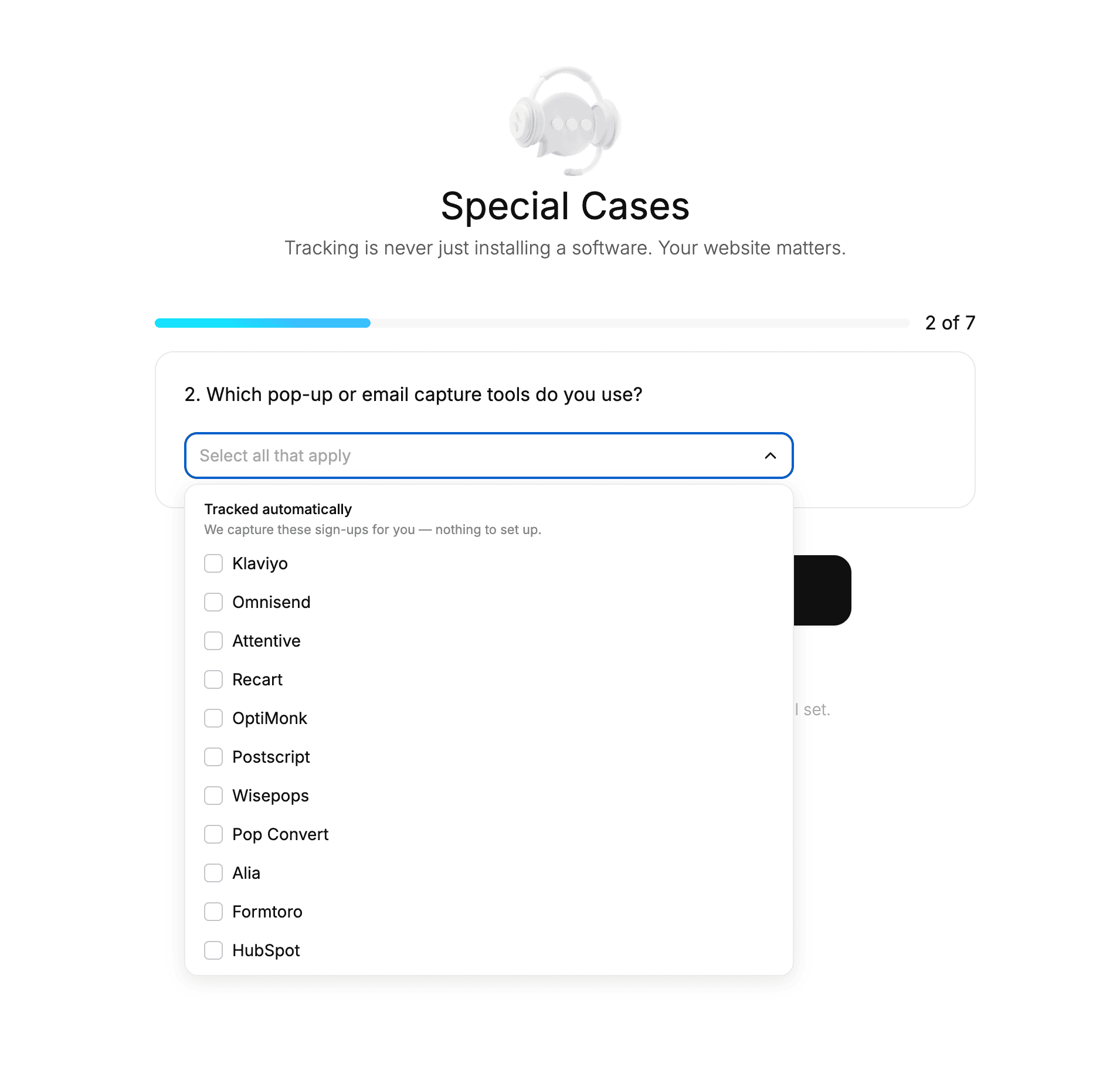
If you use an unpopular popup solution or a custom-built one instead, that's not disqualifying, but it does need specific attention. The platforms shown above are tracked automatically with nothing to set up; anything outside that list needs to be configured explicitly so captured emails actually connect to the visitor's tracked behavior rather than existing as a disconnected list signup. [2]
Why do custom ad landing pages need special handling?
Because a landing page built outside your standard Shopify theme, on a different platform entirely, or via Shopify headless, doesn't automatically capture the click ID Meta or Google attach when someone clicks an ad.
If you add landing pages on Shopify's native theme, this is handled automatically. The moment you build the landing page somewhere else, that automatic capture goes away, and it has to be handled deliberately.
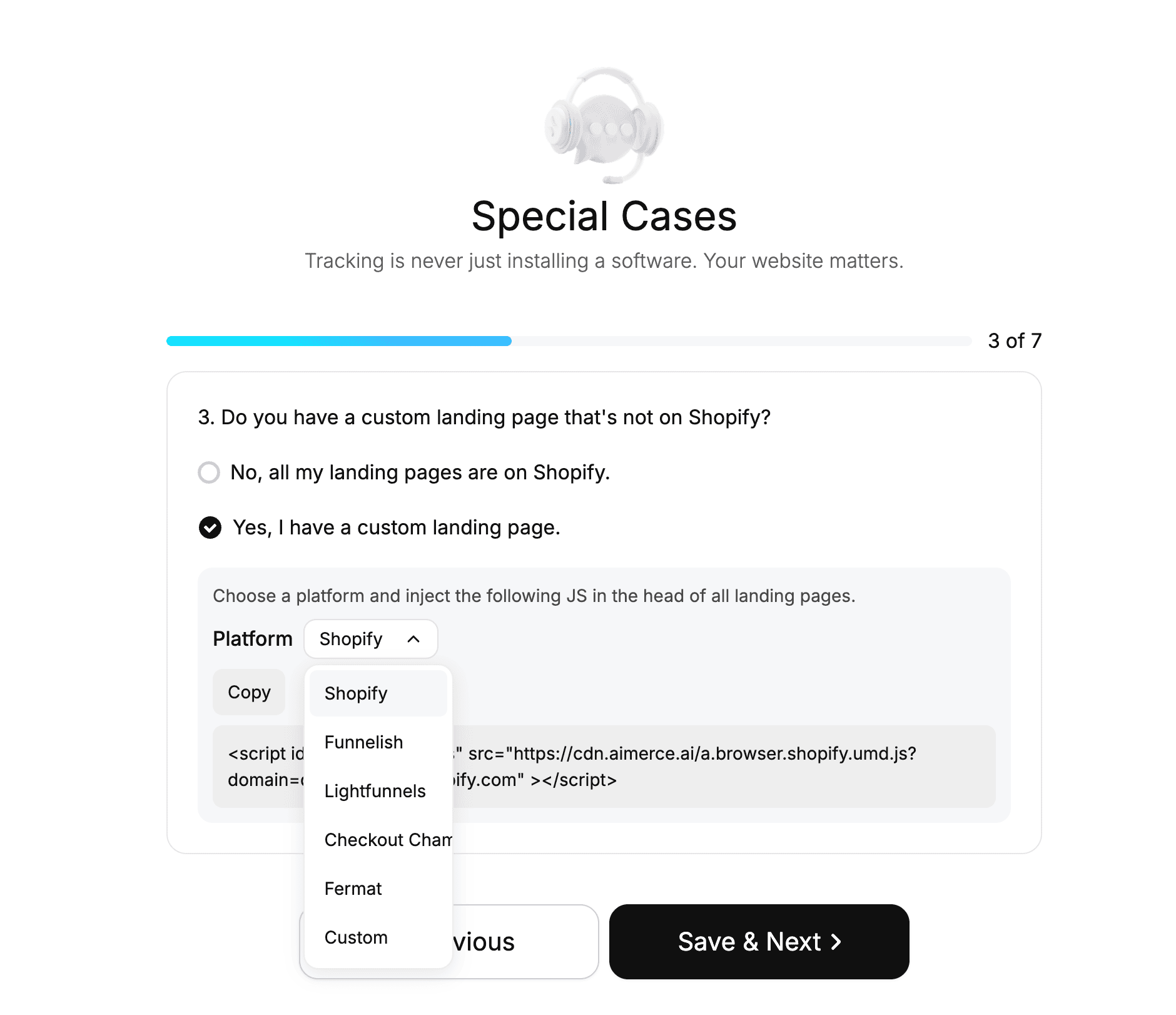
Here's why this matters specifically: a landing page captures the click ID when a visitor arrives from a Meta or Google ad. This ID is generated by the ad platform and automatically associated with the customer's events, when someone clicks a Meta ad and lands on your site, there's a click ID tied to that specific click, and it's what Meta's attribution calculations depend on. This is the same category of identifier covered in more depth elsewhere for specific platforms, Meta's fbclid, TikTok's ttclid, Reddit's rdt_cid, each platform names its own version, but the underlying mechanism is identical: lose the click ID between landing and purchase, and the platform can't connect the sale back to the ad that drove it. If you don't capture the clickID correctly, all the attribution will be off, which is exactly why ad landing pages matter so much for tracking. For the deeper, Funnelish-specific mechanics of this exact problem, native pixel apps versus custom code, domain handoff, session bridging, that's covered in full elsewhere. [2]
Why does custom or third-party checkout need its own tracking mechanism?
Because standard Shopify checkout is tracked by default, but a third-party checkout provider sits outside that default path entirely, and needs a specific way to pass the original click ID back through to the purchase event.
If you're using Shopify's native checkout, everything is tracked by default. More and more brands are starting to use third-party checkout apps instead, and for those, capturing the clickID properly, so the purchase event can be re-associated with the incoming session, is the most important thing to get right. Without it, Meta and Google can't calculate attribution properly even though the order itself completed normally.
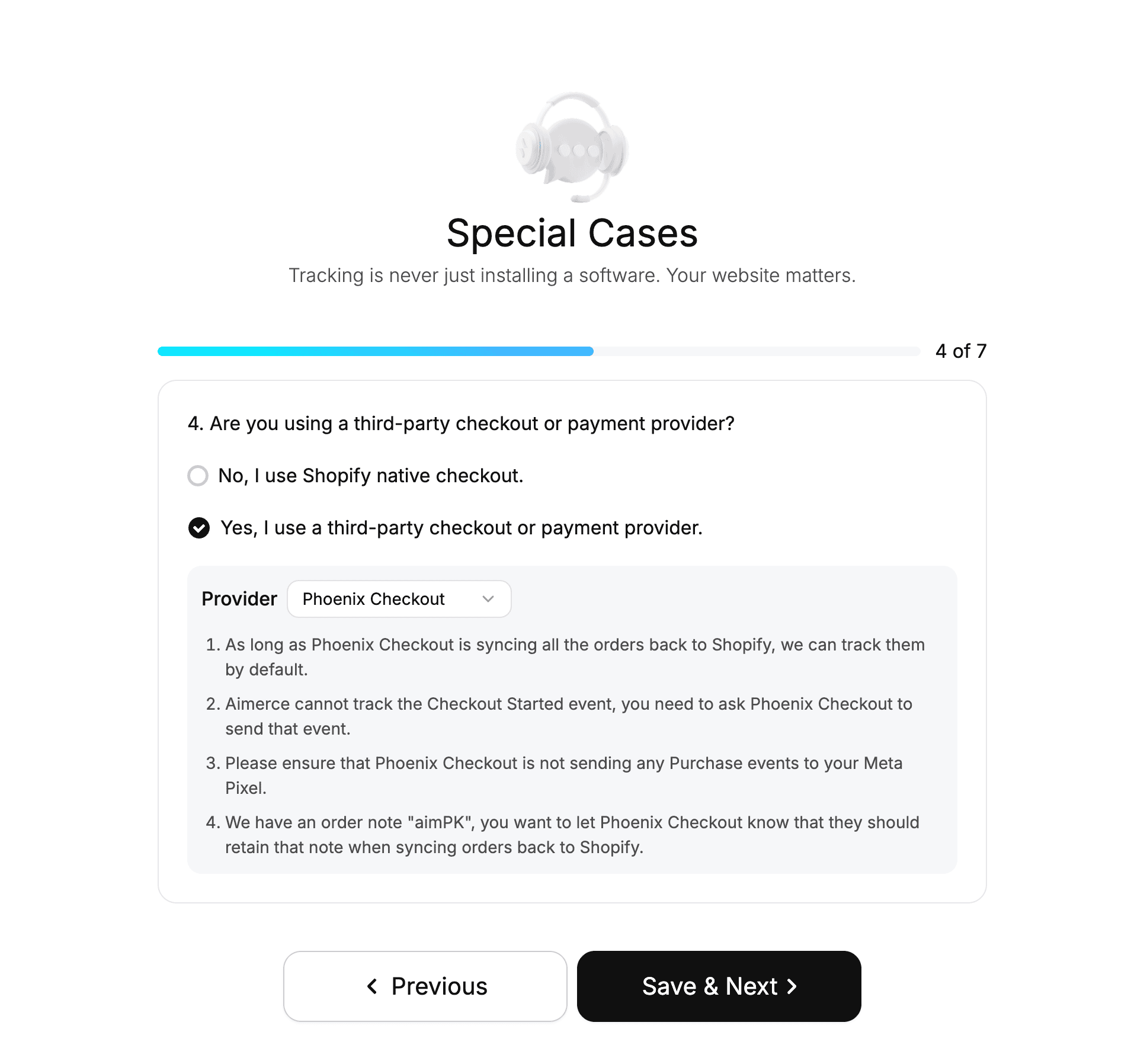
If you'd like Aimerce to handle this clickID tracking, that's possible if the third-party checkout is willing to leave an order note in Shopify properly, called aimPK. That order note is what gets used to match the order back to the original session and recover the click ID, functionally the same role as Express Checkout ClickID Relinking plays for Shop Pay and other accelerated checkout flows. [2] A few things worth confirming directly with any third-party checkout provider: that they're syncing orders back to Shopify at all, that they can send a Checkout Started event (which Aimerce can't generate on their behalf), and that they're not also sending Purchase events directly to your Meta Pixel, which would double-count the same order. [1]
How should subscriptions and rebills be handled differently from one-time purchases?
By separating first-time subscriptions, renewals, and one-time purchases into distinct events, rather than letting every rebill count as a fresh Purchase conversion.
All purchases, including subscriptions and rebills, get tracked in Meta by default. That's not automatically wrong, but system-generated renewals weren't driven by a new ad click the way a first-time purchase was, and counting them identically can quietly distort what your ad platforms think is working. To prevent system-generated subscriptions and rebills from being attributed as if they were fresh, ad-driven conversions, they can be manually removed from that count while keeping the first-time subscription intact.
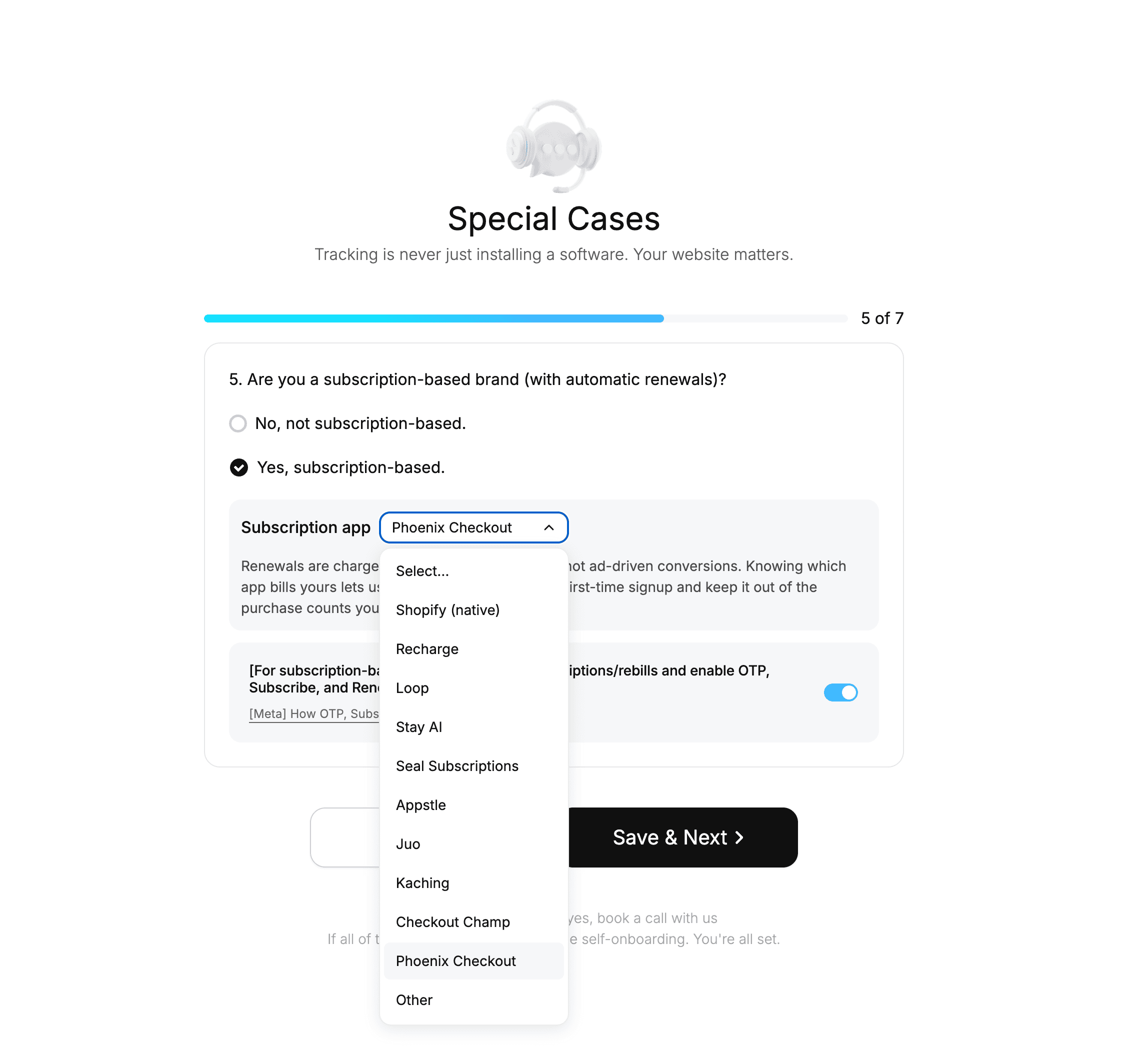
This also enables three distinct custom events for building more precise metrics: OTP for a one-time purchase, Subscribe for a first-time subscription, and Renewal for a renewal or rebill. Knowing which purchase count is actually ad-driven versus automatically billed matters directly for the kind of learning-phase and CPA analysis covered elsewhere, an ad platform optimizing against inflated conversion counts makes worse decisions with more confidence, not better ones. [2]
Does a quiz need special tracking treatment?
Only if it captures personal information. A quiz is conceptually similar to an email popup, the goal is capturing more emails, or names, or phone numbers, and if it does that, it needs to be tracked the same way any other lead capture point would be. [2]
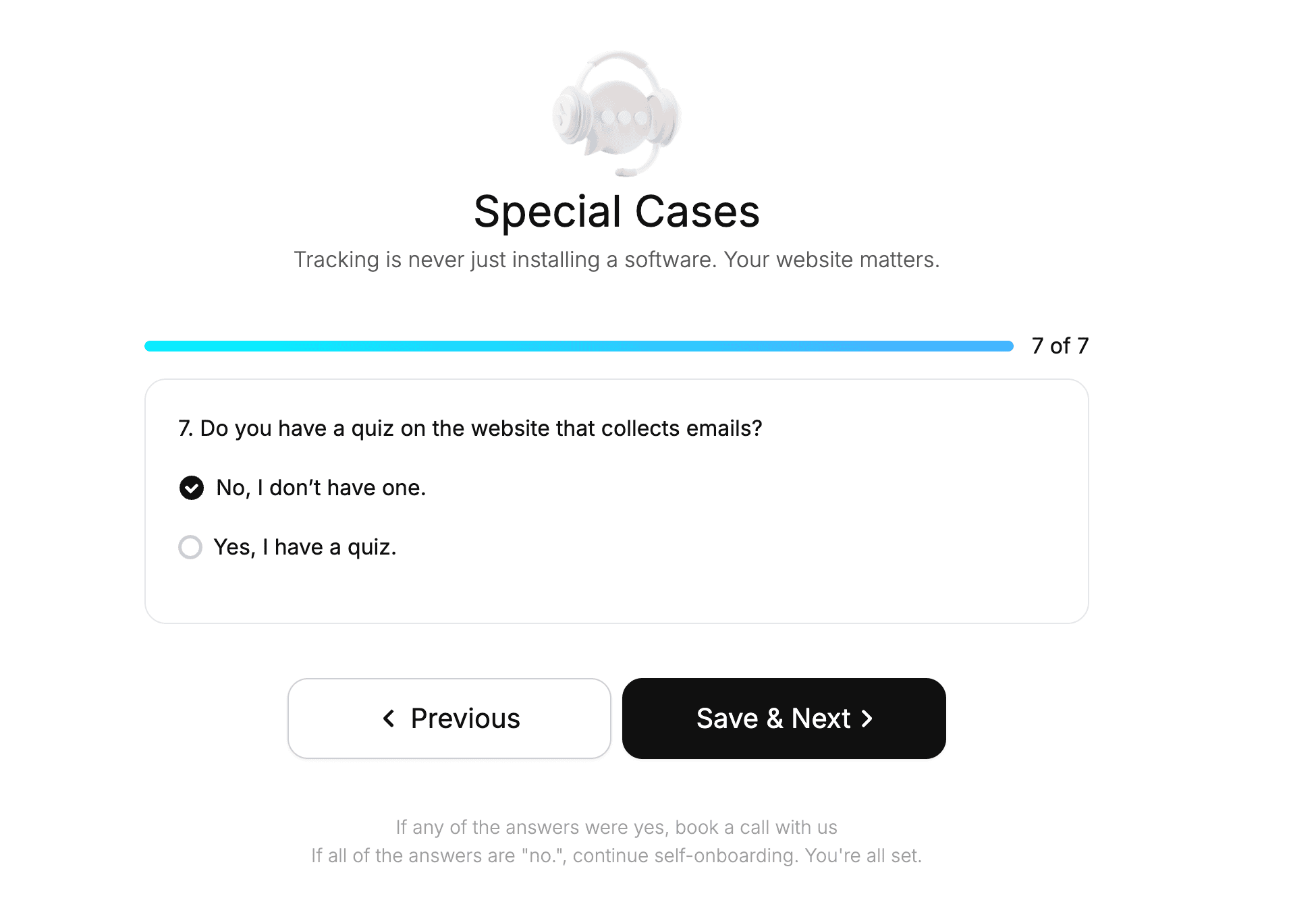
If a quiz doesn't capture any personal information, it doesn't do much from a tracking perspective, there's nothing to connect to a customer profile either way. If it does capture email, name, or phone number, that data needs the same treatment as any other identity signal: captured, associated with the visitor's session, and forwarded correctly. [1]
Five Special Cases, At a Glance
| Special case | What breaks without handling it | Where the fix lives |
|---|---|---|
| Email popup / capture | Captured emails don't connect to the visitor's tracked behavior | Native platform integration (Klaviyo, Omnisend, etc.) or custom setup |
| Custom ad landing pages | Click ID from Meta or Google ads never reaches the purchase event | Platform-specific embed script, or headless-specific session handling |
| Third-party checkout | Attribution breaks even though the order completes normally | The aimPK order note, retained by the checkout provider |
| Subscriptions and rebills | Renewals inflate Purchase counts as if they were ad-driven conversions | Separating OTP, Subscribe, and Renewal into distinct events |
| Quizzes | A quiz capturing personal data behaves like an untracked lead form | Same identity capture and forwarding as any other lead source |
Common mistakes to avoid
- Assuming a custom-built popup behaves like a native one automatically. Native platforms like Klaviyo already associate captured emails with tracked behavior; custom builds need that connection set up explicitly.
- Building an ad landing page off-platform without checking clickID capture first. This is the single most common cause of attribution looking broken when the actual orders are fine.
- Letting a third-party checkout provider skip the order note that carries clickID data back. Without it, there's no way to reconnect the completed order to the session that started it.
- Treating every subscription rebill as a fresh, ad-driven conversion. This inflates reported Purchase volume in a way that actively misleads ad platform optimization, not just your own reporting.
- Ignoring a quiz that collects contact information. If it captures personal data, it's a lead capture point that needs the same tracking attention as a popup.
FAQ
Why does capturing email help my Meta and Google ad performance, not just email marketing? Because email addresses are one of the strongest identifiers Meta and Google use to match a site visitor to a real account. The more hashed email addresses reaching the platform, the more confidently it can connect your site visitors to real users, which improves match quality and optimization.
What happens if my custom ad landing page doesn't capture the click ID? Attribution breaks. The purchase might complete normally in Shopify, but Meta or Google won't be able to connect it back to the ad click that drove it, which shows up as a campaign looking like it's underperforming when the actual problem is a missing identifier.
What is aimPK, and why does my checkout provider need to keep it? aimPK is an order note Aimerce uses to match a completed order on a third-party checkout back to the original session, recovering the click ID for attribution. If the checkout provider strips this note when syncing orders back to Shopify, that recovery isn't possible.
Should subscription renewals count the same as a first-time purchase in my ad reporting? Not for optimization purposes. A renewal wasn't driven by a fresh ad click the way a first-time subscription was, and counting them identically inflates what your ad platform thinks is converting from active campaigns.
Does a quiz on my site need tracking setup? Only if it captures personal information like email, name, or phone number. A quiz with no data capture doesn't need special handling, there's nothing for tracking to connect to a customer profile.
Can Aimerce track a third-party checkout automatically without any configuration? Not entirely automatically. It requires the checkout provider to sync orders back to Shopify, retain the aimPK order note, and send a Checkout Started event on its own, since that specific event can't be generated on the provider's behalf.
Sources
[1] Aimerce dashboard, Special Cases onboarding flow (internal documentation) [2] Yiqi Wu, Aimerce's Founder newsletter "Special cases you need to pay attention to when setting up events tracking" Delivered on August 26, 2026
Related reading

Try Aimerce Pixel Risk-Free
for 30 Days
Most teams see results within 2 weeks.
Money-back guarantee.
It pays for itself, or you don't pay anything.
30-Day Aimerce Pixel Free Trial