
What Meta Ad Strategies Are Working in 2026?
The Meta ad strategies working best in 2026 reflect a platform that has shifted heavily toward automation, creative diversity, and first-party data. The seven highest-impact strategies right now are: using value rules to influence delivery without hard targeting constraints, defining audience segments in advertising settings, producing significantly more ad creative per ad set (targeting 20 rather than the old limit of six), using partnership ads with creators, using the built-in creative testing tool, combining cold and retargeting into a single hybrid campaign, and focusing acquisition on either free or high-ticket offers rather than the crowded middle.
Meta ads have changed more in the past year than in the previous three years combined. The Andromeda update shifted how Meta personalizes ad delivery. Privacy changes have made browser pixel tracking less reliable. And the platform's move toward automation means the quality of your conversion signals now directly determines the quality of your results, regardless of how good your creative or targeting strategy is.
If you are running Meta ads for a Shopify store or DTC brand and still relying on what worked in 2024, you are leaving a measurable amount of money on the table.
Here are the 6 strategies that are working right now, what changed to make them work:
1. Use Value Rules
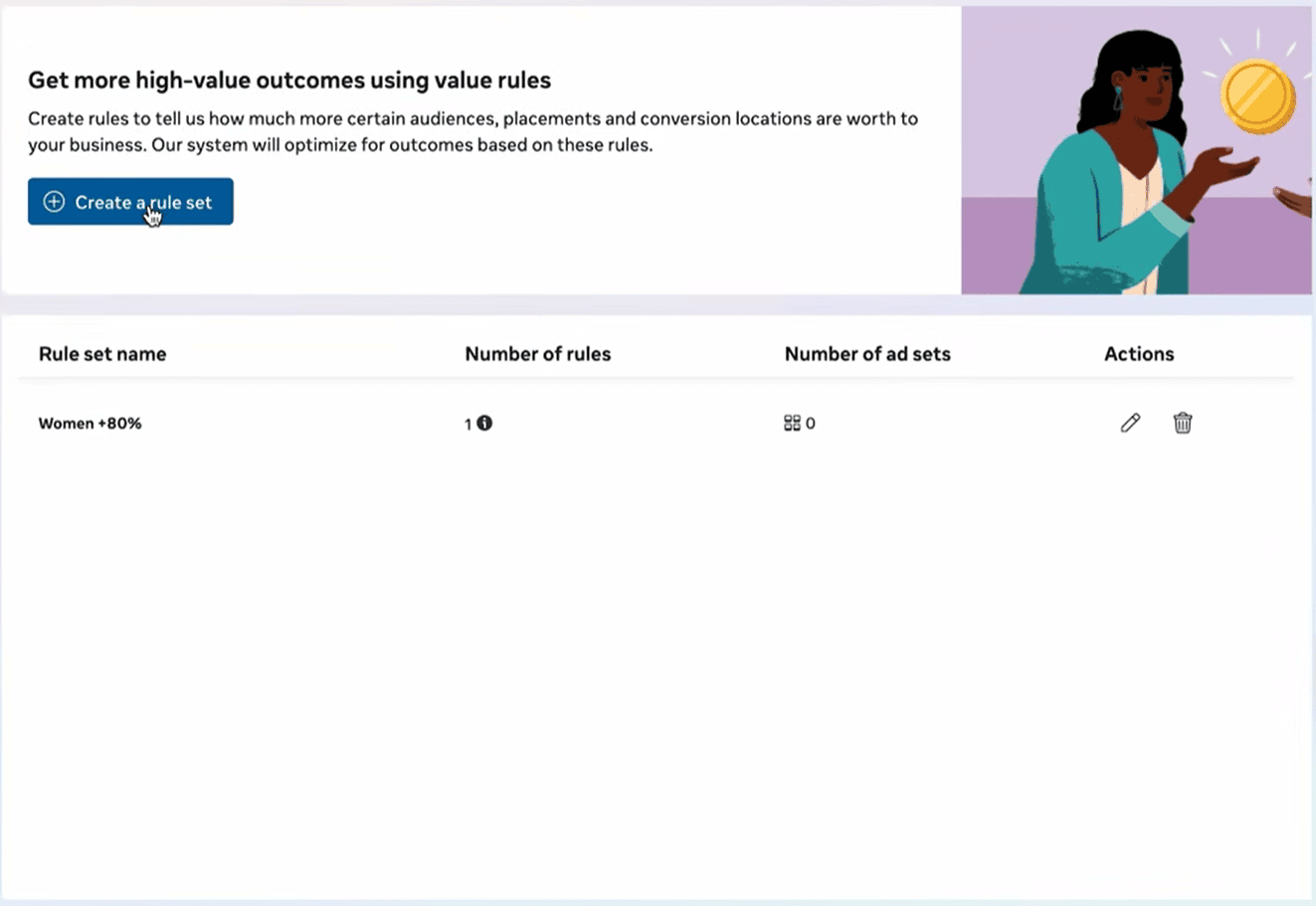
Value rules allow you to give Meta's algorithm directional guidance toward your most valuable customers without restricting who it can reach. This is the best of both worlds: open targeting with the full flexibility Meta needs to find buyers, combined with a bid multiplier that tells the algorithm which audience segments are worth more to your business.
How Do Value Rules Work on Meta?
Value rules work by letting you increase your effective bid for specific audience segments based on criteria like age, gender, location, or conversion location. Meta continues advertising to all eligible users, but it is willing to pay more in the auction to reach the segments you have identified as higher value.
How to Set Up Value Rules in Meta Ads Manager
| Step | Action |
|---|---|
| 1 | Go to Advertising Settings in Meta Ads Manager |
| 2 | Select Value Rules and click Create a Rule Set |
| 3 | Select your criteria (age, gender, conversion location, etc.) |
| 4 | Set the bid multiplier percentage based on relative customer value |
| 5 | Name the rule set and click Create |
| 6 | Apply the rule set to your campaigns and ad sets |
Why Value Rules Depend on Accurate Conversion Data
Value rules are only as good as the customer data informing them. If your purchase events are missing 30 to 40 percent of actual conversions due to browser pixel failures, your customer value analysis is built on an incomplete dataset. The segments you identify as most valuable may be skewed by which sessions your pixel could and could not track.
If you’re on Shopify, Aimerce Server-side tracking API ensures every purchase event reaches Meta regardless of the customer's browser behavior, making creative test results accurate rather than artifacts of tracking quality differences between sessions.
2. Define Your Audience Segments
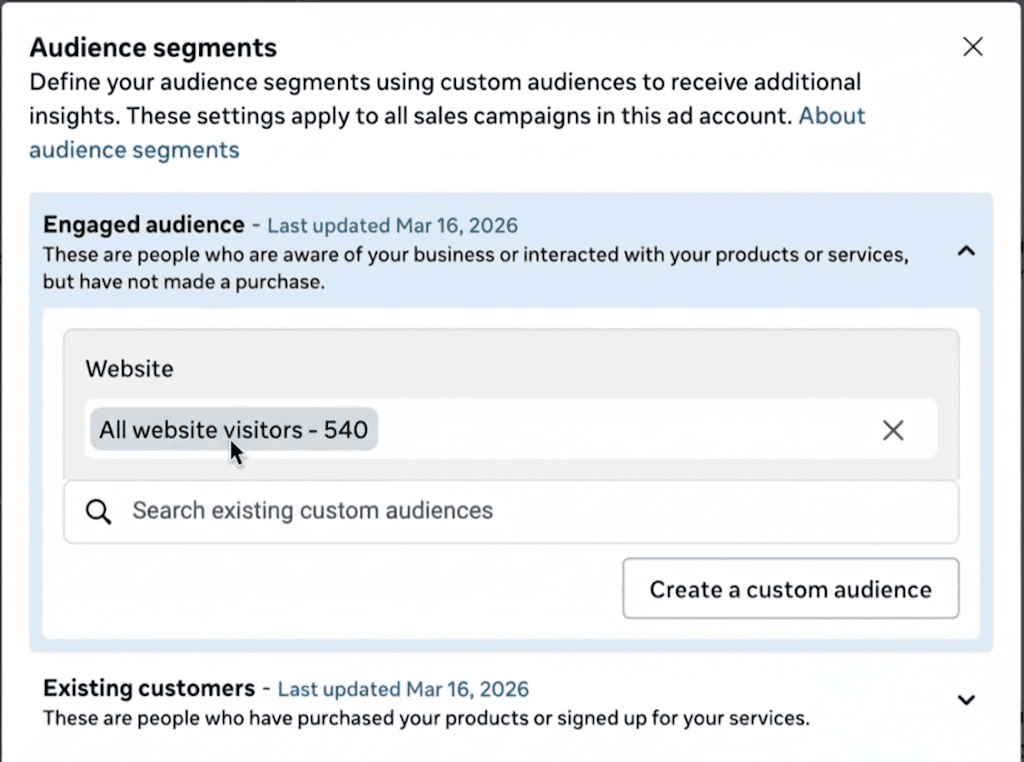
Meta breaks the audience you are reaching into three categories: new audience (cold), engaged audience (warm), and existing customers. Defining these segments in Advertising Settings gives you visibility into how Meta is allocating budget across each group and what your results look like by segment, without restricting delivery.
How to Define Audience Segments on Meta
- Existing customers: Upload your customer list to Meta and designate it as your existing customers segment in Advertising Settings
- Engaged audience: Define this as website visitors, email subscribers who have not purchased, and users who have engaged with your Meta content
- New audience: Everyone outside your existing customers and engaged audience definitions
Once defined, you can break down campaign and ad set results by segment to see how spend and conversions distribute across cold, warm, and hot audiences. This visibility is critical for understanding whether Meta's algorithm is actually finding new buyers or concentrating spend on people who already know you.
What Good Audience Segment Data Tells You
| Segment Insight | What It Signals | Action |
|---|---|---|
| Existing customers getting most spend | Meta is not finding new buyers efficiently | Broaden prospecting targeting or improve signal quality |
| New audience converting at low rate | Creative or offer is not resonating with cold traffic | Test new angles or value propositions |
| Engaged audience has high CPA | Retargeting pool is too broad | Tighten engaged audience definition or increase exclusions |
| Even split across segments at good CPA | Healthy campaign | Scale budget gradually |
3. Produce Significantly More Ad Creative Per Ad Set
The recommendation has changed dramatically. The target is now 20 different ad creatives per ad set, up from the previous Meta recommendation of six. This shift is a direct result of the Andromeda update, which fundamentally changed how Meta personalizes ad delivery.
More creative diversity improves Meta ad performance for 2 compounding reasons: personalization and fatigue reduction.
More Effective Personalization
Gone are the days when Meta would pick a single "winning" ad to display to your entire audience. Now, the algorithm plays matchmaker, connecting individual users with the specific creative they’re most likely to engage with. A larger creative pool allows for more precise personalization, which leads to a better match rate between your ads and your audience.
Reduced Ad Fatigue
We’ve all experienced it: you see the same ad over and over, and it quickly becomes annoying. When a user sees your ad too many times in a short period, engagement plummets. By having a larger rotation of creatives, Meta can show the same user a different ad in the morning, another in the afternoon, and a third the next day. This variety pushes the point of ad fatigue much later into your campaign, keeping your content fresh and effective for longer.
4. Use the Creative Testing Tool (Most Advertisers Are Not)
The Meta creative testing tool solves a specific problem that became acute after the Andromeda update: new ads added to existing ad sets receive little to no spend because the algorithm favors proven incumbents.
How does the Meta Creative Testing Tool work?
Meta’s creative testing tool allows you to run a controlled test on up to five ad creatives at once. It works by dividing your audience into separate, non-overlapping groups. This ensures each creative is tested fairly without them competing against each other for the same views.
To access it. You can find the tool at the ad level within any sales campaign.
- Navigate to the ad level.
- Scroll down to the "Ad creative" section.
- Click "Test creative."
- Set your test parameters, such as budget percentage and duration.
- Choose your primary metric for success.
Change the default metric from post engagement to something more meaningful, like cost per purchase or cost per lead. This ensures you're measuring what truly matters for your campaign's success.
Why Conversion Tracking Quality Determines Testing Quality
The creative testing tool produces meaningful results only when your conversion events are accurate. If purchase events are missing due to browser pixel failures, the test cannot correctly attribute conversions to the right creative variant. A creative that drove 20 real purchases but only 12 trackable ones appears to underperform against one that drove 15 purchases with 14 trackable ones.
If you’re on Shopify, Aimerce Server-side tracking API ensures every purchase event reaches Meta regardless of the customer's browser behavior, making creative test results accurate rather than artifacts of tracking quality differences between sessions.
5. Combine Cold and Retargeting Into a Single Campaign
Meta’s algorithm treats most of your targeting inputs as suggestions, not strict rules.
This means that even if you create a "cold" campaign and a separate "retargeting" campaign, the algorithm will likely serve your ads to a similar mix of cold, warm, and hot audiences in both. You end up with overlapping audiences and less efficient delivery.
Why is my retargeting campaign reaching cold audiences?
If you've noticed your "retargeting" ad sets are still reaching cold audiences, here's what's happening.
When you create a retargeting ad set and target your warm audiences, Meta's system treats this as a suggestion, not a strict rule. This means Meta can and often will show your ads to cold audiences if its algorithm predicts they are more likely to convert. The outcome? Your retargeting and prospecting campaigns end up reaching a very similar mix of people.
So, what's the problem with this?
The biggest issue is fragmented data. Imagine you have two separate campaigns one for prospecting and one for retargeting and each gets 20 conversions a week. That gives Meta less optimization data to work with compared to a single, consolidated campaign that generates 50 conversions a week.
More data in one campaign leads to better results:
→ Faster exit from the learning phase: Your campaign learns more quickly what works.
→ Fewer "learning limited" flags: More data helps the algorithm optimize effectively.
Smarter optimization decisions: Meta has more information to find the best-performing placements and audiences.
When to Combine vs. Keep Separate
| Situation | Recommendation |
|---|---|
| Single product, one primary audience | Combine into one hybrid campaign |
| Multiple products with distinct buyer profiles | Separate campaigns by product or audience intent |
| Weekly conversion volume under 50 total | Combine to consolidate learning signal |
| High-ticket offers with long consideration cycle | Separate retargeting with specific messaging for warm audiences |
| Standard DTC ecommerce | Combine by default; separate only with a specific reason |
6. Focus Your Acquisition Strategy
Mid-range offers are in the most competitive space, making it hard to stand out. They also create a tricky economic situation: the price is high enough that potential customers need reassurance, but it's not high enough to justify a detailed, high-touch sales process.
2 Acquisition Strategies That Work Best on Meta
- Free or Very Low-Cost Offers
A free or inexpensive offer is an easy "yes" for customers. It’s also simple to deliver from an operational standpoint and generates enough purchase volume for Meta's algorithm to optimize effectively.
- High-Ticket or Premium Offers
A high-ticket offer gives you the margin to support a full sales process, including calls, proposals, and extensive follow-up. Your cost per acquisition can be higher because each customer's value more than covers it. Brands in this space also get a major boost from Meta's algorithm as it improves its ability to find the right customers. After all, finding one $5,000 customer is far more valuable than finding ten $500 customers.
Why Accurate Conversion Tracking Is the Foundation Every Strategy Depends On
Every strategy in this guide operates on the same underlying principle: Meta's algorithm optimizes on the signals it receives. Value rules require accurate customer value data. Creative testing requires accurate conversion attribution. Hybrid campaigns require enough conversion volume to exit the learning phase. High-ticket acquisition requires precise match quality to find rare, high-value buyers.
All of these require your purchase events to arrive at Meta accurately, completely, and on time.
For Shopify brands, browser pixel tracking now fails for 28 to 45 percent of purchase events on average due to iOS privacy restrictions, Safari ITP, and ad blockers. That means the algorithm making decisions about your value rules, your creative tests, and your audience distribution is working with less than 75 percent of the truth in many accounts.
Aimerce server-side tracking Shopify solve this at the infrastructure level. Aimerce's server-side tracking sends purchase events directly from Shopify to Meta via the Conversions API, bypassing the browser entirely. Every paid order reaches Meta regardless of iOS settings, ad blockers, or browser behavior. Combined with first-party identity enrichment and automatic deduplication, this raises Meta Event Match Quality from the industry average of 8.1 to above 9.4, giving every strategy above the complete, accurate signal it needs to work.
The brands scaling most effectively on Meta in 2026 are not necessarily running better creatives or smarter targeting. They are running the same strategies as their competitors but with better data underneath every decision.
FAQ: Meta Ads Strategies for DTC Brands in 2026
What is the Andromeda update and how does it affect Meta ad strategy?
Andromeda is Meta's algorithm update that shifted ad delivery from showing one winning creative to everyone toward personalizing which creative each individual user sees. The practical impact is that more ad creative diversity per ad set produces better results, because the algorithm can match users to the creative they are most likely to engage with rather than defaulting to one broadly optimized winner.
How many creatives should you have per Meta ad set in 2026?
The target in 2026 is 20 ad creatives per ad set, up significantly from Meta's previous recommendation of six. This number reflects the Andromeda update's emphasis on creative diversity for personalized delivery and fatigue reduction. Not all 20 need to be videos. A healthy mix of formats, including static images, carousels, and video, achieves the diversity goal while distributing production cost.
Should you run separate retargeting campaigns on Meta in 2026?
In most cases, no. Meta's algorithm reaches a similar distribution of cold, warm, and hot audiences regardless of how targeting is set up, because most targeting inputs are suggestions rather than hard constraints. Combining cold and retargeting audiences into one hybrid campaign consolidates conversion data, helps exit the learning phase faster, and produces better optimization decisions. Separate retargeting is worth maintaining only for distinct products, dramatically different messaging by intent level, or high-ticket offers with long consideration cycles.
What are Meta value rules and how do they improve ad performance?
Meta value rules are bid multipliers that tell Meta's algorithm which audience segments are worth more to your business without restricting who it can reach. By setting a higher effective bid for your most valuable segments, based on your own customer data, you get open targeting flexibility combined with directional influence over delivery. The result is better audience quality without the data fragmentation that comes from narrow hard targeting constraints.
Why does conversion tracking quality affect Meta ad performance?
Meta's algorithm only optimizes on the signals it receives. When purchase events go missing due to browser pixel failures, the algorithm makes targeting, creative, and bidding decisions based on incomplete data. The effect compounds across every strategy: creative tests produce misleading results, value rules are calibrated against incomplete customer data, and campaigns stay in learning limited status because conversion volume appears lower than it actually is. Server-side tracking via the Meta Conversion API recovers the missing signal by sending purchase events from your server directly to Meta, bypassing browser restrictions entirely.
What is a partnership ad on Meta and when should DTC brands use it?
A partnership ad is an ad run simultaneously from your brand's ad account and a creator's account. It combines the credibility and scroll-stopping power of influencer content with the targeting and budget control of paid advertising. DTC brands should use partnership ads when they need to scale creative volume quickly, when their current creative has high fatigue, or when they want to test whether creator-endorsed content outperforms brand-produced content for a specific product or audience.
How does server-side tracking improve Meta creative testing results?
Creative testing accuracy depends directly on conversion tracking accuracy. When purchase events go missing, the creative test cannot correctly attribute conversions to the creative that drove them. A creative that performed better in reality may appear to lose a test simply because its audience had a higher proportion of iOS or ad blocker users whose purchases were not tracked. Server-side tracking ensures all conversions reach Meta regardless of browser behavior, making creative test results reflect actual performance differences rather than tracking coverage differences.

Try Aimerce Pixel Risk-Free
for 30 Days
Most teams see results within 2 weeks.
Money-back guarantee.
It pays for itself, or you don't pay anything.
30-Day Aimerce Pixel Free Trial