Quick Answer: First-party data is what you observe directly from customer behavior on your own site. Zero-party data is what a customer explicitly tells you, like a stated preference. Third-party data is purchased or aggregated from external sources you have no direct relationship with. Most ecommerce brands get the best results building on the first two.
Key Takeaways
- First-party data is observed behavior on channels you control: your site, app, email, and support. Zero-party data is explicitly declared by the customer, and is generally considered a subset of first-party data rather than a fully separate category [3].
- Third-party data is aggregated by external providers, often without any direct relationship between your brand and the person it describes, and it's become less reliable as browsers restrict cross-site tracking [4].
- The most common mistake is calling everything "first-party." If you didn't collect it directly, or it wasn't explicitly volunteered, it doesn't behave like first-party data for reliability or consent purposes.
- Zero-party data adds high-signal personalization but doesn't scale, most shoppers won't fill out a quiz or preference form, so it's additive to behavioral data, not a replacement for it [4].
- The most durable ecommerce approach leans on first-party data for measurement and lifecycle, layers zero-party data for personalization, and treats third-party data as a directional supplement, not a source of truth [2].
What is first-party data?
Data generated when a customer interacts directly with channels you control: your site, app, email, support, or store.
Common ecommerce examples include product page views and search terms, add-to-cart and checkout-started events, purchases and refunds, email opens and clicks, customer service interactions, and loyalty program activity. Teams rely on it because it reflects what customers actually did with your brand, you control how it's collected and stored, and it can connect actions across sessions when tied to a durable identifier like an authenticated account or email address.
The limitations are practical, not conceptual. Browser restrictions, ad blockers, and tag failures can all reduce what you actually capture, meaning "first-party data" on paper doesn't guarantee complete first-party data in practice. Identity fragmentation, a shopper browsing on mobile and buying on desktop, can make one customer look like two unless sessions are connected. And none of it works without clean event definitions and consistent instrumentation to begin with.
What is zero-party data?
Information a customer proactively and intentionally shares with you, style preferences, stated interests, quiz answers, or communication frequency choices, generally considered a subset of first-party data rather than a wholly separate category, since it's still collected on your own channels.
The distinction is useful anyway, because it's explicitly declared rather than inferred. That gives it real value: it's high-signal for personalization without requiring you to guess from clicks, and a transparent value exchange (better recommendations in exchange for a quiz answer) tends to build trust rather than feel invasive. The limitations are coverage and freshness. Only a portion of shoppers will ever share it, preferences change over time and need refreshing, and asking too many questions upfront creates friction that can cost you the conversion you were trying to personalize.
What is third-party data?
Data collected by an external provider and made available to you, typically aggregated across many sites or sources, often without any direct relationship between your brand and the person it describes.
Common uses include interest segments built from cross-site browsing, demographic or household-level attributes from external datasets, and ready-made audience segments offered through ad platforms or data marketplaces. The appeal is scale and speed, reaching people beyond your existing customer base without waiting to build your own data. The real limitations are transparency (it's often unclear how the data was collected or how current it is), precision (aggregated or modeled attributes are less accurate at the individual level), and durability (cookie restrictions and growing privacy expectations have made many third-party approaches meaningfully less reliable than they used to be).
First-Party vs. Zero-Party vs. Third-Party Data, Compared
| Dimension | First-Party Data | Zero-Party Data | Third-Party Data |
|---|---|---|---|
| How you get it | Collected on your own channels | Customer explicitly provides it | Purchased or obtained from external providers |
| Typical accuracy | High | High, for what's provided | Varies, often lower at the individual level |
| Consent clarity | Usually clear | Very clear, explicit | Often unclear |
| Scale | Limited to your own traffic and customers | Typically smaller than first-party | Often large |
| Best use | Measurement, personalization, retention, attribution inputs | Preference-based personalization, segmentation, messaging controls | Broad prospecting, supplemental targeting |
| Main risk | Data loss from tracking gaps, identity fragmentation | Low participation, stale answers | Uncertain provenance, lower relevance |
| Durability under browser privacy changes | Improves with server-side capture and durable identifiers | Unaffected, since it's declared rather than tracked | Weakening as cross-site tracking faces growing restrictions |
How do these three data types actually work together in practice?
Start with first-party data for measurement and lifecycle, layer in zero-party data where it clearly improves the shopper experience, and treat third-party data as a directional supplement rather than a source of truth.
For first-party data, that means defining a clean core event set, view content, add to cart, begin checkout, purchase, and using it to power reporting, attribution inputs, and retention flows. For zero-party data, collect preferences only when doing so improves the experience, a quiz that improves recommendations, a preference center that controls frequency, and keep it current rather than treating it as a one-time capture. For third-party data, use it for top-of-funnel reach and prospecting, validate its apparent performance using your own first-party conversion signals, and avoid building critical lifecycle flows that depend on data you can't verify.
Example, a running shoes store: first-party data shows a customer viewed trail shoes, filtered by size 10, added a specific model to cart, and purchased two days later. Zero-party data shows the same customer stated a preference for "wide fit" and "trail running." Third-party data might contribute a prospecting audience interested in outdoor sports. The most actionable insight comes from the first two; the third is mainly useful for finding new people to bring into the relationship in the first place.
What are the most common mistakes teams make with data types?
- Calling everything "first-party." If you didn't collect it directly, or it wasn't explicitly volunteered, it doesn't behave like first-party data for reliability or consent clarity, label data by actual origin in your internal taxonomy instead.
- Over-collecting zero-party data. Ask fewer questions, each tied to a clear, visible benefit, rather than a long form upfront.
- Treating third-party data as a source of truth. It's an input for reach, not a definitive customer profile, validate anything it suggests against your own first-party signals.
- Inconsistent event definitions. "Purchase" needs to mean the same thing everywhere it's used, across analytics, ads, and email, or every downstream report and automation inherits the inconsistency.
- Collecting data you never activate. Teams often track far more events than they actually use. Start with the events that drive real decisions, attribution inputs, suppression logic, lifecycle triggers, rather than instrumenting everything by default.
Why First-Party Data Is Your Biggest Marketing Revenue Opportunity
First-party data is information collected directly from your customers through their interactions with your website, app, or business, without any intermediaries. While third-party cookies face growing restrictions and iOS updates continue disrupting traditional tracking, smart ecommerce brands are doubling down on first-party data strategies.
The Hidden Revenue Leak in Your Marketing Funnel
Here's what most Shopify store owners don't realize: Safari's Intelligent Tracking Prevention deletes JavaScript-set visitor data after just 7 days. This means:
- Days 1-6: Your customer browses your site, adds items to cart
- Day 7: Safari deletes the visitor data, anonymizing the session
- Day 8+: Returning visitors can't reliably receive targeted emails or retargeting ads
- Result: A meaningful share of potential retargeting audiences and abandoned cart recovery goes missing
How Aimerce First-Party Data Transforms Marketing Performance
While understanding first-party data concepts is crucial, Aimerce server-side tracking on Shopify that captures first-party data provides the technical infrastructure to capture and activate this data at scale, delivering the 10-40% revenue lifts discussed below.
Meta Ads Optimization: Rich first-party data sent through Conversions API gives Meta's algorithm more complete customer information, helping campaigns learn faster and target more accurately. Aurum Brothers, a jewelry brand, saw a 35% Facebook ROAS lift and a 10x return on investment after implementing server-side event delivery and deduplication with Aimerce.
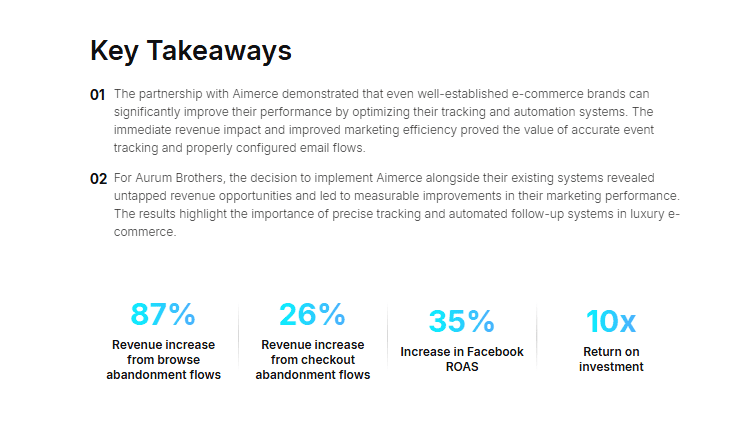 Aurum Brothers case study after implementing Aimerce's server-side tracking
Email Marketing Enhancement: Extended visitor tracking allows email platforms like Klaviyo to send abandoned cart flows to customers who return weeks later, not just within Safari's 7-day window. Little Sky Stone, a jewelry brand, saw a 35% Klaviyo revenue lift through more complete visitor identification.
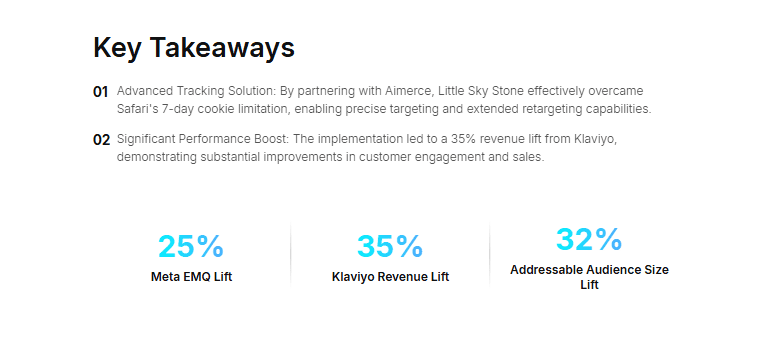 Little Sky Stone case study after overcoming Safari's 7-day cookie limitations.
Google Ads Performance: Enhanced conversions built on complete first-party data improve Google's bidding algorithms, supporting more efficient ad spend and audience targeting.
Advanced First-Party Data Collection Strategies
Server-Side Tracking Implementation: Unlike browser-based tracking, which is vulnerable to ad blockers and browser privacy restrictions, server-side tracking captures data directly from your server, improving both data completeness and compliance with privacy regulations. No tracking method captures every event under every condition, but moving collection server-side removes the most common points of failure.
FAQ
Is zero-party data better than first-party data? Not better, different. Zero-party data is explicit and declared, while first-party data also includes observed behavior like clicks and purchases. Most brands use both together: behavior for timing and intent, declared preferences for relevance.
Is third-party data going away? Not entirely, but many third-party techniques are meaningfully less reliable than they used to be due to browser changes and growing privacy expectations, which is why many teams are investing more in first-party and zero-party strategies instead.
What should I prioritize if I have limited time? Start with high-quality first-party event tracking for the core funnel: view content, add to cart, begin checkout, purchase. Then add a small amount of zero-party data only where it clearly improves personalization.
Can I build audiences without third-party data? Yes. Many brands build effective audiences using first-party behaviors, viewed a product but didn't buy, repeat purchasers, high-AOV segments, combined with zero-party preferences, without relying on third-party sources at all.
Is zero-party data the same thing as first-party data? It's generally considered a subset of first-party data. The useful distinction is that zero-party is explicitly volunteered, while first-party as a broader category also includes behavior that's observed rather than stated.
What's the biggest risk with third-party data specifically? Uncertainty, about where it came from, how current it is, and whether consent and collection context are actually clear. That uncertainty reduces precision and increases both compliance risk and the chance of building strategy on data that doesn't hold up.
Does server-side tracking count as first-party data collection? Yes. Server-side tracking is a method of capturing first-party data more completely, events are still generated by real interactions on your own channels, the server-side approach just makes delivery less dependent on a browser script surviving ad blockers or cookie restrictions.
Sources
[1] Shopify App Store, "Aimerce First-Party Pixel" listing
[2] Aimerce “First-Party Data Mastery: The Complete 2025 Guide to Revenue-Boosting Customer Tracking”
[3] U.S Chamber of Commerce “Understanding First-Party Data and How It Works”
[4] GDPR Local “Understanding Third-Party Data: Definitions, Benefits & Challenges”
Related reading

Try Aimerce Pixel Risk-Free
for 30 Days
Most teams see results within 2 weeks.
Money-back guarantee.
It pays for itself, or you don't pay anything.
30-Day Aimerce Pixel Free Trial