Quick Answer: Headless Shopify breaks tracking in two specific ways: cookies can't cross the domain boundary between your storefront and Shopify's checkout, and JavaScript execution in Hydrogen or Next.js often fires too early, gets blocked, or misses events during hydration and routing. The fix requires an explicit session ID passed through checkout, plus moving purchase events server-side.
Key Takeaways
- Headless tracking breaks for two specific, structural reasons: cookies set on your storefront domain are invisible on Shopify's separate checkout domain, and Hydrogen or Next.js's rendering model causes standard scripts to fire too early, get blocked, or miss events entirely.
- Failures cascade in a predictable order: session continuity breaks first, identity becomes patchy next since the session that would have carried an email or customer ID is already lost, and attribution gets noisy last since the click ID and UTM parameters never made it to the purchase.
- The fix is architectural, not a config tweak: issue a first-party session ID at the edge before any application code runs, move purchase event collection server-side via the order webhook, and explicitly pass the session identifier across the checkout domain boundary as an order attribute.
- Server-side tracking alone doesn't solve headless attribution. It fixes delivery reliability, but if the session identifier was never passed through the checkout transition, the purchase still can't be matched back to the ad click that drove it.
- CDN and edge caching frequently strips UTM parameters before they reach your application layer, so parameters need to be captured and persisted server-side on the first request, not read from the URL on every page.
Headless Shopify is a real architectural choice with real benefits. Brands building on Hydrogen or Next.js are not doing it for fun. They want performance, flexibility, and the ability to ship experiences that a standard Shopify theme cannot deliver.
Before you go headless, please be advised your tracking is going to break in ways that are hard to diagnose and expensive to ignore.
I've talked to enough headless Shopify merchants to know that tracking usually ends up as an afterthought. Everything looks great once the site goes live, but then they hit Meta Ads Manager and realize a meaningful share of their sales are missing attribution. The rabbit hole almost always leads to the same two culprits: cross-domain cookie loss and wonky JavaScript execution.
When you go headless (your storefront is separate from Shopify's checkout), tracking problems are expected not because someone messed up, but because the setup naturally breaks how tracking usually works.
This article explains what breaks, why, and how to fix it.
What are the two things that break tracking in every headless Shopify build?
Cross-domain cookie loss, and JavaScript execution inconsistencies. I want to be specific here because vague explanations lead to incomplete fixes.
1. Cross-domain cookie loss.
Your headless storefront runs on www.yourbrand.com. Shopify checkout runs on yourbrand.myshopify.com. These are different domains. Browser cookies do not cross domain boundaries. Full stop.
This means any identifier your tracking setup stores in a cookie on the storefront, a click ID, a session token, an fbclid, a gclid, is completely invisible on Shopify's checkout domain. When the purchase completes, the conversion event fires with no knowledge of what happened before the shopper crossed that boundary. Meta cannot attribute the sale. Google cannot attribute the sale. Your retargeting audience does not include the right people. You paid for the click and got zero credit for the conversion.
Headless tracking problems aren't just config mistakes, they're baked into the architecture so tweaking cookies won't fix them. You have to pass your session and attribution IDs across the domain bridge before the customer hits the Shopify checkout, or you're just going to keep losing data.
2. JavaScript execution inconsistencies.
Headless setups like Hydrogen or Next.js are a headache for tracking. Because they handle rendering and routing so differently, standard scripts often fire too early, get blocked, or just plain miss events during navigation. Headless frontends handle hydration, server-side rendering, and client-side routing in ways that standard tracking scripts were not designed for. You end up in a spot where Shopify shows the sale, but your analytics tool has zero record of it, leaving you totally blind to your actual ad performance.
Switching to headless Shopify strains your tracking because it relies on shaky client-side scripts. To actually get accurate data, you need to stop trusting browser-based events and move your tracking, especially for purchases, to the server side where it's reliable.
Why is the failure cascade predictable?
Because in headless builds, tracking failures compound in a specific sequence that is worth understanding.
Session continuity breaks first. The cookie that was supposed to persist the session across pages either fails to set, gets scoped to the wrong domain, or gets blocked by an ad blocker before any of your tracking logic runs.
Identity becomes patchy next. The session that was supposed to carry the shopper's identity signal, the email entered in a popup, the logged-in customer ID, was already lost. You have behavioral data with no person attached to it.
Attribution becomes noisy last. The session that was supposed to carry the UTM parameters and click IDs from the original ad was disconnected from the purchase. The conversion appears as direct traffic. The campaign that drove it gets no credit.
By the time the damage shows up in your reporting, all three layers are compromised. The fix requires addressing all three, not just the most visible symptom.
What do these failure modes actually look like in practice?
The storefront-to-checkout transition. This is where the most damage happens. When a shopper moves from your headless storefront to yourbrand.myshopify.com, every identifier stored in a first-party cookie on the storefront domain vanishes. The click ID that landed with the shopper on the first page is gone. The attribution is gone. The symptom is ad spend with no attributable conversions, not because the ads are not working, but because the tracking cannot see across the domain boundary.
Cookie scope and lifetime failures. Even when a cookie is set correctly, several conditions can prevent it from being available. A cookie scoped to www.yourbrand.com is not readable on app.yourbrand.com. Safari's Intelligent Tracking Prevention shortens the lifetime of JavaScript-set cookies, which affects headless storefronts specifically because they typically set tracking cookies client-side. SameSite attribute misconfigurations block cookies from being sent in cross-origin requests. Ad blockers prevent client-side scripts from running at all.
Caching stripping query parameters. CDN and edge caching in headless architectures frequently strips UTM parameters and click IDs before they reach your application layer. Your tracking setup reads the URL, finds no campaign parameters, and records the session as unattributed. The parameters were there when the shopper clicked the ad. They were gone by the time your script ran.
Events from multiple environments with inconsistent identifiers. In a headless setup, page views come from the browser, add-to-cart events come from API calls, and purchase events come from webhooks. If those three event sources do not share a common session key and a consistent identity strategy, you cannot stitch them into a coherent customer journey. You end up with attribution that starts in the middle of a funnel, retargeting audiences built from incomplete data, and Klaviyo flows that trigger inconsistently.
What three concepts do you need to keep separate?
Session, identity, and attribution. Most tracking discussions conflate these three, and treating them as distinct problems is what makes the fix tractable.
- Session is short-lived. It groups events within a browsing window. It answers: what did this browser do in the last hour? Sessions break constantly in headless. That is expected. The goal is to minimize unnecessary breakage and bridge the breaks that are structural.
- Identity is longer-lived. It recognizes a person across sessions using a durable first-party identifier: email, customer ID, order record. Identity does not break the same way sessions do, but it depends on sessions being intact long enough to capture the identifier.
- Attribution maps a conversion to a marketing touchpoint. It depends on both session continuity, to carry the click ID through the journey, and identity, to match the conversion to a real person.
Fix sessions first. Identity follows. Attribution follows from both.
Standard Shopify Theme vs. Headless: What Changes for Tracking
| Aspect | Standard Shopify Theme | Headless (Hydrogen/Next.js) |
|---|---|---|
| Storefront and checkout domain | Same domain | Different domains, cookies don't cross |
| Cookie-based identifiers | Survive naturally within the same origin | Invisible once the shopper crosses to Shopify's checkout domain |
| Script execution timing | Predictable, theme-controlled load order | Inconsistent, subject to hydration, SSR, and client-side routing |
| Purchase event source | Browser script on confirmation page usually works | Confirmation page unreliable, order webhook required |
| UTM parameter survival | Rarely stripped before reaching the page | Frequently stripped by CDN/edge caching before reaching the application |
| Session ID issuance | Often handled implicitly by the tracking app | Must be issued explicitly, ideally at the edge, before app code runs |
| Typical fix | Standard app install | Edge session ID, server-side purchase capture, explicit cross-domain bridging |
Which architecture patterns actually fix this?
Four, in order of how foundational they are: issuing a session ID at the edge, moving purchase collection server-side, explicitly bridging the checkout domain transition, and upgrading identity when a durable identifier appears.
1. Issue a first-party session ID at the edge, before any application code runs.
This is the most important thing you can do. Edge middleware checks for a first-party session cookie on every inbound request. If none exists, it creates one and sets it on the response before the storefront renders. This works even when browser scripts are blocked, because the cookie is set at the network layer. It is consistent across server-side rendering and client-side navigation because it exists before either happens.
The mistake most teams make is letting JavaScript generate the session ID. That means the session ID does not exist until a script runs successfully in a browser that does not block it. In headless environments, that is not a reliable assumption.
2. Move purchase event collection server-side.
The browser is not a reliable event source for purchase events in headless. The thank-you page may not render correctly in all headless checkout flows. Browser scripts on the confirmation page are subject to the same JavaScript execution inconsistencies that cause problems throughout the headless storefront.
Sending purchase event collection to server-side via Aimerce or similar tools, the order webhook fires from Shopify's server regardless of what the browser did. It is the most consistent, reliable source of truth for purchase events in headless Shopify. Any tracking setup that depends on a browser script on the confirmation page for purchase events will have gaps.
3. Explicitly pass session identifiers across the storefront-to-checkout boundary.
Do not assume identifiers will survive the domain transition. They will not. When redirecting to Shopify checkout, pass the session identifier explicitly: as an order attribute, as a URL parameter, or as part of the checkout URL. On the checkout side, read that identifier and attach it to the purchase event. This is the only reliable way to connect a purchase on yourbrand.myshopify.com back to the ad click that happened on www.yourbrand.com.
4. Upgrade identity when a durable identifier becomes available.
Start with an anonymous session ID. When the shopper provides an email at checkout, logs into an account, or completes a purchase, attach that durable identifier to the existing session. This is what allows Klaviyo to fire an abandoned cart flow for someone who added to cart on one visit and did not convert, or to connect a mobile browsing session to a desktop purchase.
What fields should you standardize across every event source?
In headless environments, your event taxonomy matters more than in standard Shopify because multiple systems are emitting events. Inconsistent naming and inconsistent fields create matching failures downstream that are painful to debug.
A practical minimum event set: page_view, view_item, add_to_cart, begin_checkout, purchase.
The fields that matter most for session continuity and downstream matching:
| Field | Why It Matters |
|---|---|
| session_id | Stitches events across environments and domains |
| event_id | Deduplication across retries and multiple emitters |
| customer_email (when available) | Durable identity signal for matching and lifecycle flows |
| customer_id (if authenticated) | Stable internal key for identity resolution |
| order_id | Ties purchase events to Shopify order records |
| currency, value | Required for downstream optimization and reporting |
| utm_source/medium/campaign | Attribution inputs that need to survive checkout transitions |
Standardize these fields once and enforce them across every event source. A page view from the browser and a purchase from a webhook should use the same field names, the same formats, and the same session ID.
How does Aimerce handle this for headless Shopify stores?
Most server-side tracking tools are built around the assumption that a browser script can run reliably on the storefront. That assumption is wrong in headless environments, and tools built on it will have gaps.
Aimerce uses Shopify webhooks and native APIs as the primary event collection mechanism rather than browser scripts or CSS selectors. This matters specifically in headless because it means the architecture does not depend on JavaScript executing correctly in Hydrogen or Next.js environments. Purchase events are captured from Shopify's order creation signal server-side, with hashed customer email and phone from the order record attached before forwarding to Meta CAPI, Google Enhanced Conversions, and Klaviyo. Bot filtering and deduplication via order ID are active by default.
For the cross-domain attribution problem, Aimerce assigns a session ID on the headless storefront and passes it through to Shopify checkout via order attributes. When the purchase completes on Shopify's checkout domain, the purchase event is matched back to the originating session and the ad click that started it. The click ID that landed on www.yourbrand.com gets attribution credit for the purchase that completed on yourbrand.myshopify.com. This is the specific problem that breaks standard pixel setups in headless, and it is solved at the architecture level rather than patched.
For view item and add-to-cart events that originate in the storefront application, Aimerce provides a JavaScript SDK that integrates at the application root level in both Hydrogen and Next.js. Loading at the root means it is consistent across server-side rendered and client-side navigated pages, which avoids the hydration timing issues that cause standard tracking scripts to miss events in headless frontends.
Setup for headless integrations typically takes 30 minutes to an hour of developer time. Headless support, for both Hydrogen and Next.js, is available on Aimerce's Growth plan. Most current headless Aimerce customers are on Next.js. Hydrogen is fully supported, VIDA, a health and wellness brand running a custom Hydrogen/React implementation, is one verified example. Keto Chow is another real example of a headless Shopify store using Aimerce to close attribution gaps at the checkout boundary.
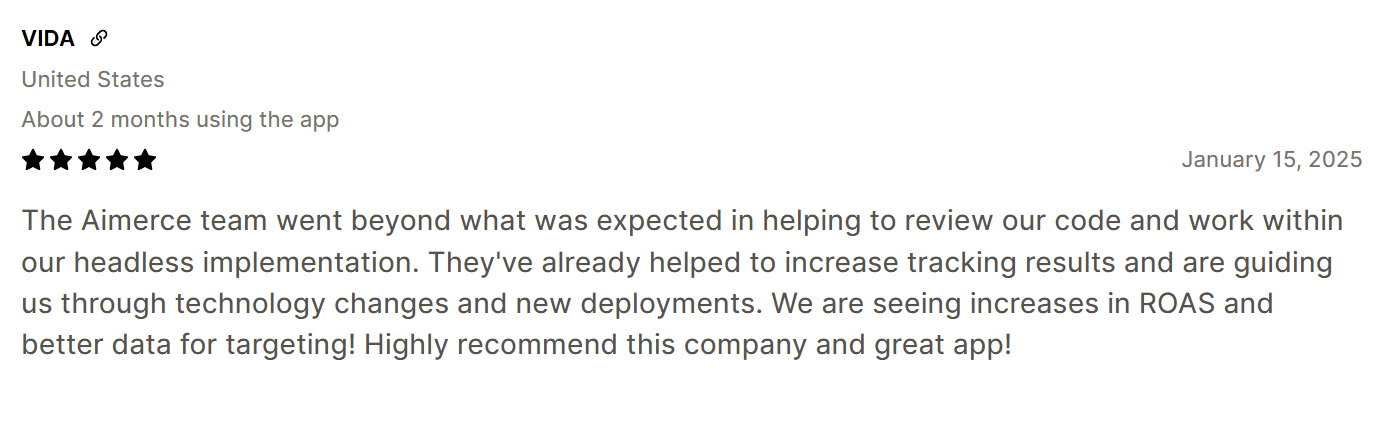 Vida's Shopify Review about Aimerce
One thing I want to say directly: headless is not a tracking problem you solve once and forget. Shopify updates checkout. Frameworks update. CDN configurations change. Any of these can silently reintroduce the gaps you fixed. Monitoring matters as much as the initial implementation.
And to be clear about what Aimerce does and does not do: it solves the tracking problem that headless creates. It is not a reason to go headless, and it is not a reason to avoid it. If your architecture requires headless, your tracking needs to account for it. That is the conversation.
How do you test your headless tracking pipeline?
Do not assume anything is working. Test every path explicitly.
- Single journey test. New visitor from a paid ad, browses, adds to cart, completes checkout. Confirm one session ID persists from the storefront through to the purchase event. Confirm the click ID is attributed to the completed purchase in Meta or Google.
- Cross-domain transition test. Confirm the session identifier is present as an order attribute when the shopper reaches Shopify checkout. Confirm the purchase event in Meta Events Manager is attributed to the originating ad click, not to direct traffic.
- Ad blocker test. Run the full journey with a common ad blocker enabled. The browser-side events may not fire. The server-side purchase event should still reach Meta and Google.
- Delayed conversion test. Visit from a paid campaign, leave, return the next day, purchase. Confirm the conversion is attributed to the original campaign source.
- Identity upgrade test. Browse anonymously, add to cart, enter email at checkout. Confirm the email is attached to the purchase event and Klaviyo receives the event with a matchable identifier.
Log what you test. If you cannot reproduce a failure, you cannot fix it.
What trade-offs are you actually accepting?
More server-side tracking means more complete conversion data and more backend responsibility. You need observability, retry logic, and someone who owns the pipeline when it breaks.
More identity stitching means better lifecycle marketing and more disciplined identifier management. You need to be intentional about what you collect, when you collect it, and how you use it.
More explicit cross-domain bridging means fewer attribution gaps and more implementation complexity. Handoff tokens need security design: short TTL, single use, signed.
There is no perfect headless tracking setup. There is only a setup you can operate reliably, debug when it breaks, and maintain as the underlying platforms change.
FAQ
Why does my Meta pixel lose attribution when shoppers reach Shopify checkout from a headless storefront? Because the storefront and Shopify checkout run on different domains, and browser cookies do not cross domain boundaries. Any click ID stored in a cookie on your storefront domain is invisible on Shopify's checkout domain. The fix is passing the session identifier explicitly through to checkout as an order attribute or URL parameter before the shopper crosses that boundary.
Does server-side tracking automatically solve headless attribution? No. Server-side tracking improves event delivery reliability by removing browser script execution from the critical path. But it does not fix attribution if the session identifier was never passed through the checkout domain transition. You need both: server-side event delivery and explicit session continuity across the storefront-to-checkout boundary. One without the other still leaves gaps.
Should I use the Shopify order webhook or the checkout confirmation page as the purchase event source in headless? The order webhook. The confirmation page is not a reliable event source in headless. Browser scripts on the confirmation page are subject to the same JavaScript execution inconsistencies that affect the rest of the headless storefront, and some headless checkout flows do not render the confirmation page in a way that allows scripts to execute correctly. The webhook fires from Shopify's server regardless of what the browser did. It is the right source of truth.
Why do UTM parameters disappear in my headless Shopify setup? CDN and edge caching strips query parameters before they reach your application layer. Your tracking setup reads the URL after caching has already removed the parameters, records nothing, and the session appears unattributed. Capture and persist UTM parameters server-side on the first request rather than reading them from the URL on each page. Store them in a server-side session record or order attributes so they survive navigation and the checkout transition.
How does Hydrogen handle tracking differently from Next.js headless Shopify? Both create the same fundamental problems: cross-domain cookie loss and JavaScript execution inconsistencies. The integration path differs slightly between the two frameworks. In practice, most headless Shopify stores using Aimerce are on Next.js, though Hydrogen is fully supported.
How long does setting up tracking for a headless Shopify store actually take? Longer than a standard Shopify theme, because the cross-domain session continuity piece requires deliberate implementation. For Aimerce specifically, the headless SDK integration typically takes 30 minutes to an hour of developer time. The server-side purchase event delivery through Shopify webhooks requires no additional development. The testing process takes as long as it takes to verify every checkout path, which is time well spent before you trust the data.
Sources
[1] WebKit.org, Apple's Intelligent Tracking Prevention documentation
Related reading

Try Aimerce Pixel Risk-Free
for 30 Days
Most teams see results within 2 weeks.
Money-back guarantee.
It pays for itself, or you don't pay anything.
30-Day Aimerce Pixel Free Trial