If you were running Facebook ads back in 2013, you remember the golden days. You could take a failing campaign, tweak the interest targeting from "Yoga" to "Lululemon," and suddenly watch your ROAS skyrocket. It was a game of manual precision. Doing it felt like a sharpshooter sniper. lol
Fast forward to 2026. The platform has changed entirely. The sniper rifle has been replaced by a heat-seeking missile system powered by artificial intelligence.
For DTC startups and established brands alike, the question is no longer "Who should I target?" The question is "Is Meta ads targeting still needed at all?"
The short answer is no. For most businesses, manual targeting is obsolete. But the long answer is more complicated because removing targeting controls creates a new problem. If you aren't telling Meta who to find, you must tell Meta what a high-value customer looks like.
This shifts the battleground from audience selection to data quality. In this new era, your success depends on server side tracking, robust attribution, and feeding the algorithm clean signals.
Here is the reality of Meta advertising in 2026 and why Aimerce is the partner you need to survive it.
The Evolution (From Granular Interests to Going Broad)
To understand why targeting has become secondary, we have to look at the trajectory of the platform.
In the early days, granular targeting was necessary because the algorithm was rudimentary. It needed your help to understand that a user interested in "hiking" might want to buy hiking boots.
As the years passed, Meta’s machine learning advanced. Advertisers started noticing that "open targeting" (selecting no interests, just age and gender) often outperformed their carefully crafted "lookalike" audiences. By removing constraints, they gave the algorithm a wider pool of data to swim in.
By 2026, this concept has solidified into standard practice. We have moved from "suggest an audience" to "broad targeting."
Suggestions vs. Controls
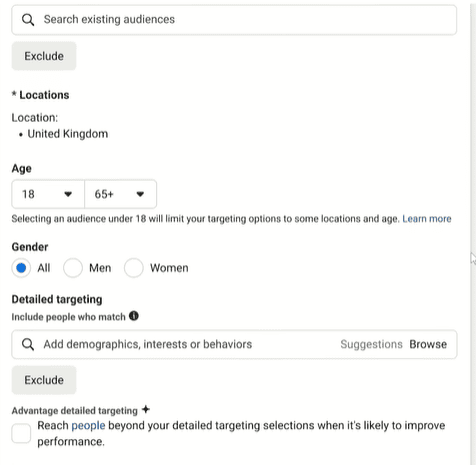
It is important to distinguish between suggestions and controls. In your ad account today, you will see a section for "Audience Controls." This is for hard boundaries. If you only ship to the US, you set the location to US. If you sell alcohol, you set the minimum age to 21. These are non-negotiable.
However, the "Detailed Targeting" inputs are now treated largely as suggestions. If you put "Social Media Marketing" as an interest, Meta might look there first. But if the algorithm sees a better conversion opportunity outside that bucket, it will ignore your suggestion and go get the sale.
For top DTC brands, adding manual targeting layers often does more harm than good. It restricts the algorithm and increases your CPMs (cost per thousand impressions).
The Rise of Automation (Advantage+)
The death of manual targeting is most visible in the dominance of Advantage+ campaigns. Meta has bet the house on automation, and the results speak for themselves.
Advantage+ Shopping Campaigns (ASC)
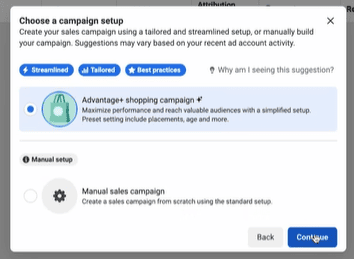
For e-commerce brands, ASC is the default growth engine. It automates up to 150 creative combinations and handles all audience targeting. You essentially hand Meta your catalog, your creative assets, and your budget. The Meta’s AI decides who sees what.
Advantage+ Lead Campaigns
Service businesses and B2B players aren't left out. Advantage+ Lead campaigns use similar machine learning to find users most likely to fill out a form or initiate a chat.
In both cases, the system prioritizes "likely to convert" over "matches this interest profile." This is why fastest growing DTC brands are leaning heavily into automation rather than micromanaging demographics.
Why The Algorithm Beats The Human
Why is broad targeting winning? Because Meta has more data points than you do.
You might assume your ideal customer is a 35-year-old woman interested in wellness. But Meta knows that user just spent three hours watching cat videos and has never clicked a "Shop Now" button in her life. Meanwhile, a 55-year-old man who loves woodworking just browsed three of your competitor's sites.
The algorithm analyzes millions of signals in real-time:
- Scroll speed
- Video watch time
- Click behavior
- Time of day
- Historical purchase data
- Device usage
No human media buyer can compete with that processing power. When you restrict targeting, you are essentially telling a supercomputer, "I know better than you." In 2026, you almost certainly do not.
The Critical Role of Data Quality
If we accept that the algorithm is the gun and broad targeting is the strategy, then data is the ammunition.
This is where most DTC startups fail. They switch to broad targeting but continue using basic, client-side tracking pixels.
Here is the problem. Privacy changes (like iOS updates) and browser restrictions (like Safari's 7-day cookie cap) have blinded the pixel. It can’t see what happens after the click. If Meta sends you 100 visitors and 10 buy, but your pixel only reports 4 purchases due to signal loss, the algorithm thinks it did a bad job. It will stop targeting those high-value people.
To make broad targeting work, you need ecommerce conversion tracking that is bulletproof. You need to capture 100% of your data and feed it back to Meta.
Enter Server Side Tracking
This is why server side tracking Shopify is the most searched technical requirement for CMOs this year. Server-side tracking moves the data collection from the user's browser (which is unreliable) to your server (which you control).
By implementing shopify server side tracking, you create a direct link between your store and Meta’s Conversions API (CAPI). This ensures that every purchase, add-to-cart, and view is recorded and attributed, regardless of ad blockers or browser cookies.
Moving Beyond Pixels (The Solution)
Setting up a server-side infrastructure is technically difficult. It used to require cloud engineers and months of maintenance. Aimerce is a first-party data platform designed specifically for Shopify brands. Here’s why it’s important:
1. The Durable ID
Aimerce utilizes a "Durable ID" technology. While standard browser cookies expire in 7 days (or 24 hours in some cases), the Aimerce pixel tracks users for up to one year. This means if a customer clicks an ad today but buys three months later, Aimerce captures that attribution.
2. Tracking Pixel Audits
Many brands don't even know their data is broken. Aimerce allows for comprehensive tracking pixel audits or auditing tracking pixels. You can immediately see the discrepancy between Shopify orders and what Meta is reporting.
3. Bot Filtering
One of the silent killers of ad spend is bot traffic. Bots click ads but never buy. If your pixel fires on bot traffic, you train Meta to find more bots. Aimerce includes advanced bot filtering capabilities. It identifies non-human traffic and stops those signals from being sent to Meta. This purifies your data stream, ensuring the algorithm only optimizes for real humans.
Yiqi Wu, the founder of Aimerce, has noted that brands switching to this infrastructure often see a 20% to 30% lift in addressable audience size. This isn't magic. It is simply capturing the data that was already there but being lost.
Best Practices for 2026 (Balancing Control and Automation)
So, if you are using Aimerce for tracking and attribution, and you are using broad targeting, what is left for you to do?
1. Creative is the New Targeting
Since you cannot select "Dog Owners" as an interest effectively anymore, you must select them with your creative.
If you sell dog food, your ad creative must explicitly show a dog eating. The algorithm will analyze the image and the text. It will serve it to people who engage with dog content.
Innovation in creative is key. Tools like an AI scene generator or AI generated scene software can help you produce high volumes of visual assets to test different angles.
2. Feed High-Value Signals
Don't just optimize for "Purchase." Optimize for "High Value Purchase." Use Aimerce to send value-based signals. Tell Meta to find people who spend over $100.
3. Use Value Rules
As mentioned in industry discussions, you can use "Value Rules" in Meta. This allows you to bid more for specific segments (like existing customers vs. new customers) without restricting the audience.
4. Audit Regularly
Use Aimerce to constantly check your Event Match Quality (EMQ). If your EMQ drops, your targeting suffers. Regular tracking pixel audits are essential hygiene for most popular dtc brands.
Why Server Side Tracking is Your Necessary Partner
The era of the "media buying hack" is over. You cannot outsmart the machine with a clever interest stack.
The competitive advantage in 2026 is data infrastructure.
Aimerce provides the server side tagging shopify solution that turns the lights back on. By identifying returning users, blocking bots, and extending attribution windows, Aimerce gives Meta the confidence to bid aggressively on your behalf.
Whether you are a scrappy startup or selling a luxury toy x, the math is the same. Better data equals better targeting.
For the ambitious aimer of high growth, relying on default Shopify pixels is financial suicide. You need a dedicated shopify server side tagging solution.
Is Meta ads targeting needed in 2026?
Stop targeting manually. Start targeting with data.
How? By feeding 100% high quality accurate data with Aimerce.
If you're ready to stop guessing and start growing, it's time to get your data right. Aimerce helps NYC ecommerce stores and global brands close the data gap and scale up.
30-Day Aimerce Pixel Free Trial