For years, digital advertisers have faced a frustrating limitation. You spend hours crafting a perfect narrative, a series of ads designed to introduce a cold prospect to your brand, educate them on your product, and finally ask for the sale. You launch the campaign, and then… you surrender control.
Meta’s algorithm takes over, showing your "Step 3" testimonial ad to someone who has never heard of you, or hammering your loyal customers with a "Hello, we are X" introductory video. It’s like trying to tell a joke but delivering the punchline before the setup. It’s inefficient and wastes money.
But that is changing. With the rollout of Meta Ad Sequencing for Auction buying types, advertisers finally have the power to curate the customer journey. You can now dictate the exact order in which people see your ads.
Here is everything you need to know about this game-changing feature, how to set it up, and why accurate attribution tracking is the secret to making it work.
What is Meta Ad Sequencing?
Ad sequencing allows you to serve a series of ads to a targeted audience in a specific order. If you have three ads: Ad A, Ad B, and Ad C. You can ensure that a user must see Ad A before they are eligible to see Ad B, and so on. This sequencing is fantastic for storytelling.
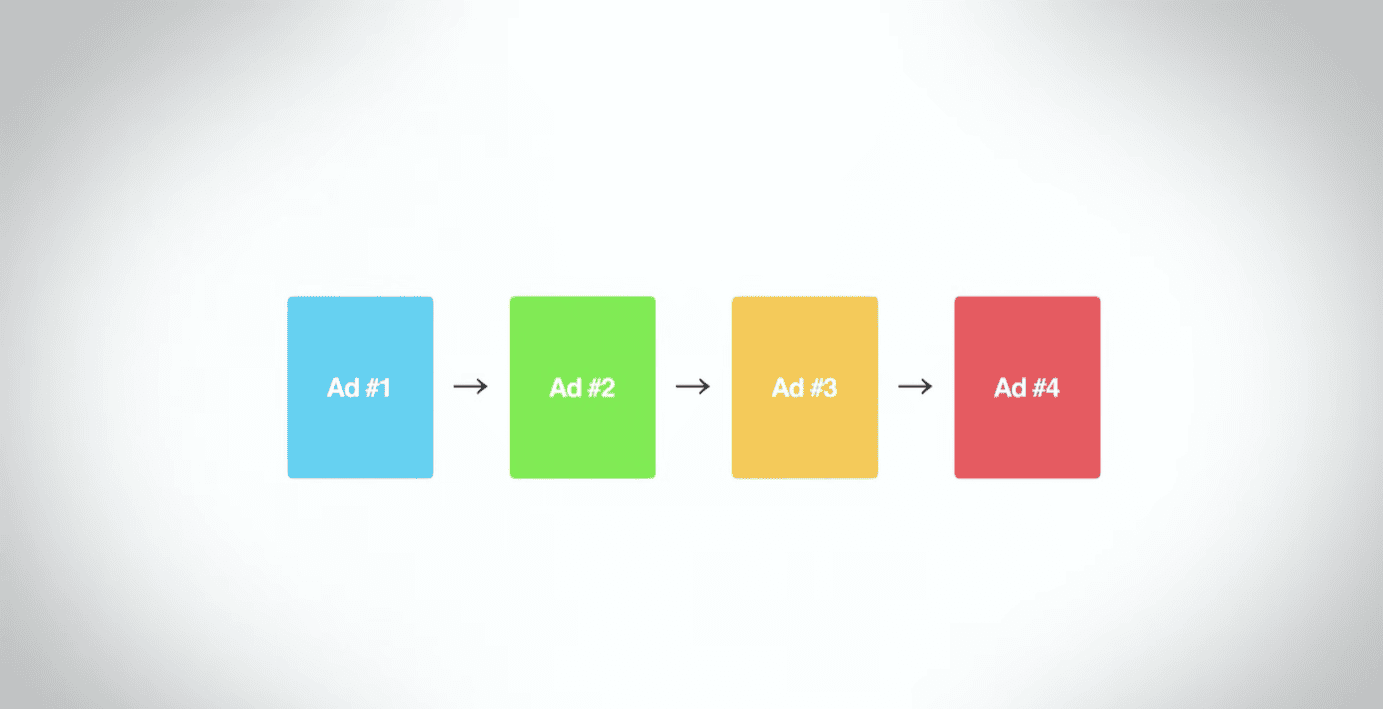
Previously, this feature was locked behind the "Reservation" buying type. This meant it was largely restricted to massive enterprises with huge budgets, the kind of companies that have HR departments (and we all know how efficient those can be). For the vast majority of DTC startups and growth marketers, this powerful tool was out of reach.
Now, Meta is rolling this feature out to the Auction buying type. This democratizes the ability to tell stories over time, making it accessible for fastest growing DTC brands and small businesses alike.
Build an Omnipresent Content Funnel as a Strategy
Why does order matter? Because trust takes time.
If you are selling high-ticket items or expertise-based services, direct selling often fails with cold audiences. You can’t propose marriage on the first date. Ad sequencing is the perfect vehicle for an "Omnipresent Content Strategy", a method of staying top-of-mind by providing value before asking for money.
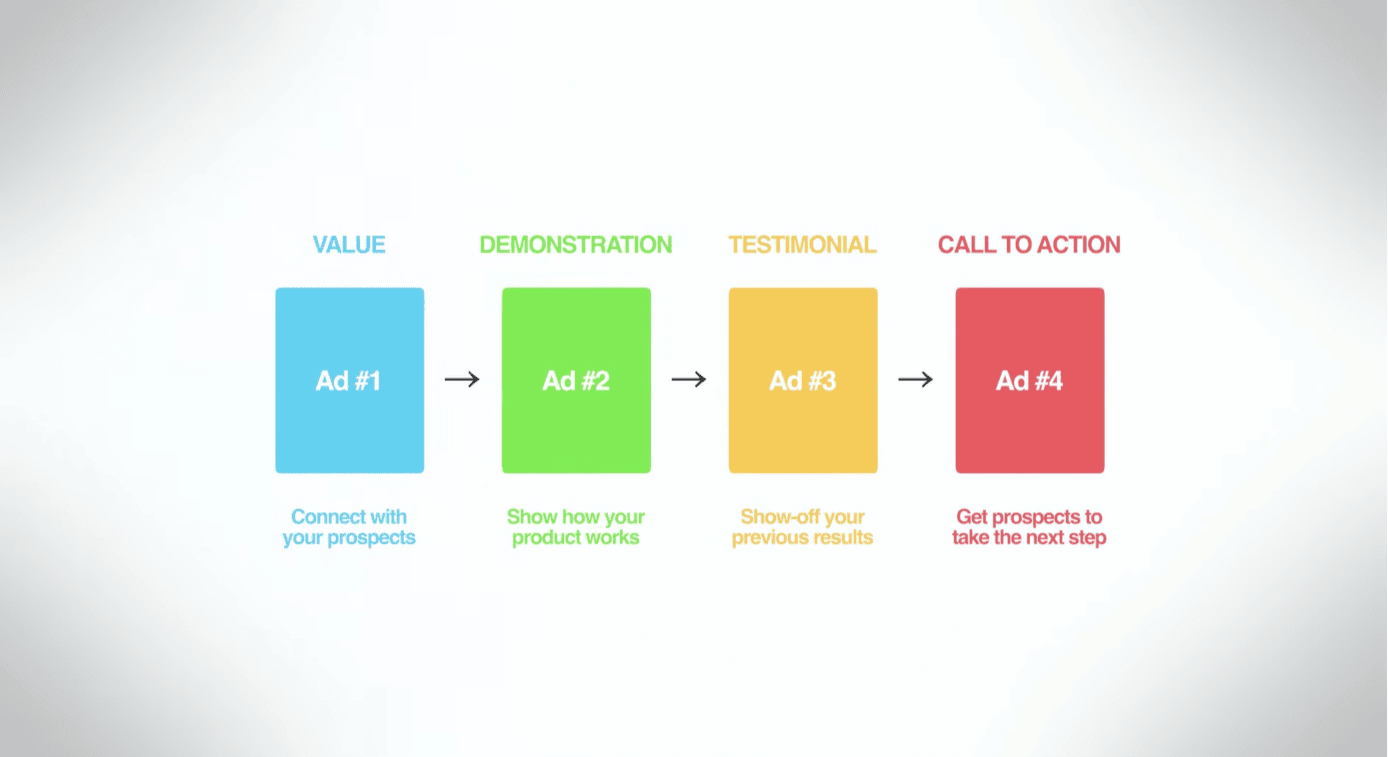
With sequencing, you can structure your campaigns into four distinct buckets:
- Value Ads: Deliver pure utility or entertainment without sales pitch.
- Demonstration Ads: Show how your product solves a specific problem.
- Testimonial Ads: Provide social proof from happy customers.
- Call to Action (CTA) Ads: Ask for the sale or lead.
By guiding a prospect through this sequence, you aren't just buying impressions; you are engineering a relationship.
Other Powerful Use Cases
- Laddering Discounts: Show a 10% off ad first. If they don't convert, show a 15% off ad next. The keenest buyers convert early at a higher margin, while hesitant buyers get the extra nudge they need.
- Event Launches: Create a countdown sequence that reveals speaker lineups or hype videos in the days leading up to a webinar or product drop.
Requirements on How to Set Up Ad Sequencing
This feature is powerful, but it comes with a strict set of rules. If you don't see the "Ad Sequencing" option in your ad set, you likely haven't met one of these criteria:
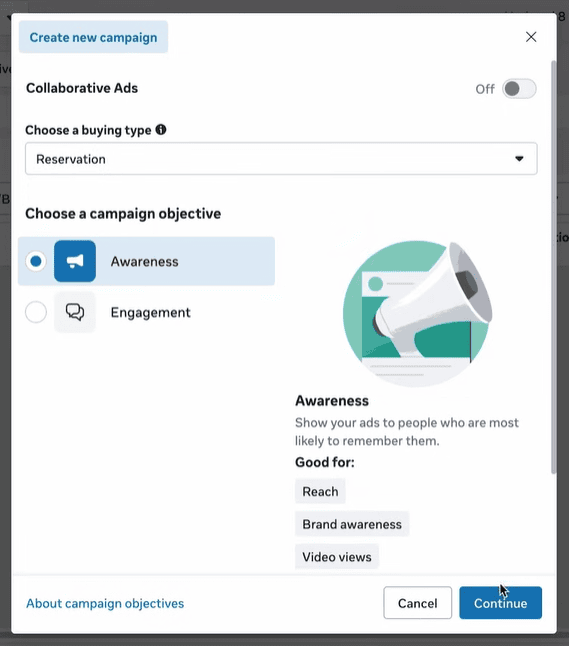
1. The Right Objective
You must use either the Awareness or Engagement campaign objectives. Currently, this feature is not available for Sales or Leads objectives directly, though you can still drive conversions by building trust through engagement first.
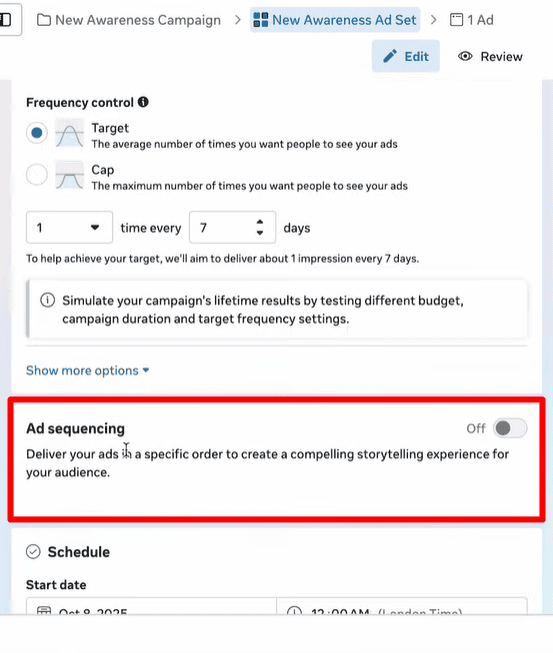
2. Select Lifetime Budgets Only
This is the biggest shift for many advertisers who prefer daily budgets. To use sequencing, you must select a Lifetime Budget at the ad set level. This allows Meta to allocate spend fluidly to ensure the sequence is completed for as many people as possible.
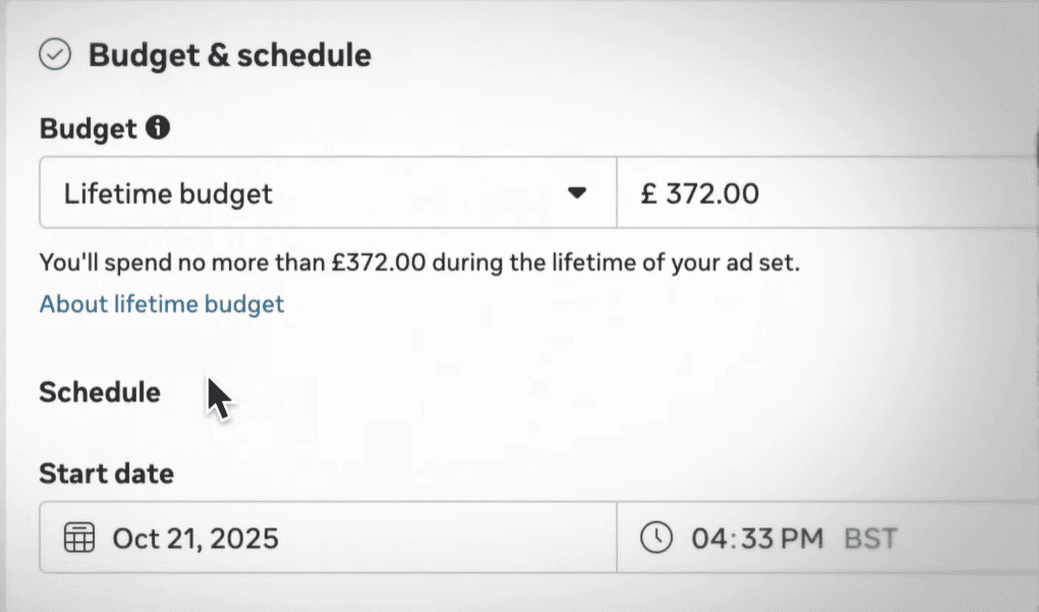
3. Choose Target Frequency
You cannot use standard delivery optimization. You must select Target Frequency as your frequency control (e.g., aiming for 1 impression every 7 days). This ensures users aren't bombarded with your entire sequence in a single afternoon.
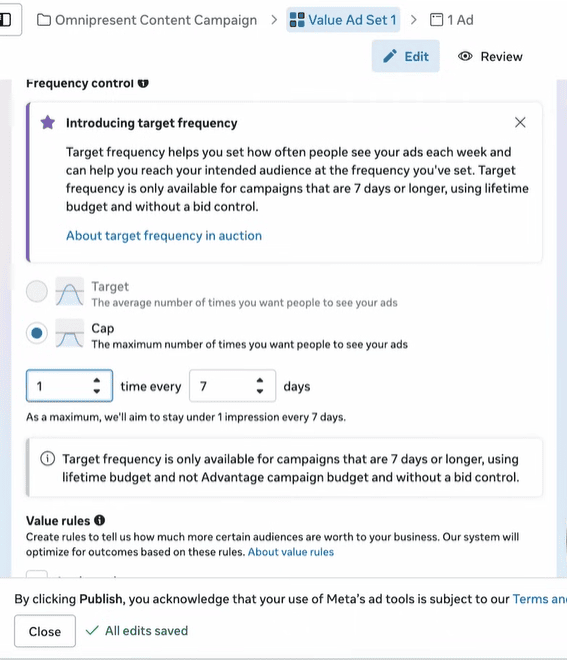
4. Set Duration
Your campaign must be scheduled to run for at least 7 days.
5. The "Publish First" Quirk
Here is the tricky part that trips people up: You often cannot enable sequencing while creating the campaign from scratch. You typically need to build your campaign with at least two ads, publish it, and then go back into the ad set settings to toggle on "Ad Sequencing" and arrange your creative order. Typically with this type of campaign, you might want to refresh your ad creative every 3-6 months to avoid ad fatigue.
Tracking and Attribution are the Invisible Foundation
Running a sophisticated ad sequence is useless if you don't know who is converting. As you move from simple direct-response ads to complex storytelling journeys, accurate data becomes the lifeblood of your strategy.
For top DTC companies and list of direct-to-consumer brands operating on platforms like Shopify, relying on browser-based pixels is no longer enough. Ad blockers, iOS updates, and privacy regulations have created massive data gaps. If a user sees Ad A and Ad B, but converts after Ad C, a standard pixel might miss the touchpoints, leaving you thinking the sequence failed.
This is where advanced tracking solutions like Aimerce come into play.
Server-Side Tracking for Shopify
To get a true picture of your sequence's performance, you need to implement shopify server side tracking. Unlike client-side pixels, server-side tagging Shopify moves data collection from the user's browser to the server. This bypasses ad blockers and ensures that every e-commerce conversion tracking event is captured accurately.
Tools like Aimerce specialize in this for tech for direct-to-consumer brands. By utilizing server-side tracking Shopify, you ensure that Meta receives high-quality data, which helps the algorithm understand exactly who is moving through your sequence and converting.
Auditing Your Data Health
Before launching a complex sequence, perform tracking pixel audits. Are your events firing correctly? Are you capturing the offline conversions API data?
High-growth aimers (ambitious marketers) know that data hygiene is critical. You should look for solutions that offer bot filtering to ensure you aren't paying to sequence ads to non-human traffic. Whether you are using Klaviyo conversion tracking for email or Meta for ads, ensuring your ecommerce events match up across platforms is vital.
If you aren't sure how to implement server-side tracking, looking into a dedicated solution like Aimerce can save you from technical headaches and wasted ad spend.
Creative Is The Fuel for Your Sequence
The technical setup is only half the battle. Your creative needs to be compelling enough to keep people watching.
Since you are telling a story, visual consistency is key. You might use an AI scene generator or AI-generated scene tools to create a consistent visual background across your Value, Demo, and CTA ads. This visual thread helps the user subconsciously recognize that these ads are part of a connected narrative, not just random noise.
Take Control of the Auction
Meta’s new ad sequencing feature is a significant step forward for advertisers who value brand building as much as immediate conversion. It bridges the gap between the "spray and pray" approach of standard auction buying and the strategic precision of reservation buying.
However, complexity requires clarity. If you are going to invest in creating multi-stage ad journeys, you must invest in the infrastructure to measure them. From tracking and attribution to tracking pixel audits, the boring backend work is what makes the exciting frontend strategy profitable.
For the most popular DTC brands looking to scale, the combination of strategic storytelling and robust server side tracking shopify is the competitive advantage needed in 2024.
Don't just run ads. Tell a story. And make sure you have the data to prove it has a happy ending.
Here to help you win! ✌️
Yiqi Wu
30-Day Aimerce Pixel Free Trial