
Meta's targeting has gotten genuinely good. I will give it that.
You set broad targeting, let the algorithm loose, and most of the time it finds buyers better than any manual audience you could build. The days of obsessing over interest stacks and lookalike exclusions are mostly behind us and that is a good thing.
But there is a real gap in what Meta can see. And most advertisers are not doing anything about it.
The problem with broad targeting is not the targeting. It is the context.
Meta optimizes within its attribution window. Seven days at most, often less. That means it learns who converts based on who purchased in the week after seeing your ad. Useful signal. But incomplete picture.
What Meta cannot see is what happens after that window closes.
It does not know that your London customers have a 40 percent higher repeat purchase rate than everywhere else. It does not know that customers over 45 have half the refund rate of customers under 30. It does not know that women buying your product for themselves are worth three times the lifetime revenue of men buying it as a gift. It does not know your lead-to-customer conversion rate varies significantly by device or placement.
You know all of this. It is sitting in your CRM right now. Meta has no idea.
This is exactly what Value Rules was built for.
Value Rules is a feature inside Meta Ads Manager that lets you increase or decrease your bid for specific segments within your broad audience. Not separate ad sets or manual targeting restrictions. You keep the open targeting that lets Meta's algorithm do what it does well, and you layer on top of it the business intelligence that you have and Meta does not.
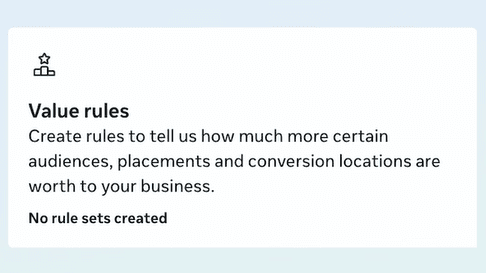 A Men’s Watch brand I have seen this work for had a specific problem. Running broad targeting meant Meta served a significant portion of ads to women which they were converted. Meta saw the conversions. Meta thought it was doing great. But these women are mainly buying men’s watch as a gift and they almost never came back. The lifetime value was a fraction of male customers buying for themselves. Meta had no way of knowing that within a seven-day window.
Value Rules let them say to Meta, keep targeting broadly, but bid 80 percent more aggressively for men because we know from our own data that they are worth significantly more to the business over time.
The criteria you can use are more flexible than most people realize.
Age and gender are the obvious ones. But you can also set rules based on location, device type, iOS versus Android, conversion location, and placement. Each of these can be a meaningful signal if you have done the work to understand your customer data.
Some examples worth thinking about for your own store.
If customers who convert on desktop have a materially lower refund rate than mobile, you can bid more aggressively for desktop conversions. If customers in certain cities have higher repeat purchase rates, you can increase bids for those locations. If leads generated through your website convert to paying customers at twice the rate of leads from instant forms, you can tell Meta that website leads are worth more. You can have up to ten rules running simultaneously.
The work is in sitting down with your CRM and your order data and actually figuring out which segments of your customer base are worth more than others. Most brands have this data and have never looked at it through this lens.
One thing that will make your Value Rules wrong before you even set them up is…
If your purchase tracking is incomplete, your LTV calculations are based on a partial picture of your customer base.
If ad blockers and iOS restrictions are causing your browser pixel to miss 30 to 40 percent of purchase events, the customer profile data feeding your CRM analysis is skewed. You might think women convert at a certain rate and have a certain LTV. But if a disproportionate share of the missing conversions came from female customers on iPhones with ad blockers, your actual LTV for that segment is higher than your data shows. Your Value Rules bid multiplier is calibrated to incomplete information.
This is the part nobody talks about when they explain Value Rules. The bid percentages you set are only as accurate as the customer data behind them. And most Shopify brands are working with customer data that has meaningful gaps in it because their ecommerce conversion tracking is browser-dependent.
Aimerce fixes this at the source. Purchase events captured from Shopify's backend via Webhooks after order confirmation reach Meta regardless of browser behavior, ad blockers, or iOS restrictions. Your customer data in Shopify is complete. Your CRM analysis is based on the full picture. Your Value Rules bid multipliers reflect your actual customer economics rather than a version of them with a systematic blind spot.
Meta is good at finding buyers
But YOU are better at knowing which buyers are actually valuable.
Value Rules is the feature that lets you combine both while Meta keeps the flexibility to find the best prospects across a broad audience. You provide the business context about which segments of that audience are worth more based on data that sits beyond Meta's attribution window.
Set it up once, get your bid multipliers right, and you are giving Meta information about your business that it otherwise has no way of accessing. Actually, that is a really a huge advantage for you that most advertisers in your category are not using.

Try Aimerce Pixel Risk-Free
for 30 Days
Most teams see results within 2 weeks.
Money-back guarantee.
It pays for itself, or you don't pay anything.
30-Day Aimerce Pixel Free Trial