Shopify quietly launched a free scanner back in April of 2026.
It's a free tool at shopify.com/agentic-readiness.
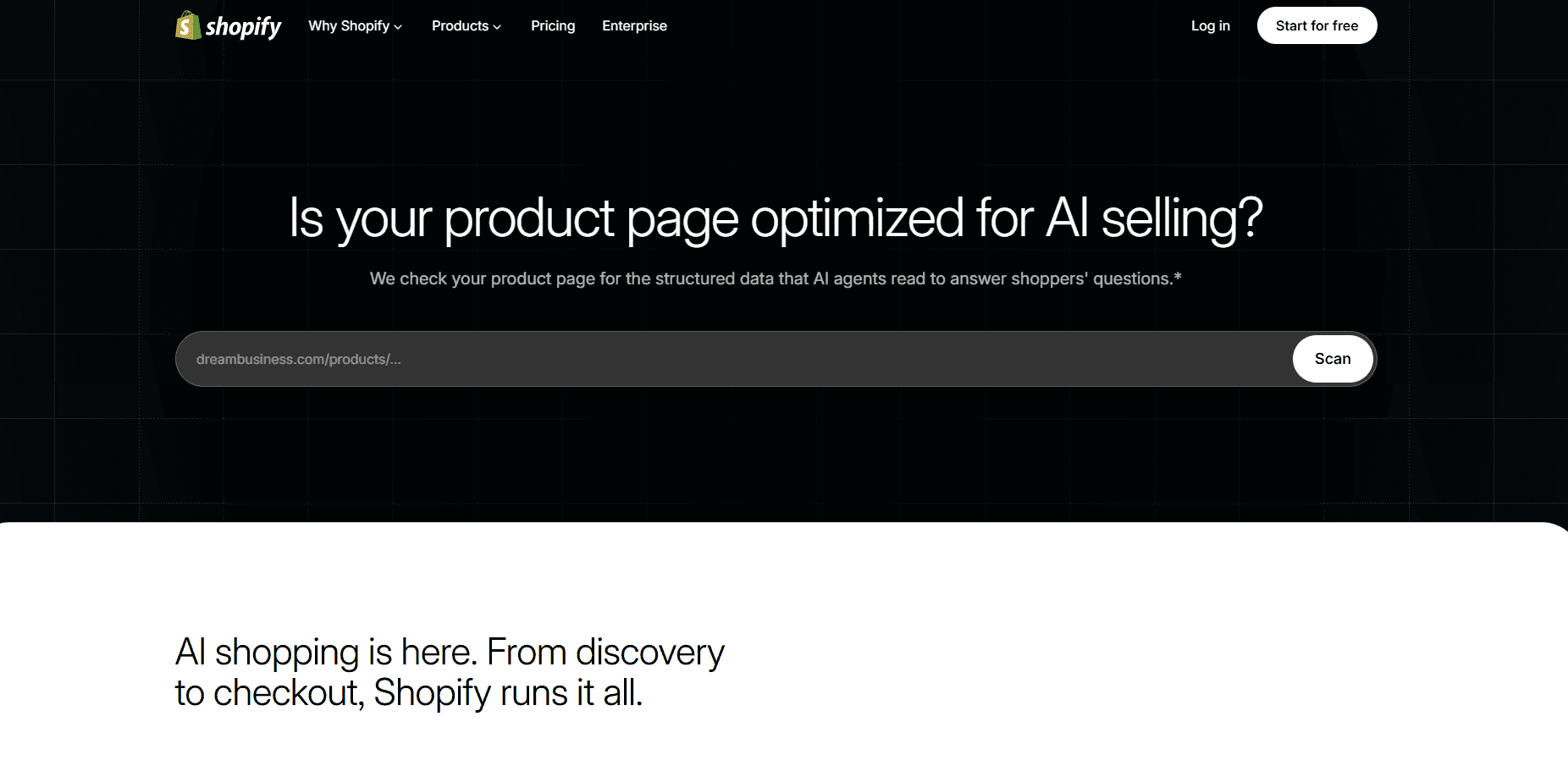
You paste your store URL. It runs 31 checks across 5 categories which are AI discoverability, product schema, transaction readiness, trust signals, and operational maturity. The output is a scored breakdown of how visible your store is to AI shopping agents like ChatGPT and Microsoft Copilot.
I ran it across a bunch of stores and the same 3 issues showed up almost every single time. Let’s get into it.
1. Missing llms.txt
The problem is most people have never heard of this file.
llms.txt was proposed by Jeremy Howard (of fast.ai) in September 2024. The idea is simple, HTML pages are a mess for AI agents to parse. Navigation menus, ads, JavaScript, pop-ups. So when an AI agent tries to understand your store by crawling your HTML it gets a noisy with incomplete picture.
llms.txt is a plain markdown file that sits at yourstore.com/llms.txt. It gives AI agents a direct, clean brief of what you sell, who your customers are, how your catalog is structured, what your policies are. Think of it as the AI-readable version of your store's "about page" combined with a catalog index.
Without it, AI agents your store’s readability and accuracy in their responses may suffer. With it, you are giving them exactly what they need to represent your store accurately.
Directories tracking llms.txt files show a growing list of ecommerce stores adding them. Several Shopify-specific apps and scripts now generate it automatically from your catalog but the majority of Shopify stores still don't have one. Shopify's scanner flags this consistently.
2. Incomplete product schema
Most Shopify themes include basic JSON-LD product schema but BASIC is not enough.
AI agents don't read your product descriptions the way a human does. Instead, they parse your JSON-LD markup directly to understand product details like name, price, availability, brand, ratings, description, SKU. If a field is missing from your schema, the agent either doesn't know that information or skips the product entirely.
The most commonly missing fields I see when auditing Shopify product schema are:
- aggregateRating - It is your average review score and number of reviews. AI agents use this to assess whether a product is trusted before recommending it.
- brand - straightforward but often missing. Particularly matters when someone asks an AI "what are good [brand name] alternatives."
- availability - whether the product is currently in stock, an AI agent will not recommend an out-of-stock product. If availability is not in your schema, it may not know.
- description in schema - a lot of themes put the product description in the page HTML but not in the JSON-LD itself. Although the human sees it. The AI agent doesn't.
3. Thin policy pages
This one catches people off guard.
Before recommending a store, AI agents check your return policy, shipping policy, and privacy policy. Why? Because an AI agent recommending your store to a buyer is effectively vouching for the purchase experience. A one-sentence return policy or a generic placeholder privacy policy reads as a trust signal failure.
Your policy pages need to be specific. Not "we accept returns on a case by case basis" but how many days, what condition, who pays return shipping, does it cover sale items, how long does a refund take to process. Not just "we ship via standard carriers" but processing time, carrier names, estimated delivery windows, what happens with lost packages, which regions you ship to.
AI agents are reading these pages to decide whether to send their users to you. Thin pages mean no recommendation.
Note: That the scanner tool does NOT fix anything.
What this tool does not tell you is…
Shopify scanner only checks technical surface signals. There are four things that also affect AI visibility but are not measured by the scanner:
- your Google Merchant Center feed quality
- backlinks/content authority
- review volume
- and, whether AI crawlers can reach your store.
Just benchmark numbers I found from eCommerce Fastlane, giving you a sense of what different score ranges mean in practice:
| 50 | ahead of most |
|---|---|
| 65–80 | mid-market competitive |
| 80+ | target for larger stores (representing a well-optimized Agent ready site) |
Basically a good score doesn't tell the whole story.
Shopify's agentic readiness scanner shows you what is broken and ranks it by priority. The fixing is still on you. Most brands have no idea how far behind they are on AI readiness because they have never had a way to see it.
Run it on your store. reply to this email with your score. I want to know what you find.
shopify.com/agentic-readiness
Cheers,
Yiqi

Try Aimerce Pixel Risk-Free
for 30 Days
Most teams see results within 2 weeks.
Money-back guarantee.
It pays for itself, or you don't pay anything.
30-Day Aimerce Pixel Free Trial