
Meta has re-launched native in-app checkout on Facebook, this time powered by Stripe. Buyers can now tap "Buy Now" on a Facebook ad and complete a purchase in one click using their saved Meta wallet credentials, without ever leaving the app. Instagram is next. For Shopify DTC brands, this is one of the most significant shifts in how commerce happens on Meta since the introduction of the Conversions API.
The infrastructure behind it is meaningful, the direction is clear, and the brands that understand it early will be better positioned than those who wait.
What Is Stripe's Facebook Checkout?
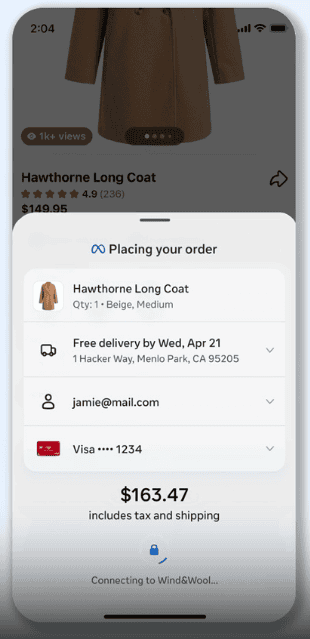 Image via: Stripe
Stripe has partnered with Meta to power a native checkout experience inside Facebook ads. Here is how it works:
- A shopper sees your ad on Facebook and taps "Buy Now"
- Meta surfaces a native checkout screen powered by Stripe
- The buyer pays using credentials saved in their Meta wallet
- The purchase completes inside the app, no redirect to your website required
Businesses opt in via a toggle in the Stripe Dashboard and link their Meta Ads account. The feature is live now with brands like Fanatics and Quince. Instagram ads are the next surface.
The underlying infrastructure is called the Agentic Commerce Protocol, a purchasing framework designed for AI-powered commerce environments where transactions can complete across feeds, agents, and platforms without requiring a brand's website to be part of the journey.
Why This Attempt Is Different From Meta's Last One
As I posted on Linkedin, Meta tried to build a native checkout before and it failed.
The key difference Meta is not trying to own the transaction layer this time. Stripe owns payments. Shopify or your backend owns the catalog and order infrastructure. Meta owns the discovery and ad surface. Each party does what it is actually good at.
The Shopify Checkout API integration into Meta's Universal Checkout Platform (UCP) is the detail most brands are missing. Historically, syncing product catalogs between Shopify and Meta required duplicate pipelines and constant reconciliation. By reading directly from Shopify's native infrastructure, that problem is solved at the architecture level.
What This Means for Shopify DTC Brands Right Now
Reducing friction between ad and purchase has always improved conversion rates. One-click checkout inside the app eliminates the redirect, the page load, the form fill, and the payment entry that cause drop-off between ad click and completed purchase. For brands with strong creative and clear offers, that friction reduction has meaningful potential.
The questions is,
Can your current setup support it? Enabling the feature requires a Stripe account connected to your Meta Ads account via the Stripe Dashboard. For Shopify brands not currently processing through Stripe, that adds an integration step. For brands already on Stripe, the opt-in is a toggle.
How to Position Your Brand to Win Early
1. Understand the catalog requirements
The integration reads from Shopify's catalog infrastructure. Your product catalog in Shopify needs to be clean, complete, and accurately synced to Meta for the checkout experience to work correctly. Audit your catalog now, product titles, descriptions, images, pricing, and inventory all need to be accurate on both sides.
2. Evaluate your Stripe setup
If you are already processing payments through Stripe, enabling this feature is a dashboard toggle once Meta makes it available for your account. If you are not on Stripe, evaluate whether the potential conversion lift from one-click checkout justifies adding it to your payment stack alongside your existing processor.
3. Think about your offer structure
One-click checkout works best for simple, single-product offers with clear pricing. Subscription products, bundles with complex configuration, or products that require size or variant selection add friction back into the in-app flow. Start with your highest-converting single-SKU products.
4. Get your tracking infrastructure ready

Try Aimerce Pixel Risk-Free
for 30 Days
Most teams see results within 2 weeks.
Money-back guarantee.
It pays for itself, or you don't pay anything.
This is where the preparation work matters most right now. When a purchase completes inside Facebook without touching your Shopify storefront, your browser pixel does not fire. Your attribution data depends entirely on:
- Backend order webhook capture from Shopify's order infrastructure
- Meta Click ID stored at the point of ad interaction for offline matching
- Hashed customer email for Enhanced Matching via Meta Conversions API
Server-side tracking built on Shopify's order webhooks is the architecture that captures these purchases reliably regardless of where the checkout completes. This is not a problem to solve after adoption scales. It is the infrastructure to have in place before you opt in.
5. Watch the data before scaling spend
Once live, run the feature on a small portion of your ad budget before committing significant spend. Monitor:
- Conversion rate: does one-click checkout increase or decrease completed purchases compared to your standard flow?
- Average order value: does the simplified checkout change what customers buy?
- Return rate: does the reduced friction attract a different buyer profile?
- Attribution consistency: are orders appearing in both Meta Ads Manager and Shopify correctly?
Give it at least two to three weeks and sufficient volume before drawing conclusions.
Where Meta Commerce Is Heading
This announcement is one piece of a larger shift. Meta is rebuilding its commerce infrastructure on third-party rails that scale, Stripe for payments, Shopify for catalog and order management, and the Agentic Commerce Protocol for AI-powered purchasing environments.
The practical implication for DTC brands is the brands that are well-integrated with Shopify's native infrastructure and have clean first-party data pipelines will have the easiest path to participating in whatever Meta commerce surfaces come next. The brands running fragile browser-based tracking stacks will face an expanding blind spot as more purchases complete in environments their pixels were never designed to reach.
This is not a warning but a structural observation about where the advantage lies as the environment changes.
What to Do This Week
| Action | Why It Matters Now |
|---|---|
| Audit your Shopify product catalog accuracy | Required for clean catalog sync with Meta's UCP |
| Check whether you are on Stripe or can add it | Prerequisite for opting into the feature |
| Identify your top single-SKU conversion products | Best candidates for the one-click checkout test |
| Confirm your server-side tracking captures Shopify order webhooks | Ensures purchases complete outside the storefront are still tracked |
| Verify Meta Click IDs are being stored at ad interaction | Required for offline conversion matching if CAPI does not auto-capture |
Frequently Asked Questions
What is Stripe's new Facebook checkout feature? Stripe has partnered with Meta to power a native one-click checkout inside Facebook ads. When a buyer taps "Buy Now" on a Facebook ad, Meta surfaces a checkout screen powered by Stripe using the buyer's saved Meta wallet credentials. The purchase completes inside the app without requiring the buyer to visit the brand's website. Businesses opt in via the Stripe Dashboard.
How do Shopify brands enable Stripe's Facebook checkout? Shopify brands need an active Stripe account connected to their Meta Ads account. Once Meta makes the feature available for your account, you opt in via a toggle in the Stripe Dashboard. The integration uses Shopify's Checkout API to sync catalog and order infrastructure, which means your Shopify product catalog needs to be accurate and complete before enabling the feature.
How does Stripe's Facebook checkout affect attribution tracking for Shopify brands? When a purchase completes inside Facebook without the customer visiting your Shopify storefront, your browser pixel never fires. Attribution for these purchases depends on backend order webhook capture from Shopify, stored Meta Click IDs from the original ad interaction, and hashed email Enhanced Matching via Meta Conversions API. Server-side tracking built on Shopify's order webhooks is the most reliable infrastructure for capturing these conversions.
Is Stripe's Facebook checkout available for all Shopify brands right now? The feature is live in early access with select brands including Fanatics and Quince. Broader availability is rolling out through 2025. Instagram ads are the next announced surface. Check your Stripe Dashboard and Meta Ads account for access as the rollout expands.
What products work best with one-click Facebook checkout? Simple single-SKU products with clear pricing and no complex variant selection work best. Subscriptions, bundles, and products requiring significant configuration add friction back into the in-app flow. Start with your highest-converting single-product offers before testing more complex catalog items.
The Future of Facebook Ads Is Here, Are You Ready?
Stripe's Facebook checkout is early-stage infrastructure with meaningful potential. The friction reduction between ad and purchase is real. The Shopify Checkout API integration solves a catalog sync problem that has frustrated brands for years. And the broader direction, Meta building commerce on scalable third-party infrastructure rather than trying to own every layer, is a more durable bet than what came before.
The brands that prepare now, clean catalogs, Stripe integration, and tracking infrastructure built on backend order data rather than browser events, will be best positioned when this feature scales.
For Shopify brands running server-side tracking through Aimerce, the webhook-based architecture that captures purchases from Shopify's order backend is already in place. The tracking infrastructure question is answered. The remaining work is catalog hygiene, Stripe setup, and testing.
The window to wire in early is open. The brands that move now will have the data advantage when everyone else is scrambling to figure out attribution six months from now.
30-Day Aimerce Pixel Free Trial