You’ve crafted the perfect creative. You’ve nailed your copy. You’ve defined your audience. But do you know where your ad is actually showing up?
Not all Meta advertisers realize this, but the specific location or placement, or even where your ad appears on Facebook and Instagram can drastically change your results. Some placements generate high-quality sales, while others might drain your budget on accidental clicks.
If you are running a business, specifically among DTC startups or established fastest growing dtc brands, understanding placement strategy is non-negotiable. We’ll break down exactly when to trust Meta’s automation and when to take manual control to protect your ROI.
Understanding Facebook Ad Placements
Before we dive into strategy, we need to define what placements actually are. In the Meta ecosystem, a placement is simply the specific place your ad appears.
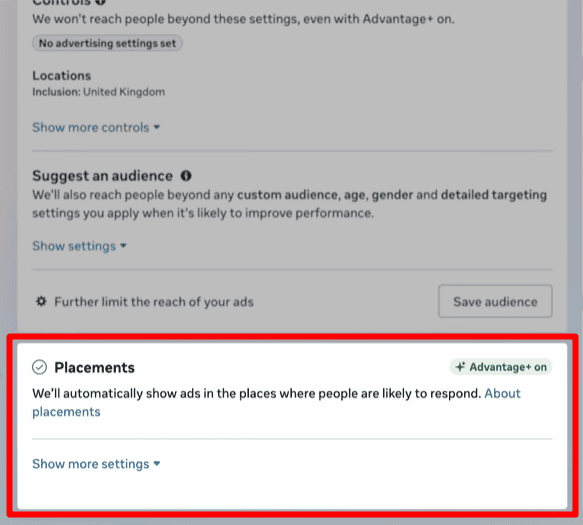
Placements are selected at the ad set level. While Meta pushes advertisers toward "Advantage+ placements" (formerly automatic placements), you have the power to click "Show more settings" and see exactly where your money is going.
Your ads can appear across five main platforms:
- Facebook: Feeds, Stories, Reels, Marketplace, Right Column.
- Instagram: Feeds, Stories, Reels, Explore.
- Audience Network: Third-party apps and websites that monetize via Facebook ads.
- Messenger: Sponsored messages in the inbox or stories.
- Threads: The newest addition to the inventory.
For most top dtc companies, Facebook and Instagram do the heavy lifting. However, understanding the nuance of the Audience Network is critical for ecommerce conversion tracking.
Ad Placement Selection at the Ad Set Level
When you open your ad set, you are faced with a choice: Advantage+ or Manual. Advantage+ gives Meta’s algorithm free rein to find the cheapest result based on your objective. Manual allows you to uncheck specific platforms or placements.
The decision you make here dictates the quality of traffic you receive. But making the right decision requires accurate data. Without robust attribution tracking like Aimerce, you might think a placement is performing well when it is actually driving low-quality traffic.
Placement Options
Not all impressions are created equal. An impression on a user’s Instagram Feed usually carries more weight than a banner ad at the bottom of a gaming app on the Audience Network.
1. Platform-Specific Placements
You can get granular. You might decide you want to be on Instagram Reels but not Facebook Reels. You might want the Facebook Feed but not the Right Column.
If you are a luxury toy x brand or selling high-end apparel, the visual fidelity of Feeds and Reels is paramount. Banners on third-party sites might dilute your brand equity.
2. The Hidden Risk of the Audience Network
The Audience Network is often cheaper. Why? Because there is less demand. The inventory is often lower quality, and it is prone to accidental clicks. If you are seeing suspicious traffic metrics, bot filtering becomes essential.
Tools like aimerce offer tracking pixel audits and bot filtering to ensure that the traffic you are paying for is genuine. If you are an aimer aiming for efficiency, you need to know if your budget is being wasted on bot traffic from obscure placements.
Analyzing Placement Performance
You shouldn't guess which placement works; you should look at the data.
1. Monitoring Results by Placement Option
In Ads Manager, use the "Breakdown" feature. Select "Placement" to see exactly which platform drove your results.
You might see that Facebook Feed is driving sales at a $25 CPA, while Audience Network is driving "clicks" at $0.50 but zero sales. This is a common scenario for many most popular dtc brands.
2. The Data Accuracy Problem
Here is the catch: Meta’s native reporting is modeled. Signal loss means Meta doesn't always know which placement actually drove the sale. This is why server side tracking shopify is critical.
By implementing Shopify server side tracking, you send accurate data back to Meta. This helps the algorithm understand that the sale came from the high-quality Instagram Feed view, not the cheap click elsewhere. If you want to join the list of direct to consumer brands that scale profitably, you need to fix your signal loss.
The Role of Campaign Objectives in Placement Strategy
The "Best" strategy depends entirely on what you are asking Meta to do. The algorithm is very literal.
1. Lead and Sales Campaigns
If you are running a Sales or Leads campaign and optimizing for a conversion event (like Purchase), you can generally trust Advantage+ placements.
Why? Because Meta is incentivized to get you that purchase. If the Audience Network isn't generating sales, the algorithm will stop spending money there. It will naturally gravitate toward Feeds and Stories.
However, this only works if your data is clean. If you haven't set up server side tagging shopify or the offline conversions api, Meta is flying blind. Aimerce ensures that your ecommerce events are tracked accurately, allowing the Advantage+ algorithm to do its job effectively.
2. Awareness, Traffic, and Engagement Campaigns
If you are optimizing for Link Clicks, Landing Page Views, or Reach, the game changes.
If you tell Meta, "Get me as many clicks as possible," it will find the cheapest clicks available. Often, those cheap clicks live on the Audience Network or in accidental click zones on mobile apps.
In these campaigns, you must use Manual Placements.
The Strategy:
- Select Manual Placements.
- Uncheck Audience Network.
- Uncheck Messenger (usually).
- Focus strictly on Feeds, Stories, and Reels on Facebook and Instagram.
This ensures your "Traffic" campaign actually brings potential customers, not bots. This is a strategy often taught by experts like Yiqi Wu to help grow NYC ecommerce brands.
Why Technical Setup Matters for Placements
You cannot out-strategize bad data. Whether you use Manual or Advantage+ placements, your success relies on the feedback loop between your website and Meta.
1. Server Side Tracking
Many brands ask how to implement server sided tracking. It sounds complex, but it is the backbone of modern advertising. Shopify server side tagging ensures that when a customer converts, that data is matched to the specific ad and placement that drove it.
2. Auditing Your Pixel
Regular auditing tracking pixels and tracking pixel audits are necessary to ensure no events are being duplicated or missed. Aimerce automates this, providing the best tech for direct to consumer brands.
So, Which Strategy Should You Use?
So, which strategy should you use?
- For Sales/Conversions: Use Advantage+ Placements, provided you have robust server side tracking shopify (like aimerce) installed to guide the algorithm.
- For Traffic/Awareness: Use Manual Placements and exclude the Audience Network to avoid low-quality traffic and bots.
The landscape of tracking and attribution is changing. Relying on default settings without the right technical infrastructure is a recipe for wasted spend. By combining smart placement strategies with shopify server side tracking and bot filtering, you can ensure every dollar spent drives real growth.
Are you ready to fix your data and optimize your placements? If so, It’s time to look into aime marketing solutions that give you the edge.
Here to help you win! ✌️
Yiqi Wu
30-Day Aimerce Pixel Free Trial