What Does Shopify's Data Show About AI-Referred Shoppers in 2026?
According to Shopify’s early data, AI-referred orders grew nearly 13x year-over-year in Q1 2026. Referral sessions from AI chatbots grew more than 8x over the same period. Organic search still refers more total sessions and same-store organic sessions actually grew ~5% in that window but AI is growing on top of that base, not instead of it.
When Shopify analyzed traffic and conversion data across its merchant base, three things kept showing up about shoppers arriving from ChatGPT, Perplexity, Gemini, Copilot, and similar tools. They convert at nearly 50% higher rates than visitors from organic search. They spend 14% more per order. And more than half of them land directly on a product page compared to just 20% for organic search visitors, who typically arrive on homepages and category pages still figuring out what they want.
So by the time an AI-referred shopper clicks through to your store, the research is already done. They know what they want. They just need somewhere to buy it.
Here’s what Shopify’s early data shows:
- AI-referred sessions convert at nearly 50% higher rates than sessions from organic search
- Average order values are 14% higher on orders attributed to AI-referred traffic
- More than half of AI-referred sessions start directly on a product detail page, compared to just 20% for organic search
These are behavioral data points measured across real storefronts, held consistently throughout Q1 2026 as AI session volume continued to grow.
Why Do Shoppers Coming From AI Platforms Convert Better Than Organic Search
The answer lies in what Shopify's analysts call journey compression.
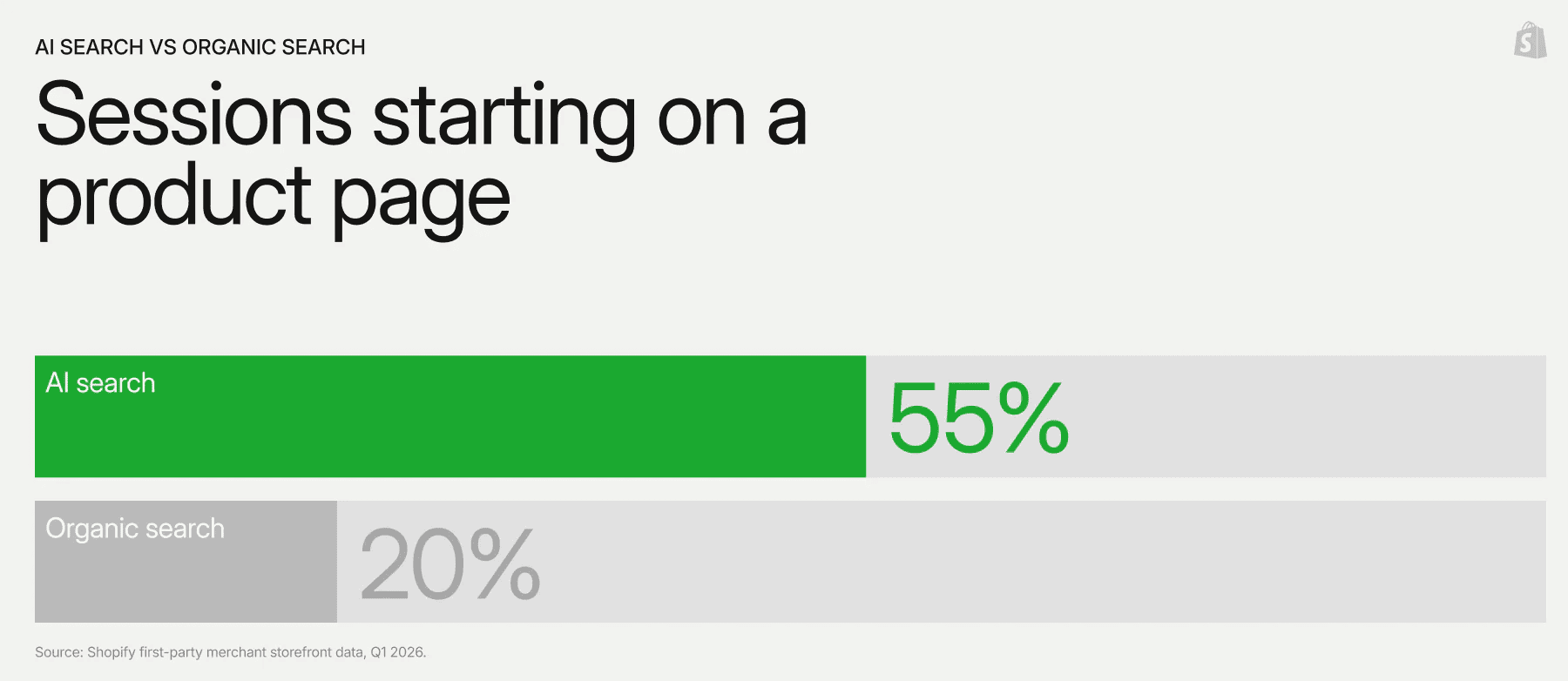 Image via Shopify
When a shopper uses ChatGPT or Perplexity to find a product, they're not really shopping by the time they land on your store. They already did the shopping. They just described what they needed, then the AI filtered through the options, and what got surfaced was the closest match to what they asked for. So, basically the decision was already made before they ever click through.
In a traditional Google search journey, a consumer might run three to five searches, visit eight to twelve pages across multiple sites, and return to buy in a completely separate session days later. Discovery and consideration are spread out. Most visits land on a homepage or a category page not the specific product someone wants.
That's why more than half of AI-referred sessions land directly on a product detail page, compared to about 20% for organic search. Google sends people to your homepage or category page to figure things out. AI sends them straight to the specific product they already decided they want.
Shopify's numbers back this up across the board. AI-referred sessions outperform organic search on conversion rate in 23 out of 25 product categories, by an average of 56% which is a fundamentally different type of visitor arriving at your store.
Is AI Commerce Just Another Channel Trend Or Is This Different?
You've actually seen this happen before, you just might not have connected the dots.
Remember when online shopping first took off? Stores didn't close overnight or people didn't suddenly stop walking into malls. What happened was that a new way of shopping appeared, and the brands that took it seriously early ended up way ahead of the ones that ignored it. Same thing happened with mobile. Same thing happened with social media.
Right now, most people still find products through Google but a growing number are starting their search in ChatGPT or Perplexity or Gemini instead. They will just describe what they need, the AI figures out what fits, and they click through ready to buy.
AI commerce is still early so there is still a huge opportunity for everyone in this space.
Why Isn't My Shopify Store Showing Up in ChatGPT or Gemini Recommendations?
AI agents don't browse your storefront the way a human does. They query structured data from product feeds and APIs, and they do it through the Universal Commerce Protocol (UCP), the open standard co-developed by Shopify and Google that lets AI agents discover, evaluate, and transact with merchants. If your catalog isn't structured for that query layer, you don't show up regardless of how good your products are.
If your catalog isn't structured for that query layer, you don't show up regardless of how good your products are.
The most common catalog problems that cause merchants to get skipped:
- Brand-only product titles - "The Sunday Tee" tells an AI agent nothing about fit, material, or use case. It cannot match your product to what someone searched for.
- Thin descriptions - missing attributes like material composition, sizing, use cases, or care instructions means the agent has nothing to evaluate.
- Internal tags - tags that make sense to your team often don't map to how shoppers actually describe what they're looking for.
Shopify's own guidance is explicit about this. "The quality and structure of what [AI agents] find is what determines whether they recommend you."
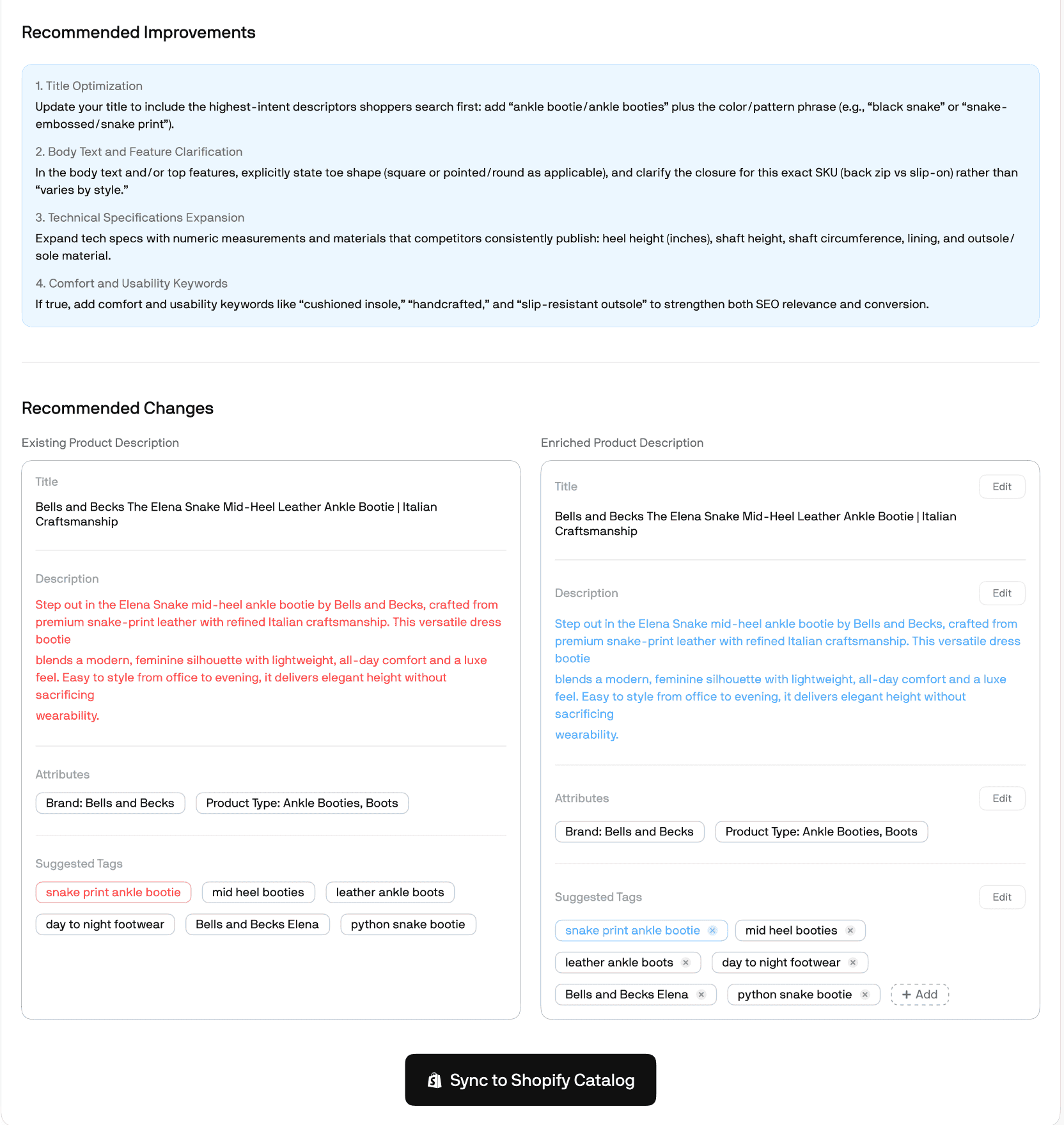
In order to approach this, you have to maintain two versions of your product data. Keep your display name as a separate metafield for your storefront and "The Sunday Tee" stays on your website. Use the Shopify product title for the descriptive, attribute-rich version that feeds into UCP: "Men's Relaxed Fit Organic Cotton Crew Neck T-Shirt, Weekend Wear, Pre-Washed." Same product, two representations optimized for two different audiences.
Aimerce server side tracking on Shopify has a built in Catalog AI Enrichment for this problem by auditing your catalog against UCP requirements, enriching product titles, descriptions, and attributes, and syncing the enriched catalog back to Shopify so AI agents can actually find and recommend your products.
How Should Shopify Merchants Prepare for Agentic Commerce Right Now?
Shopify's team identified five high-leverage actions for merchants who want to be positioned before agentic commerce reaches mainstream scale.
1. How Do I Track AI Referral Traffic Separately in Shopify Analytics?
Open any report in your Shopify Analytics dashboard and filter by AI answer engines under "Referrer Channel." Look for ChatGPT, Perplexity, Copilot, Claude, and others. For Gemini, filter "Referrer Host" for gemini.google.com.
Compare conversion rates, AOV, and revenue per session against your organic search channel. Even if volume is small, the per-session performance may already surprise you. Treating AI traffic as a rounding error within organic is the same mistake many merchants made with mobile right before mobile stopped being a rounding error. Shopify brands who identify these signals early can optimize their product data
2. How Do I Optimize My Shopify Product Pages So AI Agents Recommend Them?
Well-formed HTML, detailed product descriptions, and comprehensive attribute data aren't just good for human shoppers they're the primary signal AI agents use to evaluate and recommend your products.
Include key features, technical specs, popular use cases, and the context a shopper needs to feel confident buying without visiting a homepage or reading a full brand story. By default, Shopify uses server-side rendering, which means AI platforms read your content immediately without JavaScript rendering.
This is also where your catalog structure matters most. Products with thin descriptions, vague titles, or missing attributes are systematically skipped. Clean, rich, well-structured catalog data is the entry ticket to AI-mediated commerce.
3. How Do I Get My Brand Recommended by AI Search Engines Like Perplexity or ChatGPT?
Journey compression means shoppers using AI are doing more research before they ever reach your site but they're doing it inside an AI conversation, not on Google. AI systems determine which products to recommend based on signals from across the web such as reviews, editorial mentions, community discussions on Reddit, comparison content, and broader brand presence.
The goal is consistent, genuine mentions that give AI systems enough signal to treat you as an authoritative source in your category. The tactics vary by brand what matters is giving people a real reason to talk about you and making it easy for them to do so.
4. Does Optimizing for AI Search Mean I Should Stop Investing in Google SEO?
Organic search still drives more total sessions than all AI platforms combined. And here's the good news. SEO and AI discoverability aren't competing priorities. Many AI systems retrieve content from web search indexes when generating answers your search ranking is a direct input into whether AI recommends you.
Clean technical architecture, structured data markup (product schema, review schema), authoritative content, and strong brand presence serve both channels simultaneously. The fundamentals of good SEO are also the fundamentals that drive AI citation.
Common Questions About AI-Referred Traffic and Shopify Store Performance
How much better do AI-referred shoppers convert compared to organic search? According to Shopify's Q1 2026 data, AI-referred sessions convert at nearly 50% higher rates than organic search sessions. On product detail page sessions specifically, AI-referred conversion rates outperform organic SEO in 23 of 25 merchant categories by an average of 56%.
What is the Universal Commerce Protocol (UCP)? UCP is an open standard co-developed by Shopify and Google that enables AI agents to discover, interact with, and transact with merchants. When an AI agent shops on behalf of a user, it queries merchant catalogs through this protocol. Shopify surfaces your entire product catalog through UCP to every connected AI agent.
Why do AI shoppers spend more per order? Shopify's data shows AI-referred orders carry 14% higher average order values than organic search. The leading explanation is journey compression AI agents deliver pre-qualified buyers who have already completed their research and arrive at your product page ready to buy, rather than still browsing.
How fast is AI-referred commerce growing on Shopify? AI-referred orders grew nearly 13x year-over-year in Q1 2026. Referral sessions from AI chatbots grew more than 8x over the same period. The growth is happening on top of organic search, which also grew ~5% in the same window.
What should I actually do to get my products recommended by AI agents? Start with your catalog. Ensure product titles include descriptive attributes, not just brand names. Write full, structured product descriptions that include material, fit, use cases, and specifications. Use structured data markup. Make sure your catalog is well-formed and synced through Shopify's UCP layer. Then measure AI traffic as its own channel in Shopify Analytics to track what's working.
Does optimizing for AI hurt my regular SEO? No, they're largely complementary. Many AI systems pull from web search indexes to generate answers, which means your search ranking directly influences whether AI recommends you. Strong SEO fundamentals (technical health, structured data, authoritative content) serve both channels.
What Should Shopify Merchants Do Today Before AI Commerce Goes Mainstream
You see, Shopify's data is telling us something pretty clear. Shoppers coming from AI platforms are already converting better and spending more than the those shoppers coming from organic search.
Think about what happened with mobile in 2012 or social commerce in 2019. The merchants who took those channels seriously before everyone else did built advantages that were very hard to close later. Not because they were smarter, but because they showed up when the channel was still uncrowded and compounded from there.
Actually, AI commerce is at that same point right now. Your catalog is what determines whether AI agents find your products and recommend them. Getting it right while most of your competitors are still treating this as a future problem that's the window Shopify is pointing to. It's open. The question is are you gonna use it?

Try Aimerce Pixel Risk-Free
for 30 Days
Most teams see results within 2 weeks.
Money-back guarantee.
It pays for itself, or you don't pay anything.
30-Day Aimerce Pixel Free Trial