Quick Answer: Aimerce and TripleWhale solve different layers of the same problem. Aimerce is server-side event capture, making sure purchase, checkout, and cart events actually reach Meta, Google, and Klaviyo. TripleWhale is attribution and reporting, turning that data into dashboards. Many Shopify brands run both. Aurum Brothers did, and saw a 35% Facebook ROAS lift within 16 days.
Key Takeaways
- Aimerce and TripleWhale aren't direct substitutes: one captures events, the other reports on them.
- Aurum Brothers ran Aimerce alongside their existing TripleWhale Sonar setup and saw an 87% lift in browse abandonment revenue, a 26% lift in checkout abandonment revenue, and a 35% Facebook ROAS increase within 16 days.
- Most of that lift came from fixing deduplication: the same purchase was firing twice and distorting what Meta's algorithm was learning from.
- Express checkout (Shop Pay, Apple Pay, PayPal) skips the page where the Meta Pixel normally fires, which is one of the most common reasons Shopify orders and Meta-reported conversions don't match.
- If you'd rather self-host the infrastructure than run a managed platform, Stape plus Google Tag Manager is the other legitimate path, we've broken that comparison down separately.
What Each Tool Is Actually Solving
Shopify teams usually start this comparison after a familiar moment: spend is steady, revenue is steady, but tracking looks off. Conversions don't line up across platforms, retargeting audiences shrink, optimization feels less responsive.
Aimerce is a server-side data capture layer. It's built for stores where browser-based tracking breaks down: high Safari traffic, express checkout adoption, long purchase cycles, meaningful ad blocker exposure. It handles server-side event delivery to Meta and Google, express checkout tracking for orders that skip the thank-you page, extended cookie life past Safari's ITP limit, and cross-device identity stitching.
TripleWhale is an attribution and reporting layer. Its value is organizing performance data into a clear view for decision-making, particularly for teams that want a plug-and-play analytics experience across channels.
The practical distinction: if your problem is "our numbers don't match and we don't know what to trust," that's a capture problem. If your problem is "we have data, but we need better views and context," that's a reporting problem. A reporting tool can't surface events that were never captured in the first place, which is exactly what one brand found out.
How Aurum Brothers Ran Aimerce and TripleWhale Together
Aurum Brothers is a premium men's jewelry brand with over 9,900 positive reviews and a global customer base. As stated in their success story with Aimerce, they were already running TripleWhale Sonar for event tracking, but suspected they were missing customer interactions: browse abandonment flows underperforming, Facebook ROAS lower than expected, Klaviyo audiences that felt incomplete.
A well-configured reporting tool can't surface events it never received. So instead of replacing TripleWhale, Aimerce was implemented alongside it to run a direct side-by-side comparison, adding enhanced event tracking for Initiate Checkout and Add Payment Info, new Klaviyo flows to capture previously missed events, and deduplication logic to stop duplicate sends from inflating reported metrics.
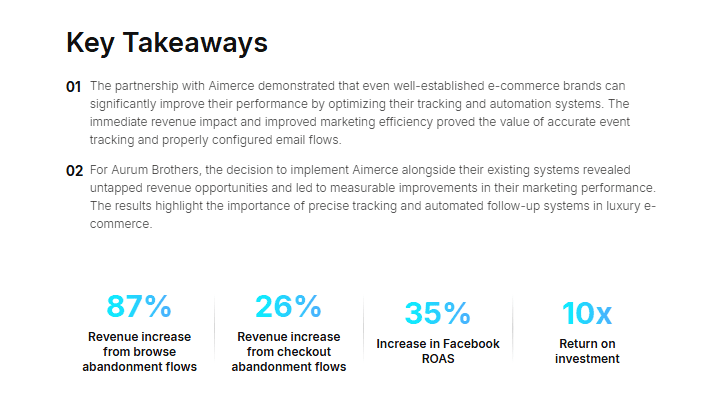
Results within 16 days
| Metric | Lift |
|---|---|
| Browse abandonment flow revenue | +87% |
| Checkout abandonment flow revenue | +26% |
| Email revenue from new flows | +13% |
| Facebook ROAS | +35% |
| Return on investment | 10x |
The Facebook ROAS improvement came specifically from eliminating duplicate events. When the same conversion fires twice, Meta's algorithm gets a distorted signal about what actually drives purchases, and fixing that improved targeting efficiency immediately. Their marketing director described the 16-day results as an eye-opening turning point for the brand.
The lesson generalizes past jewelry: adding a reporting tool on top of incomplete data produces incomplete insights. The fix wasn't a better dashboard, it was fixing what the dashboard was measuring in the first place.
Why Browser-Only Tracking Breaks Down (the short version)
The Meta Pixel is a client-side script, and it degrades under a few common conditions: Safari and Firefox restrict third-party cookies, ad blockers can suppress the pixel script entirely, express checkout flows (Shop Pay, Apple Pay, PayPal) skip the thank-you page where the Pixel fires, and mobile-to-desktop purchase journeys break identity continuity. For stores with meaningful mobile traffic or express checkout adoption, the gap between Shopify orders and reported Meta conversions can run 20 to 40%.
That gap isn't just a reporting inconvenience, it's a training signal problem. Meta's algorithm optimizes against whatever it receives, and if a third of your purchases never reach it, it's optimizing against a distorted picture of your actual buyers. We've gone deeper on the mechanics of this, including Safari's ITP and iOS App Tracking Transparency specifically, in our server-side tracking tools comparison.
What If You'd Rather Self-Host the Infrastructure?
Aimerce and TripleWhale are both managed platforms. If your team has engineering resources and wants full control over the data layer instead, Stape plus Google Tag Manager is the other legitimate path, lower software cost, more configuration work, and you own the maintenance when Shopify or Meta change something. We've written a full pros-and-cons breakdown of Stape + GTM vs. Aimerce if that's the direction you're considering.
A Useful Way to Compare: Where Does the Value Show Up?
If your priority is making downstream tools work better, focus on getting purchase and funnel events delivered reliably to Meta and Google, improving match quality, and getting events there fast enough for the algorithm to use them.
If your priority is decision-making and reporting, focus on how the tool models attribution, reconciles spend and revenue across channels, and supports your team's actual reporting workflow.
Many teams eventually want both, Aurum Brothers is proof of that, but the sequencing matters. Better reporting on unreliable data still produces unreliable decisions.
Common Scenarios: Which One Do You Need Right Now?
Paid social performance feels stuck. Campaigns aren't learning well, audiences are smaller than expected, conversions look underreported relative to Shopify orders. Bias toward Aimerce and server-side event delivery.
The team argues about which dashboard is right. Signals are intact, but interpretation is the disagreement. This is a reporting problem, not a capture problem. Bias toward TripleWhale.
You're scaling channels and need clearer attribution views. If event capture is already reliable, a reporting-first approach helps. Bias toward attribution and reporting workflows.
What Server-Side Tracking Doesn't Solve
It's realistic to expect real improvement from server-side approaches, but worth being upfront about the limits: consent choices still have to be respected if a shopper declines tracking, not every session has an email or authenticated signal to work with, cross-device identity continuity improves but isn't universal, and Meta and Google will still report differently because they use different attribution windows and methodologies. That last point isn't a tracking failure, it's just how each platform counts credit, and we've covered why those numbers will never fully reconcile in more depth elsewhere.
Implementation and Ownership
Where does tracking live? Browser tags are easy to add but easier to break. Server-side approaches are more durable but need a solid initial implementation.
Who owns the data layer? For long-term control and signal quality, prioritize first-party capture and clean identifiers. For quick visibility into performance, prioritize dashboards and reporting workflows.
How much ongoing maintenance can you support? Aimerce is a no-code Shopify app with guided implementation and no ongoing engineering requirement, which is a great Stape alternative. TripleWhale similarly offers plug-and-play onboarding. Neither needs a dedicated data team to operate.
FAQ
What is the difference between Aimerce and TripleWhale? Aimerce is a server-side tracking and data capture tool, making sure conversion events reach Meta, Google, and Klaviyo reliably, including express checkout orders that bypass the Meta Pixel. TripleWhale is an attribution and reporting tool that organizes and visualizes performance data across channels. Many teams use both.
Does TripleWhale use server-side tracking? TripleWhale has server-side components as part of its attribution methodology, but its primary value is reporting and multi-touch attribution modeling rather than event capture reliability. If conversions aren't reaching Meta or Klaviyo accurately, a dedicated server-side tracking tool addresses that more directly.
Should I use Aimerce instead of TripleWhale? Depends on your primary pain point. If paid social performance is degraded by tracking gaps or your Klaviyo audiences are smaller than expected, Aimerce addresses the capture layer. If your primary need is attribution views and cross-channel reporting, TripleWhale addresses that. Many Shopify stores, Aurum Brothers included, use both.
Does server-side tracking work without the Meta Pixel? They're designed to work together, not as replacements. The Pixel captures browser-side signals, the Conversions API sends server-side events, and together they give Meta a more complete dataset. Running only one leaves gaps in signal coverage.
How does express checkout affect Meta conversion tracking? Shop Pay, Apple Pay, and PayPal often skip the order confirmation page where the Meta Pixel fires a Purchase event, so those purchases go unreported. For stores with high express checkout adoption, this can cause a 20 to 40% gap between Shopify orders and reported Meta conversions.
If we already have dashboards, do we still need server-side tracking? Often yes, because dashboards are only as accurate as the events feeding them. If underlying conversion capture is degraded by express checkout gaps, Safari restrictions, or ad blockers, a better reporting layer won't fix the signal quality problem underneath it.
Sources
[1] Aimerce Success Stories, "How Aurum Brothers Generated 13% Additional Revenue in 16 Days"
Related reading

Try Aimerce Pixel Risk-Free
for 30 Days
Most teams see results within 2 weeks.
Money-back guarantee.
It pays for itself, or you don't pay anything.
30-Day Aimerce Pixel Free Trial