Meta has released a new "Describe Your Audience" AI targeting feature that lets advertisers write a plain-language description of their ideal customer and have Meta's algorithm generate relevant interest and behavior targeting options automatically. In its current form it is a useful time-saving tool but not a major performance lever. Where it gets genuinely interesting is where it is clearly heading, and that future version has real implications for how DTC brands think about audience strategy.
Here is an honest breakdown of what the feature does today, what it will likely become, and what it means for your campaigns.
What Is Meta's "Describe Your Audience" Feature?
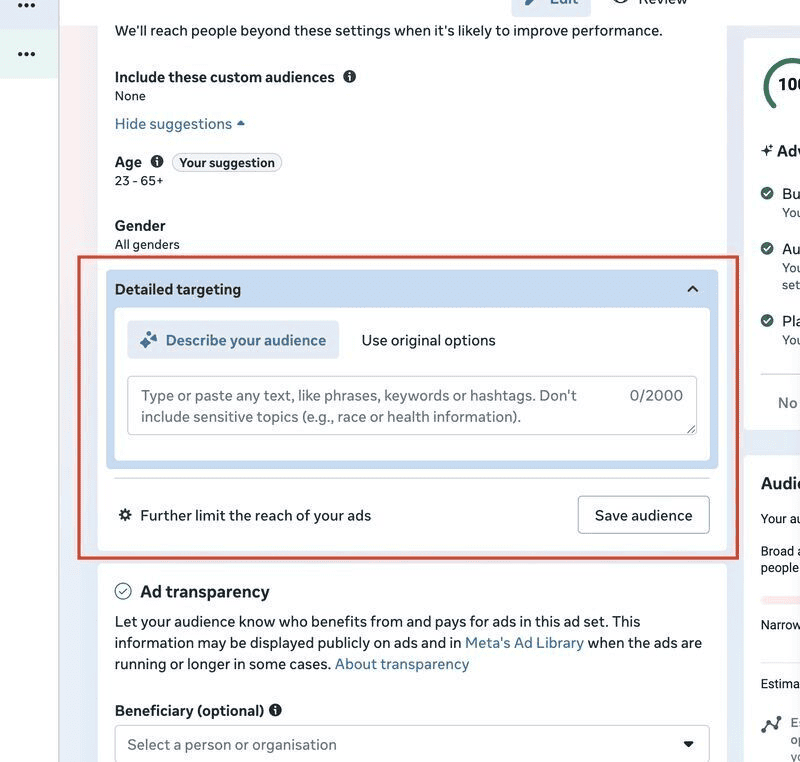
Found at the ad set level in Ads Manager under the Audience section, this feature replaces the traditional browse-and-select approach to detailed targeting with a free-text input of up to 2,000 characters.
You describe your ideal customer profile in plain language. Meta's AI analyzes that description and generates a list of interest and behavior targeting options that match it. You then review those suggestions and add the ones that fit into your ad set.
How to find it:
- Open Ads Manager and go to the ad set level
- Scroll to the Audience section
- Click Show Suggestions, then scroll to Detailed Targeting
- If you have access, you will see Describe Your Audience alongside the original Use Original Options toggle
 Not all ad accounts have this yet. Meta is currently testing it in select accounts before a broader rollout.
What It Does Well Right Now
Surfaces targeting options you did not know existed
Meta's detailed targeting library is updated constantly. Options are added and removed without announcement. If you have been advertising for a while, there are almost certainly relevant interest and behavior categories that have appeared since you last audited your targeting. The AI description tool can surface these automatically.
Saves time on targeting research
Writing a detailed ICP description and letting Meta generate suggestions is faster than manually browsing through category trees, especially for new campaigns or new products where you are still exploring audience options.
Handles nuanced audience descriptions
The free-text format lets you describe specific professional roles, behavioral patterns, and contextual qualifiers that do not map neatly to any single targeting category. Meta's AI interprets the full description rather than requiring you to find an exact category match.
What It Does Not Do Well Right Now
Detailed targeting is a suggestion, not a filter
This is the critical nuance most coverage of this feature misses. Any detailed targeting options you add, whether through this new tool or the original interface, are added as suggestions. Meta can choose to show your ads to people outside those categories if its algorithm predicts they are likely to convert.
The practical implication: detailed targeting has less direct impact on delivery than it did three to four years ago. The algorithm has moved toward using targeting as a starting signal rather than a hard boundary.
Current reliability issues
The feature is in active testing and does not always work. Generate options sometimes returns nothing. This is expected behavior for a feature still in rollout. Treat it as experimental for now.
Where This Feature Is Going? (Which Is More Interesting)
The current implementation converts your description into existing targeting categories. The more significant evolution, which Meta is clearly moving toward, is skipping the category conversion entirely.
Instead of: description, then categories, then delivery, the future version would be: description, then direct delivery to the people who match it.
This matters because Meta's existing interest and behavior categories are broad by necessity. "Interested in Facebook advertising" could include someone who watched one video about ads six months ago and a performance marketer who runs eight-figure campaigns professionally. The category cannot distinguish between them.
A detailed plain-language description can. "In-house performance marketer managing Meta ad spend for a large corporation" is a level of specificity that no category currently captures. If Meta can use that description to target delivery directly, advertisers gain the ability to reach much smaller, much more qualified audiences.
The trade-off that makes this valuable for both sides:
Reaching a hyper-specific audience costs more per thousand impressions. But if the audience is genuinely more qualified, the cost per conversion drops. Advertisers pay more per impression and get more per conversion. Meta earns more from its inventory. Both sides benefit when the targeting precision is real.
This is the direction Meta's algorithm has been moving for years. The "Describe Your Audience" feature is an early public-facing version of that shift.
What This Means for Your Audience Strategy Right Now
Do not overweight detailed targeting in your current campaigns
The Describe Your Audience tool is worth using for discovery: finding targeting options you were not aware of. But do not build your campaign strategy around precise detailed targeting as if it controls who sees your ads. It does not, not with current Meta delivery mechanics.
Where the real targeting happens in 2026:
| Signal Type | How Meta Uses It | Your Control |
|---|---|---|
| Detailed targeting | Suggestion only, algorithm can ignore | Low |
| Creative content | Primary signal for audience matching | High |
| Conversion events | Core optimization signal | High (depends on tracking quality) |
| Custom audiences | Strong seed for lookalikes | Medium |
| Broad targeting | Algorithm finds buyers from scratch | High (requires strong creative and clean data) |
Creative and conversion data are your actual targeting levers
The more sophisticated Meta's algorithm becomes at finding buyers, the more your conversion signal quality matters. When Meta optimizes delivery toward people likely to purchase, it uses your purchase event data to define what "likely to purchase" means.
If that data is incomplete because ad blockers, Safari ITP, or iOS restrictions are suppressing purchase events before they reach Meta, the algorithm is finding buyers based on a partial picture of who your real customers are. It may systematically underreach the most valuable segments of your audience because those customers happened to be on Safari or had an ad blocker running when they converted.
This is where server-side tracking connects directly to targeting quality. Aimerce captures purchase events at the server level and sends them to Meta via Conversions API regardless of browser restrictions. The cleaner and more complete your conversion data, the more accurately Meta's algorithm understands who your real buyers are, and the better it targets future delivery toward people who match them.
Better tracking does not replace good creative or smart campaign structure. But incomplete tracking actively degrades the audience signals Meta uses to find your next customer.
How to Use the Describe Your Audience Feature Effectively Today
Write a specific ICP description, not a demographic one
Vague: "People interested in ecommerce and digital marketing aged 25 to 45" Specific: "Shopify store owners spending $5,000 or more per month on Meta ads who are actively trying to improve their attribution tracking and ROAS"
The more behavioral and situational detail you include, the more useful the generated suggestions will be.
Use it for discovery, not strategy
Review the generated options and note any you were not aware of. Add the most relevant ones to your ad set as suggestions. Then monitor performance over time to see whether they contribute to improved delivery.
Check back quarterly
Meta adds and removes targeting options regularly. Run this exercise every three to four months to catch new categories that have appeared since your last audit.
Frequently Asked Questions
What is Meta's Describe Your Audience feature? It is a new AI-powered targeting tool in Meta Ads Manager that lets advertisers write a plain-language description of their ideal customer profile and automatically generates relevant interest and behavior targeting suggestions. It is currently in limited testing and is not yet available in all ad accounts.
Does Meta's new AI targeting feature improve ROAS? In its current form, the feature is primarily a time-saving discovery tool. Detailed targeting options in Meta are added as suggestions and the algorithm can choose to ignore them. The more significant future version, where Meta delivers directly to your ICP description without converting it to categories first, has stronger ROAS implications but is not yet available.
Why is clean conversion tracking important for Meta audience targeting? Meta's algorithm finds new buyers by optimizing toward people who resemble your existing converters. If purchase events are missing due to ad blockers or iOS restrictions, Meta builds its audience model from incomplete data. Server-side tracking through tools like Aimerce ensures purchase events reach Meta via Conversions API regardless of browser restrictions, giving the algorithm a more accurate picture of who your real buyers are.
Is detailed targeting still important on Meta in 2026? Less so than it was. Meta now treats detailed targeting as a delivery suggestion rather than a hard audience filter. The algorithm increasingly finds buyers through creative content and conversion signal optimization rather than category-based targeting. This makes conversion data quality and creative strategy more important than precise targeting selection.
How do I access the Describe Your Audience feature in Meta Ads Manager? Go to the ad set level, scroll to the Audience section, click Show Suggestions, then scroll to Detailed Targeting. If your account has access, you will see a Describe Your Audience option alongside the original Use Original Options toggle. If you do not see it, the feature has not yet rolled out to your account.
Has Manual Targeting Become Obsolete?
Meta's "Describe Your Audience" feature is a valuable tool for discovering new targeting options. It can uncover interest and behavior categories you might have missed, saving you time on audience research.
More importantly, this feature indicates the future direction of Meta's targeting capabilities. As the platform's algorithm evolves to use simple, plain-language descriptions of your ideal customer profile (ICP) to guide ad delivery, the ability to clearly define your audience will provide a significant competitive advantage.
For now, your most dependable targeting tool is your conversion data. The more high-quality data you provide Meta about your actual customers, the more effectively it can target similar individuals. In the near future, successful campaigns will be determined not by detailed targeting settings, but by strong creative strategy and the quality of your conversion signals.
30-Day Aimerce Pixel Free Trial