Quick Answer: Aimerce doesn't run 16 separate tracking integrations. It runs one first-party pixel that captures, identifies, and enriches every event once, then delivers it to whichever of the 16+ connected ad, email, and checkout platforms you're actually using, from Meta and Google to Klaviyo and OpenAI Ads.
Key Takeaways
- Aimerce runs one first-party pixel across 16+ destinations, not 16 separate integrations each with its own point of failure.
- The pipeline is four steps: capture (server-side, not browser-side), identify (a visitor ID that persists up to a year, versus days under Safari's ITP), enrich (adding first-party identifiers for match quality), and deliver (formatted per destination, with automatic deduplication).
- Adding a new platform means connecting an existing pipeline to it, not rebuilding tracking from scratch.
- Deduplication happens automatically at delivery, so a browser event and a server event describing the same purchase never get double-counted.
- Most brands use only a handful of the 16+ destinations at once, and the underlying architecture is identical regardless of how many are connected.
What does "one pixel, 16+ destinations" actually mean?
It means the hard part, capturing accurate, enriched, deduplicated event data, gets solved once, and every connected destination benefits from that same foundation, rather than each platform requiring its own separate tracking setup.
Most tracking apps integrate with one platform, maybe two. Aimerce connects to more than 16, spanning ad platforms, email and SMS tools, and checkout systems, without asking a merchant to install 16 separate things. The distinction that actually matters isn't the count, it's that this isn't 16 different integrations bolted together. It's one single data stream feeding 16 platform destinations.
Which platforms does Aimerce actually integrate with?
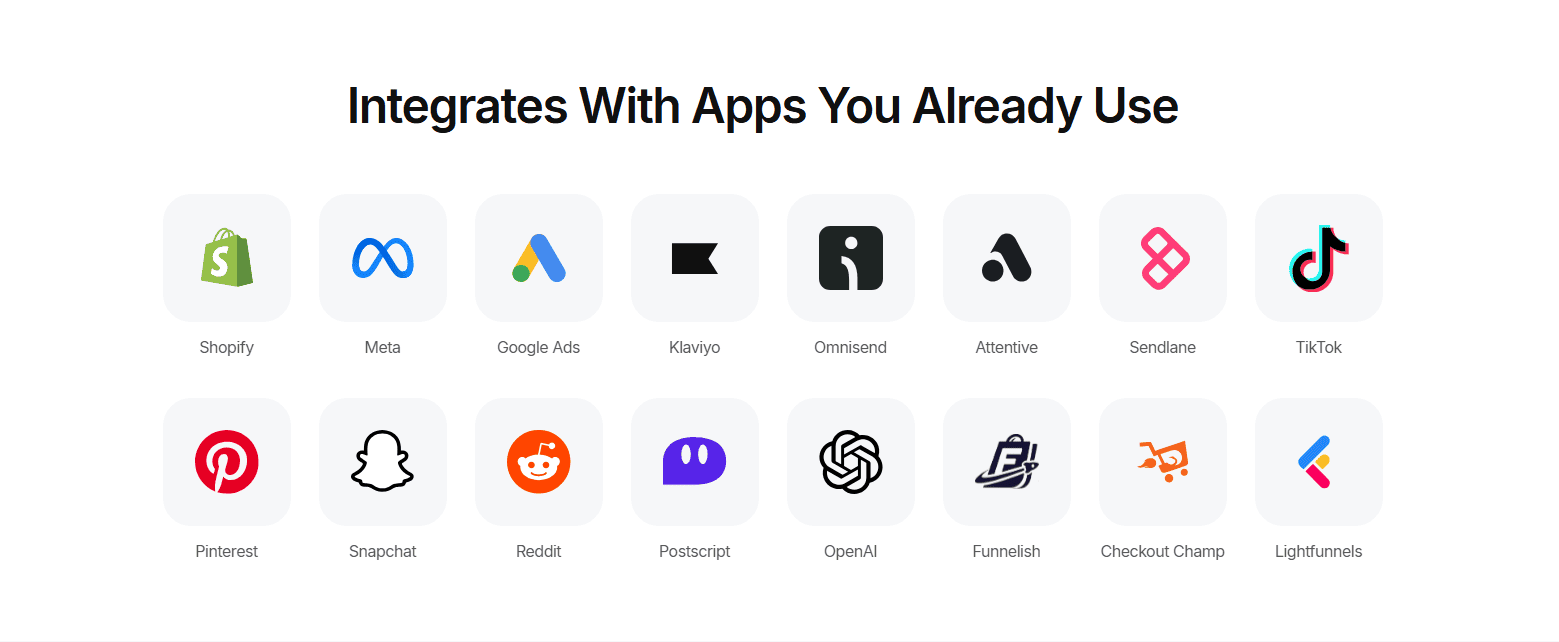
Sixteen, spanning three categories: ad platforms, email and SMS tools, and checkout or funnel systems.
Ad platforms: Meta (Facebook & Instagram), Google Ads, TikTok, Pinterest, Snapchat, Reddit, Taboola, and OpenAI Ads (ChatGPT Ads Manager)
Email & SMS platforms: Klaviyo, Omnisend, Attentive, Sendlane, and Postscript
Checkout & funnel platforms: Checkout Champ, Funnelish, and Lightfunnels
Most brands don't use all 16 at once, and that's fine, the same architecture applies whether you're connecting two destinations or eight.
Automatic standard tracked events by destination
| Destination | Typical Events Tracked |
|---|---|
| Meta (Facebook & Instagram) | PageView, ViewContent, AddToCart, InitiateCheckout, Lead, Purchase |
| Google Ads | Page View, View Item, Add to Cart, Begin Checkout, Purchase |
| TikTok | Page View, View Content, Add to Cart, Initiate Checkout, Place an Order, Complete Payment |
| Page Visit, View Category, Add to Cart, Checkout, Lead | |
| Snapchat | Page View, View Content, Add to Cart, Start Checkout, Purchase |
| Page Visit, View Content, Add to Cart, Purchase | |
| Taboola | Page View, Add to Cart, Purchase |
| OpenAI Ads (ChatGPT Ads Manager) | Page View, Purchase, plus a broader 11-event standard taxonomy now published by OpenAI (order_created, checkout_started, items_added, lead_created, and others) — confirm current mapped coverage before publishing |
| Klaviyo | Viewed Product, Started Checkout, Placed Order, Ordered Product, Active on Site |
| Omnisend | Viewed Product, Added to Cart, Started Checkout, Placed Order |
| Attentive | Product Viewed, Added to Cart, Checkout Started, Purchase |
| Sendlane | Product Viewed, Cart Updated, Order Placed |
| Postscript | Checkout Started, Order Placed |
| Checkout Champ | Checkout Initiated, Order Confirmed |
| Funnelish | Page View, Add to Cart, Checkout Started, Purchase |
| Lightfunnels | Page View, Add to Cart, Order Complete |
Why not just build 16 separate integrations instead of one pipeline?
Because 16 separate integrations means 16 separate points of failure, 16 things to update whenever Shopify changes something, and 16 places tracking can quietly break without anyone knowing which one.
Aimerce runs on a single first-party pixel instead. One capture point, four steps, then delivery to however many of the 16 destinations a given brand is actually using.
What actually happens between a click and a delivered event?
Four steps: capture, identify, enrich, and deliver, in that order, and each one solves a specific failure point in how tracking normally breaks.
Capture. The pixel records every meaningful event, page views, add-to-carts, checkouts, purchases, server-side rather than in the customer's browser. Server-side capture isn't affected by ad blockers, and it doesn't depend on a browser rendering a page a particular way. The event gets recorded once, at the source, regardless of what's happening on the customer's device.
Identify. Every event gets attached to a durable visitor ID that persists for up to a year. Compare that to a Safari cookie, which survives for a matter of days under Intelligent Tracking Prevention [1]. This is the piece that actually determines how much customer activity is still visible months after third-party cookies stopped doing the job. A visitor ID that lasts a year means retargeting and attribution windows that reflect a full customer lifecycle, not a week-long snapshot.
Enrich. Before anything gets sent anywhere, each event picks up first-party data, customer details, product information, click IDs, the specific identifiers ad platforms use for matching and optimization. This step directly determines Event Match Quality on Meta specifically: the more complete and accurate the enrichment, the higher the match quality, and the better Meta's algorithm can use the data it receives.
Deliver. The enriched event gets formatted and sent to each connected platform's server-side API, Meta's Conversions API, Google's Enhanced Conversions, Klaviyo's event tracking, whatever the destination requires. Deduplication happens automatically here too, so a browser event and a server event describing the same purchase never get counted twice, a common source of inflated numbers when tracking systems aren't built to handle both paths together.
What happens when you add a new platform?
Connecting one more destination to a pipeline that's already capturing, identifying, and enriching every event correctly, not rebuilding tracking from scratch.
If a brand is only running Meta and Klaviyo today, that's two of the 16 destinations, and the architecture behind that is identical to what a brand running eight destinations is using. Starting to advertise on TikTok, or adding Reddit, doesn't require a new tracking build. It requires connecting an existing pipeline to one more place.
Do you need to use all 16 destinations?
No. The count isn't a target, it's a description of what's available without rebuilding anything when a new channel gets added.
If you're only running one or two destinations today: the architecture is identical to a brand running eight. There's no extra complexity for using fewer.
If you're planning to add a new ad or email platform: you're connecting one more destination to an existing, already-working pipeline, not starting over.
If a destination's event taxonomy is still evolving (as OpenAI Ads' was until recently), the underlying capture, identify, and enrich steps don't change. Only the specific event names and fields sent to that one destination need updating as the platform's own spec matures.
Common mistakes to avoid
- Assuming more connected destinations means more setup or maintenance overhead. The point of a single pipeline is that it doesn't, the hard part is solved once regardless of how many destinations are attached.
- Treating unused destinations as something that needs configuring. Only the platforms actually in use need to be connected, the other 14 or so just aren't relevant yet.
- Assuming every destination has equally mature event support. Some platforms, like OpenAI Ads, have historically had a narrower or newer event taxonomy than long-established ones like Meta or Google, and it's worth confirming current coverage per destination rather than assuming parity.
FAQ
Does Aimerce require a separate setup for each ad platform it connects to? No. Aimerce uses a single first-party pixel that captures, identifies, and enriches events once, then delivers to whichever destinations are connected. Adding a new platform means connecting an existing pipeline to it, not rebuilding tracking.
How does Aimerce prevent duplicate events between browser and server tracking? Deduplication happens automatically at the delivery step. A browser-side event and a server-side event describing the same action are matched and counted once, rather than inflating totals on the platform receiving them.
Why does visitor ID duration matter for tracking accuracy? A longer-lasting visitor ID means more of a customer's activity stays connected to them over time. Safari's Intelligent Tracking Prevention limits cookies to a matter of days, while a durable, non-cookie-based visitor ID can persist for up to a year, which materially changes how much of the customer journey ad platforms can see and use for optimization.
Do I need to use all 16 platforms Aimerce integrates with? No. Most brands use a handful of the 16, whichever ad, email, and checkout platforms they're actually running. The architecture behind the pixel is the same regardless of how many destinations are connected.
Does adding more destinations slow down event delivery? No. Each destination receives its own formatted delivery independently once an event has been captured, identified, and enriched, so adding a destination doesn't change how the others are processed.
What happens if a destination's standard events change, like OpenAI Ads did? Only the mapping to that specific destination needs updating as its taxonomy matures. The capture, identify, and enrich steps upstream don't depend on any one destination's event names, so a change on one platform doesn't require touching the pipeline itself.
Sources
[1] WebKit.org, “Apple's Intelligent Tracking Prevention documentation (script-writable cookie lifetime cap)” [2] OpenAI, "Supported events"
Related reading

Try Aimerce Pixel Risk-Free
for 30 Days
Most teams see results within 2 weeks.
Money-back guarantee.
It pays for itself, or you don't pay anything.
30-Day Aimerce Pixel Free Trial