In February 2026, OpenAI quietly began testing ads on ChatGPT with a small group of brands. In early May, OpenAI launched a Conversions API and pixel-based measurement, introduced CPC (cost-per-click) bidding, and opened a beta self-serve Ads Manager for US advertisers.
Then on May 7, 2026 they announced expansion of the Ads pilot to the UK, Mexico, Japan, Brazil, and South Korea.
This is OpenAI building a third major advertising platform.
What the ChatGPT Ads Manager Is
The Ads Manager is a self-serve campaign management portal for businesses who want to advertise in ChatGPT. It is currently in beta and available to US advertisers, with a gradual rollout to more businesses planned.
Through the Ads Manager, advertisers can:
- Register as an advertiser and add payment information.
- Set campaign budgets, bids, and pacing preferences.
- Upload ad creative. Launch and manage campaigns.
- View performance through a built-in reporting dashboard.
The portal is designed to serve businesses of all sizes, from SMBs and startups to global brands. As of the May launch, OpenAI dropped the $50,000 minimum spend requirement that existed during the February pilot to make the platform accessible to SMBs
For businesses not ready to go direct, access is also available through agency partners and technology partners who support campaign setup, budgeting, and creative while OpenAI controls all ad delivery decisions.
The Two Bidding Models
- CPM (cost-per-mille impressions) - Available since the February pilot began. Advertisers pay per thousand ad views. OpenAI positioned this as a way for advertisers to "understand demand, delivery, and early performance in a new environment" before committing to performance-based buying.
- CPC (cost-per-click) - Advertisers are only charged when someone actually clicks on an ad. OpenAI's rationale: "Many ChatGPT conversations are active and decision-oriented. People are often learning about a category, comparing options, or deciding what to do next. In those moments, a click can be a meaningful signal that an ad was relevant and helped someone move forward."
The CPC model is the more significant addition for performance advertisers. It aligns payment with demonstrated interest rather than passive exposure.
The Pixel and Conversions API in ChatGPT
OpenAI launched a Conversions API alongside pixel-based measurement in May 2026. This allows advertisers to track what happens after someone engages with a ChatGPT ad. A purchase, a lead submission, a sign-up, or another meaningful conversion action.
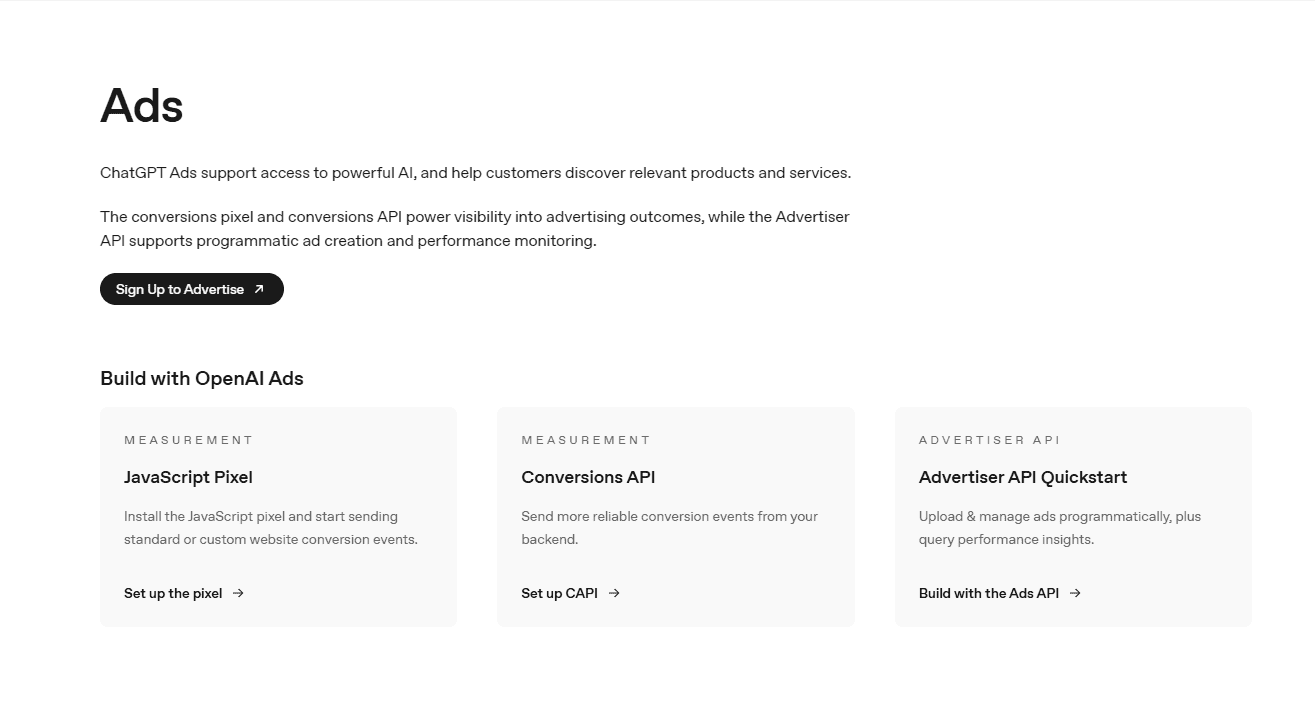
The mechanics mirror Meta's Conversions API almost exactly. Advertisers send conversion event data from their server directly to OpenAI's system. The platform uses that data to understand campaign performance and improve ad matching quality. Advertisers receive aggregated performance insights without access to individual user conversations.
OpenAI stated that better measurement data serves two purposes. It helps advertisers understand performance, and it "helps improve the experience for people using ChatGPT" by enabling the platform to show more relevant ads and build optimization systems accountable to real outcomes rather than impressions alone.
ChatGPT's Conversions API works identically to Meta's CAPI. Server-side events, enriched customer data, aggregated reporting. Brands that already have clean server-side tracking through Aimerce have already solved the data infrastructure problem for Meta and Google. The same setup will apply to ChatGPT when access opens. If you are already sending enriched server-side events to Meta via Aimerce, the ChatGPT Conversions API integration will be familiar to you.
For brands that have already built server-side conversion tracking infrastructure for Meta and Google, the architecture of a ChatGPT Conversions API integration will be familiar.
The Partner Ecosystem
OpenAI has formalized two categories of partners for ChatGPT advertising.
- Agency partners: Dentsu, Omnicom, Publicis, WPP. These are the four largest agency holding groups in the world. Brands already working with these agencies can buy ChatGPT ads through existing relationships and workflows. The agencies handle budgeting, bidding, and creative. OpenAI controls all delivery decisions.
- Technology partners:
- Adobe - via Adobe Experience Cloud and Adobe Advertising. Connects creative workflows and audience data to ChatGPT ad campaigns. High relevance for enterprise ecommerce brands.
- Criteo - a commerce media platform built specifically for product-level retargeting. Criteo powers retargeting across 22,000+ publisher sites and already integrates with Shopify. Their presence in the ChatGPT ecosystem is a significant signal about the direction of the platform.
- Kargo - a premium native advertising platform focused on high-impact creative formats for brand-safe environments.
- Pacvue - a retail media platform for advertising on Amazon, Walmart, Target, and Instacart. Specializes in sponsored product and catalog-level advertising.
- StackAdapt - a programmatic demand-side platform covering native, display, video, and CTV. Allows advertisers to buy ChatGPT inventory through existing programmatic workflows.
These involvement suggests that ChatGPT ads will evolve toward product-level advertising, not just brand awareness campaigns.
How ChatGPT Ads Are Different from Google and Meta
The structural difference between ChatGPT advertising and traditional search or social advertising is the quality and explicitness of purchase intent.
Google infers intent from a search query. When someone searches "running shoes marathon training" Google knows they are likely interested in running shoes. But it does not know their budget, their specific use case, how far they are in the consideration process, or what alternatives they are evaluating. While Meta on the other hand, infers intent from behavioral signals, demographics, and engagement patterns. It builds a probabilistic model of who might be interested in a product based on what they have clicked, liked, and purchased.
ChatGPT has explicit conversational context. When someone asks "what running shoes should I buy for marathon training under $150, I have flat feet and mostly train on roads", the purchase intent is stated rather than inferred. The category decision has already been made.
This is a qualitatively different intent signal. OpenAI's bet is that advertisers will pay a premium to reach users whose commercial intent is explicitly stated rather than probabilistically inferred.
OpenAI's Revenue Targets
OpenAI expects to generate $2.5 billion in advertising revenue in 2026. The company has also been reported to be targeting $100 billion in ad revenue by 2030. Both figures reflect ambitious projections for a platform that started its ad pilot in February 2026.
For context, Google generated approximately $264.5 billion in total ad revenue in 2024. Meta generated approximately $160 billion. OpenAI is not competing at that scale in the near term. But $2.5 billion in year one of a serious ads business would be a meaningful beginning, and $100 billion by 2030 would place them in the same category as the established platforms.
ChatGPT advertising as competitive threat to Google, not Meta.
Google's core business is search advertising and advertisers pay to appear when users express commercial intent through search queries. ChatGPT is now offering a competing surface for capturing that same commercial intent, at potentially higher intent quality, through conversational queries.
Google Gemini and Google AI Mode are both expected to outgrow ChatGPT on raw user numbers this year, according to Emarketer projections. Google has also moved aggressively to integrate AI into its ad products and has seen recent ad revenue growth from that focus. The competitive dynamic between ChatGPT and Google AI search advertising will be one of the more significant stories in digital advertising over the next two to three years.
Meta's position is less directly threatened. ChatGPT is not attacking Meta's social feed model. But as ChatGPT advertising matures into a performance channel, it will compete for advertiser budget allocation. Dollars that shift to ChatGPT ads come from somewhere, and some of those dollars will come from Meta and Google budgets.
ChatGPT advertising is moving fast
In three months, OpenAI went from a quiet CPM pilot with a handful of brands to a self-serve Ads Manager, CPC bidding, a Conversions API, and partnerships with the largest agency holding groups and five major ad technology companies.
Although the platform is still early and direct access for most brands is limited, the infrastructure being built follows the same patterns as Meta and Google.
Most Shopify and DTC brands do not have direct access to ChatGPT advertising today. The self-serve beta is US-only with a gradual rollout.
Product-level advertising is coming and the intent signal is genuinely different. If ChatGPT's ad platform matures as designed, it will offer access to users who are explicitly in purchase consideration mode, with stated preferences and stated constraints. That is a different kind of audience than Google or Meta can offer, and it may justify different bidding economics.
The time to prepare is before access opens broadly, not after.
Frequently Asked Questions
What is ChatGPT Ads Manager? A beta self-serve portal that allows US advertisers to create and manage ad campaigns that appear in ChatGPT. Advertisers can set budgets, bids, and pacing, upload creative, launch campaigns, and view performance through the portal. It launched in May 2026 with a gradual rollout to more businesses planned.
How are ChatGPT ads different from Google ads? Google ads appear next to search results when users express intent through a search query. ChatGPT ads appear in conversational sessions where users have explicitly stated their interest, consideration criteria, and context. OpenAI argues this produces a higher quality intent signal because the user's needs are stated rather than inferred.
What bidding options are available for ChatGPT ads? Two options: CPM (cost-per-thousand impressions), which has been available since the February 2025 pilot began, and CPC (cost-per-click), which was introduced in May 2026. CPC means advertisers are only charged when a user clicks on an ad.
What is OpenAI's Conversions API? A server-side measurement tool that allows advertisers to track what happens after a user engages with a ChatGPT ad, including purchases, lead submissions, and sign-ups. It mirrors the function of Meta's Conversions API and Google's Enhanced Conversions. Advertisers receive aggregated performance data only and do not get access to individual conversation content.
What countries are ChatGPT ads available in? The self-serve Ads Manager is currently available for US advertisers. On May 7, 2025, OpenAI announced expansion of the ads pilot to the UK, Mexico, Japan, Brazil, and South Korea.
How does ChatGPT protect user privacy in ads? Advertisers receive aggregated performance data only and do not have access to individual conversations. OpenAI updated its privacy policy with explicit language about how advertiser purchase data is handled. The company has stated that ChatGPT's answers remain independent from ads and conversations stay private.

Try Aimerce Pixel Risk-Free
for 30 Days
Most teams see results within 2 weeks.
Money-back guarantee.
It pays for itself, or you don't pay anything.
30-Day Aimerce Pixel Free Trial