I'm going to say something that might surprise you coming from me.
Claude is genuinely impressive. Anthropic's partnership with Klaviyo connecting Claude to your Klaviyo data through MCP is one of the most meaningful developments in email marketing this year.
But there's something Claude cannot do inside Klaviyo. And until that changes, AIM is irreplaceable.
Let me explain exactly why.
What the Claude + Klaviyo MCP Integration Actually Is
On May 7, 2026, Klaviyo and Anthropic announced an expanded integration. You connect your Klaviyo account to Claude, and Claude can access your campaign data, flow performance, customer profiles, and lifecycle signals all through natural language.
Ask Claude to summarize last month's flow performance. Ask it to identify underperforming segments. Ask it to draft a re-engagement brief for customers who haven't purchased in 90 days. It pulls your actual Klaviyo data and gives you back finished outputs reports, briefs, audits without you touching a single spreadsheet.
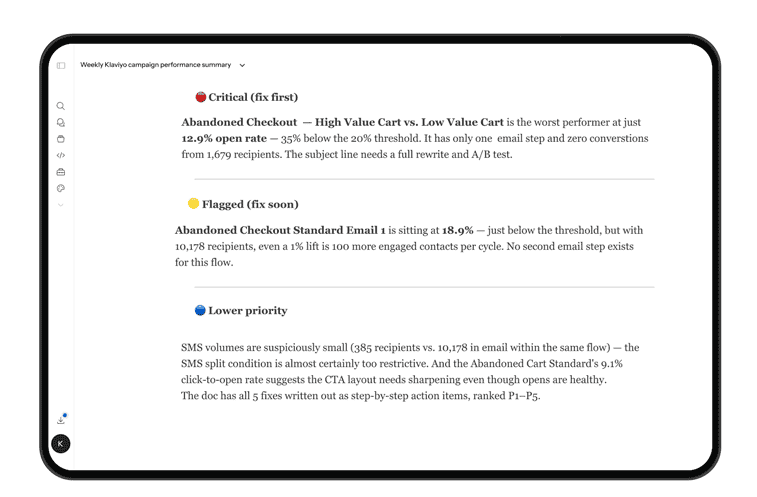 Image via Klaviyo
In Claude Cowork, Anthropic's desktop tool, this gets even more powerful. You describe an outcome "audit all my flows, generate a brief for each, save them to client folders" step away, and come back to finished work. For agencies managing ten accounts, what used to take half a day becomes an overnight job.
This is genuinely great. I mean that.
Claude via MCP can see your flows. Klaviyo's MCP server has get_flows and get_flow tools that let Claude list your flows and pull high-level details and performance reports. So when Claude tells you your welcome series has an 18% open rate, it's working with real data.
But that's where Claude's view of your flows ends.
There are no MCP tools for reading filter logic, inspecting trigger configuration, checking email-level settings, or verifying UTM toggles. And there are zero write tools for flows, not one. Claude via MCP cannot touch a flow, change a filter, fix a trigger, or correct a setting even if it identified the problem. That's not a limitation Anthropic will patch next quarter. It's the boundary of what MCP was designed to do.
Claude sees that your flows exist and how they perform but cannot see how they are built. And it cannot fix them. While Claude is good at auditing them, it lacks the "write" permissions and toolsets to modify Flow logic. AIM fills this by allowing one-click fixes within the Klaviyo interface.
But notice what's happening here. Claude is working with data that already exists. Performance metrics. Historical campaign results. Aggregated signals from flows that are already live.
Claude is looking backwards. And that's exactly where AIM takes over looking forward.
The Gap Claude Cannot Fill
Here's the thing about Klaviyo mistakes the expensive ones happen before the flow goes live.
A filter set to the wrong condition. A trigger that fires on the wrong event. A UTM tag that got skipped on one email in a 7-step sequence. An email with no footer. A flow step that's incomplete.
These aren't visible in performance data because they haven't caused damage yet. Or worse, they have caused damage, and the data just looks like "underperformance" without telling you why.
Claude cannot open your Klaviyo flow builder and look at what you're building right now. It cannot scan your draft emails for missing tracking. It cannot catch a misconfigured filter before you hit publish. It has no access to the construction layer the place where the mistakes actually happen.
You will catch errors in a live campaign example while building. Imagine sending that to 500K people. 😬
What AIM Does That Claude Literally Cannot
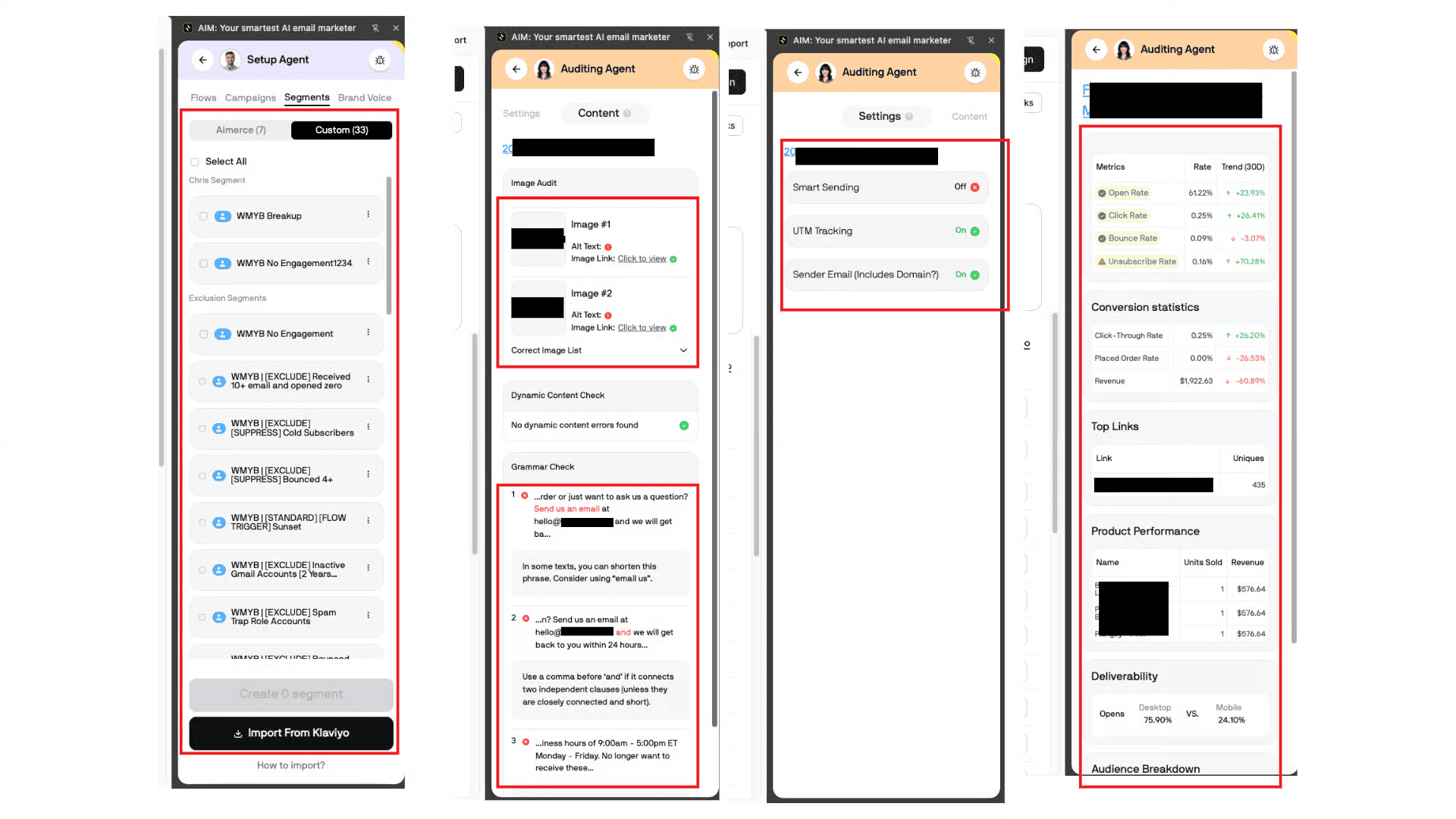
AIM lives inside Klaviyo. Not alongside but inside it. It runs in a side panel while you build, and it watches what you're doing in real time.
When you're constructing a flow, AIM is scanning it as you go. It catches:
- Filters that are misconfigured before they send emails to the wrong segment
- Triggers that won't fire the way you think before a single customer hits them
- Emails missing UTM tracking before your reporting becomes meaningless
- Missing preview text, no footer, broken flow logic before your subscribers see it
- Flow steps that are incomplete or out of sequence
It doesn't just flag these things. On a paid plan, it applies the fix directly inside Klaviyo with one click. You don't leave the builder. You don't file it away to fix later. You fix it now, while the context is fresh.
Claude can tell you that a flow underperformed last month. AIM stops the underperformance from happening in the first place.
Think of It This Way
Claude + Klaviyo MCP is your strategist and analyst. It takes what's already running, makes sense of the data, and turns it into the reports, briefs, and recommendations your team needs to move forward. It's exceptional at this. Use it.
AIM is your builder's safety net. It's the layer of intelligence that sits between your intentions and what actually goes live. No amount of post-hoc analysis fixes a flow that sent the wrong emails to the wrong people for three weeks.
If Claude identifies a problem in a Flow, you currently have two ways to fix it:
- Manual Entry: You copy Claude’s suggestions and manually update the Klaviyo Flow Builder.
- Browser Extensions: Use a tool like AIM (as mentioned in your previous text), which lives inside the Klaviyo UI and offers "one-click" fixes for common errors like UTMs and filters.
One tool looks at the past and shapes the future while the other protects the present.
The more you use Claude to surface insights and plan campaigns, the more flows you're building and shipping. More velocity means more opportunities for mistakes to slip through. AIM is what keeps quality consistent when you're moving fast.
The Workflow That Reflects This
Before you build → Claude Use Claude's Klaviyo MCP integration to pull performance data, identify gaps, and generate the brief that informs what you're about to build. Ground your work in real signals before you start.
While you build → AIM Open Klaviyo, activate AIM, and build with your co-pilot running. Every filter, trigger, UTM, and flow step gets checked in real time. Mistakes get caught before they cost you.
After you ship → Claude Let Claude pull the results, generate the reports, and draft the recommendations for what comes next. Close the loop and start the cycle again.
For Agencies: Claude Cowork handles your bulk reporting and client briefs across ten accounts. AIM keeps every flow you build for every client clean, consistent, and correct. One tool scales your output. The other protects your quality.
In-house teams: You're moving fast and wearing multiple hats. Claude gives you the analytical horsepower you don't have time to develop manually. AIM is the safety net that catches what you'd otherwise miss because you're moving too fast.
Solo founders: Start with AIM. It's the highest-value tool at the moment of construction, which is where solo operators spend most of their time. When you're ready to stop rebuilding reports from scratch, add Claude.
I built AIM because the construction layer of Klaviyo has always been where the real mistakes happen. And nothing that works at the data layer however powerful can fix something that went wrong at the build layer.
We nearly doubled a brand's flow revenue from $4.4 million to $7.8 million not by inventing new strategy, but by fixing what was broken at the construction layer. Filters. Triggers. UTM toggles. Smart sending settings. Dead links.
Claude and Klaviyo have built something genuinely impressive. It changes how marketers interact with their data. I'm excited about it.
And it doesn't touch what AIM does. Not even close.
That's not a knock on Claude. That's just an honest read of where each tool operates. Claude is brilliant at making sense of what's already happened. AIM is what makes sure what's happening right now is built correctly.

Try Aimerce Pixel Risk-Free
for 30 Days
Most teams see results within 2 weeks.
Money-back guarantee.
It pays for itself, or you don't pay anything.
30-Day Aimerce Pixel Free Trial