Meta's algorithm is good at finding buyers. The problem is it treats a $20 buyer the same as a $200 one. If your store has customers who buy once and disappear alongside ones who spend big and come back, your campaigns are probably spending a lot of budget on the wrong people. Meta Value Rules exist to fix exactly that.
If you are running Meta Ads and optimizing for purchases, Meta is making a decision every single time it enters an auction: how much should we bid to show this ad to this person?
By default, it bids based on one thing which is the likelihood of a purchase. Any purchase.
That works fine if all your customers are worth roughly the same. But for most Shopify brands, they are not. Some customers buy once at a low price point. Others buy repeatedly at a higher one. Some regions have high return rates that quietly destroy your margins. Some placements attract real buyers. Others attract clicks that never convert.
Meta Value Rules let you build that nuance into your bidding. Instead of saying "find me buyers," you can say "find me these specific buyers, and spend more to reach them."
This guide breaks down exactly how to use them, in plain terms, without turning your ad account into a science experiment.

Try Aimerce Pixel Risk-Free
for 30 Days
Most teams see results within 2 weeks.
Money-back guarantee.
It pays for itself, or you don't pay anything.
What Are Meta Value Rules?
Meta Value Rules are bid multipliers. They tell Meta's algorithm to bid higher or lower depending on who it is about to show your ad to.
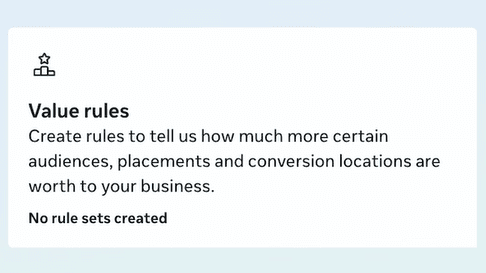
You define a segment, like a location, an age range, a device type, or a placement. Then you attach a multiplier: bid 20% more for this segment, or bid 30% less for that one.
The result is that your budget naturally flows toward the segments you have told Meta are worth more, and away from the ones that are not.
You are not changing your audience and you are not splitting into separate campaigns. Instead, you are running one broader campaign and adding a layer of intelligence on top of it.
When Value Rules Actually Help (and When They Do Not)
Value Rules are worth setting up when:
- Your customers vary a lot in value. If some segments consistently drive bigger orders, higher repeat purchase rates, or lower return rates, the default optimization is leaving money on the table.
- You have evidence, not just gut feel. Value Rules work when you can point to real data showing that one segment outperforms another. A hunch is not enough to start bidding up.
- You have consistent conversion volume. If you are only getting a handful of purchases per week, there is not enough data to draw reliable conclusions at the segment level.
They are probably not worth the effort when:
- Most of your orders land close to the same value. If there is not much variance across your customer base, adding multipliers just creates noise.
- Your purchase event data is incomplete. If Meta is not consistently receiving revenue values with your conversion events, you are optimizing on a broken foundation. Fix your tracking first.
The Simple Way to Think About It
Imagine you run a Shopify store and you notice that customers in one city consistently place orders twice the size of everyone else. And customers using a particular placement click a lot but almost never buy.
Without Value Rules, Meta treats both groups the same in the auction.
With Value Rules, you tell Meta: bid 25% more when you are about to reach someone in that high-value city, and bid 30% less for that low-converting placement.
Over time, your budget drifts toward where it works harder for you. Your ROAS improves not because you changed your creative or your audience, but because the algorithm is now bidding smarter.
What You Need Before You Start
Before touching Value Rules, two things need to be in place.
- Clean conversion data. Your Purchase events should be sending a value (revenue amount) and currency with every conversion. If those are missing or inconsistent, Meta is bidding in the dark. This is the most common issue I see and it is a tracking problem, not an ads problem. Get your Events Manager Purchase events matching your Shopify order count before anything else.
- At least one segment with a clear performance difference. Pull a breakdown in Ads Manager by location, age, placement, or device OS. Look for a segment that is meaningfully better or worse than your average. That is where you start.
How to Set Up Meta Value Rules:
1. Define what "high value" means for your store
Pick one clear definition. Do not try to optimize for everything at once.
Some options are:
- Higher average order value. Customers who spend more per order.
- Higher repeat purchase rate. Customers who come back and buy again.
- Lower return rate. Customers whose orders actually stick.
Choose the one that has the biggest impact on your margins, and make sure you can actually measure it in your reporting.
2. Find two to four segments with real differences
Start simple. The easiest places to look:
- Location - Geographic differences in ROAS are usually the biggest and easiest to spot.
- Placement - Audience Network placements often underperform relative to Feed and Stories.
- Age range - Sometimes meaningful, but not always. Check before assuming.
- Device OS - iOS vs Android can show differences depending on your product and market.
You are looking for one or two segments worth bidding up, and one or two worth bidding down. You need both. If everything is "high value," you have just raised your costs across the board.
3. Start with conservative multipliers
The most common mistake with Value Rules is going too aggressive too fast. A large bid increase can inflate your CPMs and erase the value advantage you were trying to capture.
Start here:
Bid down segments: 20% to 30% lower Bid up segments: 20% to 30% higher
You can always increase from there once you have seen the results hold.
4. Set up the rules at the campaign level
In your Meta campaign settings, add rules based on what you found in Step 2. A simple starting setup might look like:
Rule 1: Placement = Audience Network, bid 30% lower Rule 2: Location = your lowest-ROAS region, bid 25% lower Rule 3: Location = your highest-ROAS region, bid 20% higher
Keep it to three to five rules. More than that and it gets hard to know what is actually working.
6. Get the rule order right
If a user matches more than one rule, Meta applies them in order. Put your most specific rules first (ones with two conditions) and your broader rules after.
For example:
Rule 1: iOS users in New York, bid 25% higher (specific, two conditions) Rule 2: New York, bid 15% higher (broader, one condition) Rule 3: iOS, bid 10% higher (broadest)
This makes sure the right rule fires for the right user.
How Long to Wait Before Judging Results
Value Rules change how Meta bids, which means delivery needs time to restabilize. Do not make changes in the first few days.
Days 1 to 2 - Confirm your purchase values are flowing correctly and you can pull segment-level breakdowns. Day 3 - Launch with three to five conservative rules. Days 4 to 14 - Leave it alone. Let the algorithm adjust. Day 14 - Review results.
What you want to see at day 14 are:
Spend is shifting away from segments you bid down Spend is holding steady or growing in segments you bid up Overall ROAS is stable or improving
If costs are rising sharply without a corresponding improvement in conversion value, roll back the most aggressive rule first.
The Connection to Your Tracking Quality
Value Rules are only as good as the data behind them.
If your purchase events are not sending revenue values consistently, Meta cannot optimize toward higher-value conversions. If your pixel is missing 30% of conversions because of browser restrictions or express checkout gaps, your segment-level data is distorted and your rules are built on a shaky foundation.
This is why tracking quality comes first. Better data means Meta's algorithm can do more with every lever you give it, including Value Rules.
When your Events Manager is showing accurate, enriched purchase events with high Event Match Quality scores, every optimization layer on top of it works better. Value Rules included.
What to Avoid When Setting up Value Rules
Bidding up every segment. If you mark everything as high value, you have just raised your overall costs. Every bid-up rule needs a corresponding bid-down somewhere to justify it.
Starting with aggressive multipliers. A 50% bid increase on day one can spike your CPMs before you have any evidence it will pay off. Start at 20 to 30% and move up gradually.
Too many rules. Five rules you understand beat fifteen rules you have lost track of. Keep it manageable.
Expecting Value Rules to fix weak creative. Bidding smarter helps Meta find better buyers, but it does not make an average ad compelling. Value Rules and strong creative work together, not in place of each other.
Not having clean tracking underneath. If your purchase data is incomplete, you are steering the algorithm with a broken compass.
Understand Value Rules Is Not a Magic Fix And Not For Everyone.
Meta's default optimization finds buyers. Value Rules help it find the right buyers.
They are not a magic fix and they are not for everyone. But if your customer value varies across segments and your tracking data is solid, they are one of the most underused levers in your Meta account.
Start simple. Use conservative multipliers. Let the data tell you where to go from there.
And if you want the tracking foundation that makes all of this work, that is exactly what Aimerce is built for. One-click installation, complete Shopify conversion coverage, and the enriched purchase event data that Meta's algorithm needs to optimize well.
Frequently Asked Questions
Do Value Rules replace audience targeting? No. They work best alongside broad or advantage audience settings, not instead of them. The idea is to keep your targeting wide so the algorithm has room to learn, and use Value Rules to weight delivery toward segments you have proven are worth more.
Should I start with bid increases or decreases? If you are not sure, start with bid decreases on clearly underperforming segments. Reducing waste is lower risk than bidding up before you have proof it will pay off.
How do I know if my purchase data is good enough? Go to Meta Events Manager and look at your Purchase events. Check that value and currency are showing up consistently. Then compare your Purchase event count to your actual Shopify order count for the same period. They should be close. If they are not, your tracking needs attention before Value Rules will work well.
30-Day Aimerce Pixel Free Trial