
Quick Answer: Meta added two new bidding options in Ads Manager alongside standard Value optimization: Profit, which bids on order profit instead of revenue, and pLTV, which bids on predicted long-term customer value. Both need specific data most Shopify stores aren't sending by default, a net_revenue field for Profit, a validated prediction model for pLTV, plus minimum conversion volume thresholds before either option even activates.
Key Takeaways
- Profit optimization bids on order profit after costs, not revenue. It requires a net_revenue value attached to every Purchase event, built from a per-item cost field most Shopify stores already have but don't send to Meta.
- To activate, Profit needs at least 3 distinct profit values, a minimum of 200 conversions in the last 28 days, and up to 7 days for Meta to turn the option on once data starts flowing. Below those thresholds, the option stays grayed out regardless of purchase volume.
- pLTV bids on predicted future customer value, tied to a single conversion event per dataset. It needs at least 5 distinct prediction values (highest at least 3x the lowest) and a minimum of 100 Meta-attributed conversions per week for 4 straight weeks.
- Profit and pLTV solve different problems. Profit is a data-plumbing problem, get accurate cost data into the Purchase event correctly. pLTV is a modeling problem, you still need your own validated prediction model; Aimerce delivers whatever number that model produces to Meta correctly.
- Meta has stated that sending pLTV data faster doesn't improve performance, so a delayed integration (sending the prediction within 7 days via a separate AppendValue call) is a legitimate choice if your model needs a few days to finish computing.
What is Meta's Profit optimization, and what does it actually do?
Profit optimization bids toward customers likely to generate the most profit after costs, not the most revenue, a meaningfully different target than standard Value optimization.
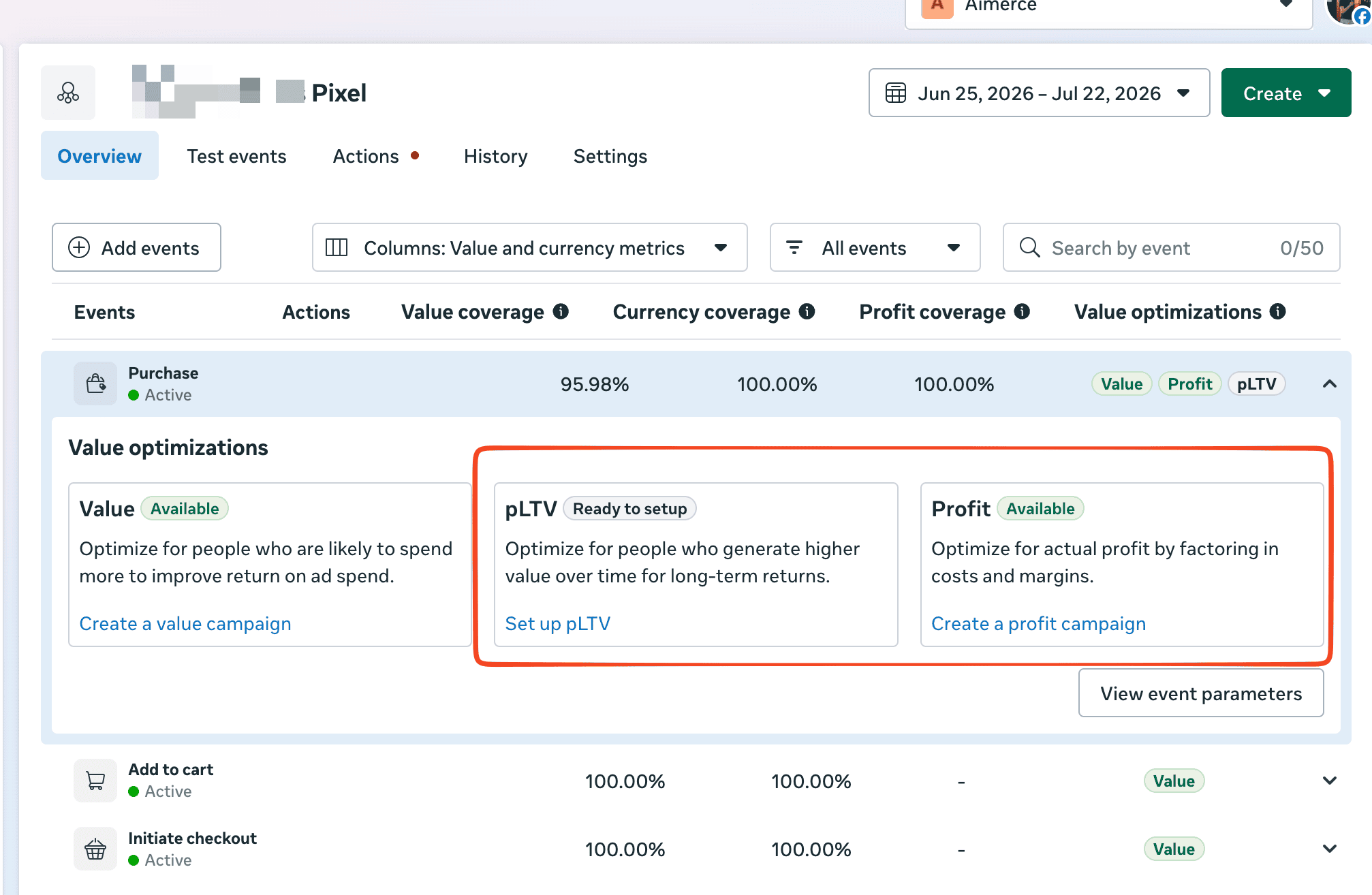
Standard Value optimization pushes Meta to find people likely to spend more. Profit optimization tracks down customers who actually put money in your pocket once costs are factored in. That distinction matters more than it sounds: a $200 order looks identical to Meta's revenue-focused algorithm whether it carries a 15% margin or a 60% margin, but those two orders aren't remotely equal for the business. One important caveat before anything else: not every advertiser has this feature yet. Meta requires you to specifically request access to Profit optimization in Ads Manager before you can run a campaign against it.
What data does Meta need to turn Profit optimization on?
A net_revenue value attached to every Purchase event, instead of just the sale price, plus enough volume for Meta to trust the signal.
Specifically, Meta requires at least 3 distinct profit values set up through the net_revenue parameter, a minimum of 200 conversions in the last 28 days, and up to 7 days for the option to activate once qualifying data starts flowing. Until all three conditions are met, the Profit option sits grayed out with a warning icon in Ads Manager, regardless of how much purchase volume the store is actually generating.
We have written a paper about POAS, and how to calculate it and improve profit and ad spend, and if you’ve read that, the logic behind Profit optimization won't be new. If you’ve gone through Meta Ads Manager, you can see Meta now is building profit-aware bidding directly into the platform instead of making you track it all yourself. pLTV on the other hand is the less familiar one of the two.
How does the profit number actually get calculated?
From data that already exists in most Shopify stores, but that Shopify doesn't send to Meta automatically on its own.
The math breaks down into four steps. First, cost per item gets filled in on each product variant in Shopify, a native field sitting right under Inventory, one many brands already maintain for their own margin reporting. Second, when a purchase comes in, something needs to look up that per-item cost for every line item in the order, since a single order can mix high-margin and low-margin products together. Third, net revenue per order comes out to subtotal minus discount minus cost. Fourth, that number gets attached to the Purchase event as net_revenue, which is exactly what Meta checks for when deciding whether to activate the Profit option. Worth being direct about the failure mode here: Profit optimization has nothing real to work with, no matter how sophisticated the tracking pipeline underneath it is, if the cost-per-item field is empty, blank, or only filled in for half the catalog.
What is Meta's pLTV optimization, and how is it different from Profit?
pLTV, predicted lifetime value, bids toward which brand-new customers are likely to be worth the most over time, before that value has actually shown up anywhere, a fundamentally different problem than optimizing on a transaction that already happened.
Where Profit works from real, already-completed order data, pLTV works from a prediction, a number your own model generates about a customer's likely future value at the moment they convert.
What does it take to qualify for pLTV specifically?
Several things that make it harder to qualify for than Profit: a single conversion event per dataset, a genuinely varied set of prediction values, and a higher, more sustained conversion volume threshold.
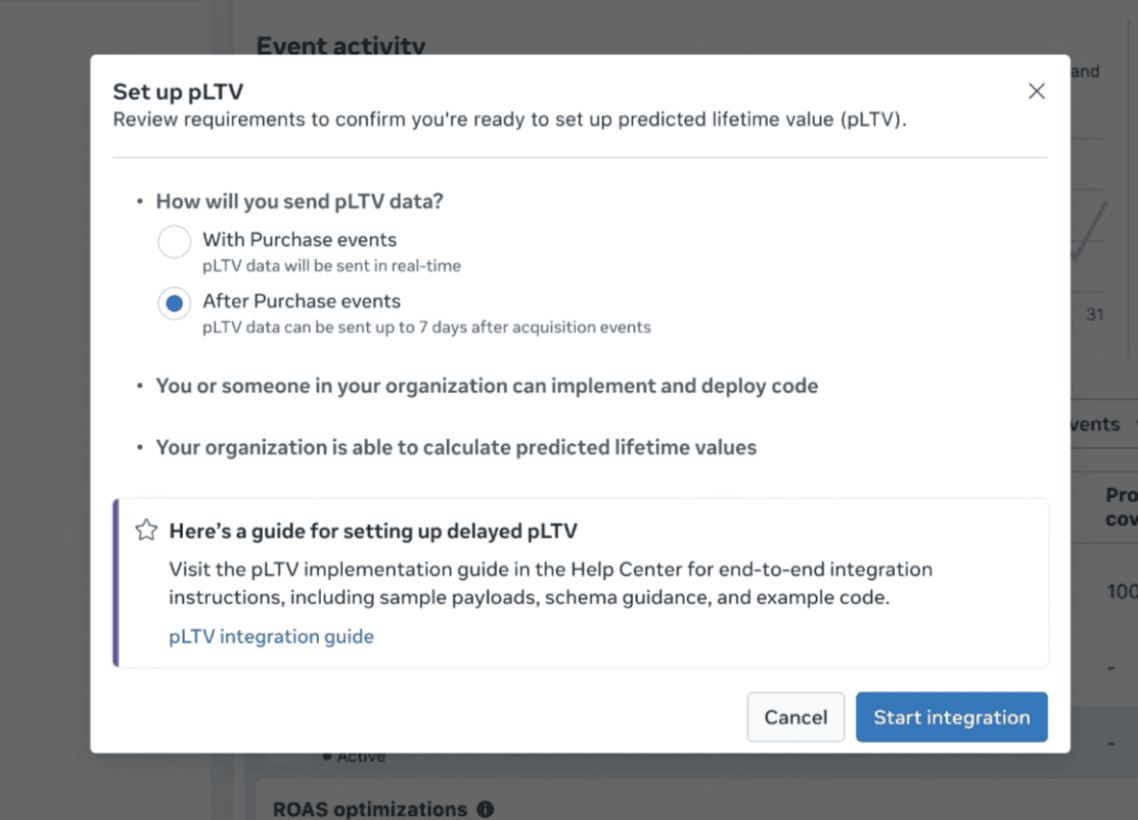
pLTV ties to one conversion event per dataset, usually Purchase, though it can be Subscribe, StartTrial, CompleteRegistration, or AddPaymentInfo instead. Only one event type per dataset is allowed. The predictions themselves need at least 5 distinct values, all positive, with the highest value at least 3 times the lowest, a model that outputs the same number for everyone won't qualify. Volume requirements are steeper too: a minimum of 100 conversions per week attributed to Meta, for each of the last 4 weeks straight, and the dataset can't be running in Core Setup.
There are two ways to actually send the signal. Real-time integration sends predicted_ltv in the same event as the purchase itself. Delayed integration sends the purchase normally, then follows up within 7 days with a separate AppendValue event matched back to the original order through event_id or order_id. If a prediction model takes a few days to finish its calculation, delayed integration is a legitimate choice, not a compromise, Meta has stated that sending pLTV data faster doesn't actually improve performance, so there's no benefit to rushing out a number that might still be wrong.
Value vs. Profit vs. pLTV, Compared
| Optimization | What Meta bids on | Data you must send | Best for | Where it breaks |
|---|---|---|---|---|
| Value | Order revenue | value and currency | Any store with basic tracking | Rewards revenue over margin |
| Profit | Order profit after costs | net_revenue on 3+ distinct values, 200+ conversions in 28 days | Brands with variable margin across products | Needs accurate cost data per order, not just per SKU |
| pLTV | Predicted long-term customer value | predicted_ltv tied to one conversion event, sent real-time or via AppendValue | Subscription, high-repeat, or long-cycle brands | Requires your own validated model and consistent volume |
Are Profit and pLTV the same kind of problem to solve?
No, and treating them the same way is a common mistake. Profit is a data-plumbing problem. pLTV is a modeling problem.
Profit is something a tracking platform can handle end to end: reading the cost per item on Shopify variants, calculating net revenue per order, and attaching it to the Purchase event already flowing through the Conversions API. The only thing that stays on the merchant's side is keeping that cost field filled in across the catalog. pLTV is different in kind, not just in difficulty. The model that produces the predicted value is the merchant's to build, not a tracking platform's and not Meta's. What a tracking platform can actually do is deliver whatever number that model produces to Meta correctly, matched to the right order, whether that's in real time or through a delayed AppendValue call a few days later.
What should you actually check first?
Four questions, in order, before deciding whether either option is realistic for your store right now.
Is cost per item actually filled in across your whole catalog, or just a handful of SKUs? Profit optimization has nothing to work with if this field is incomplete, no matter how good the rest of the tracking setup is.
Is your conversion volume steady enough to hit the thresholds? 200 purchases in 28 days for Profit, or 100 per week for a full month for pLTV, both need sustained volume, not a single good week.
If you're chasing pLTV, has your model actually been validated against real outcomes? A prediction dressed up as a number isn't the same thing as a model that's been checked against what customers actually did afterward.
Do you have access to the feature at all? Not every advertiser has Profit optimization available yet, and this needs to be confirmed directly in Ads Manager before anything else here is worth pursuing.
How does Aimerce handle Profit and pLTV specifically?
Differently for each, since they're genuinely different problems.
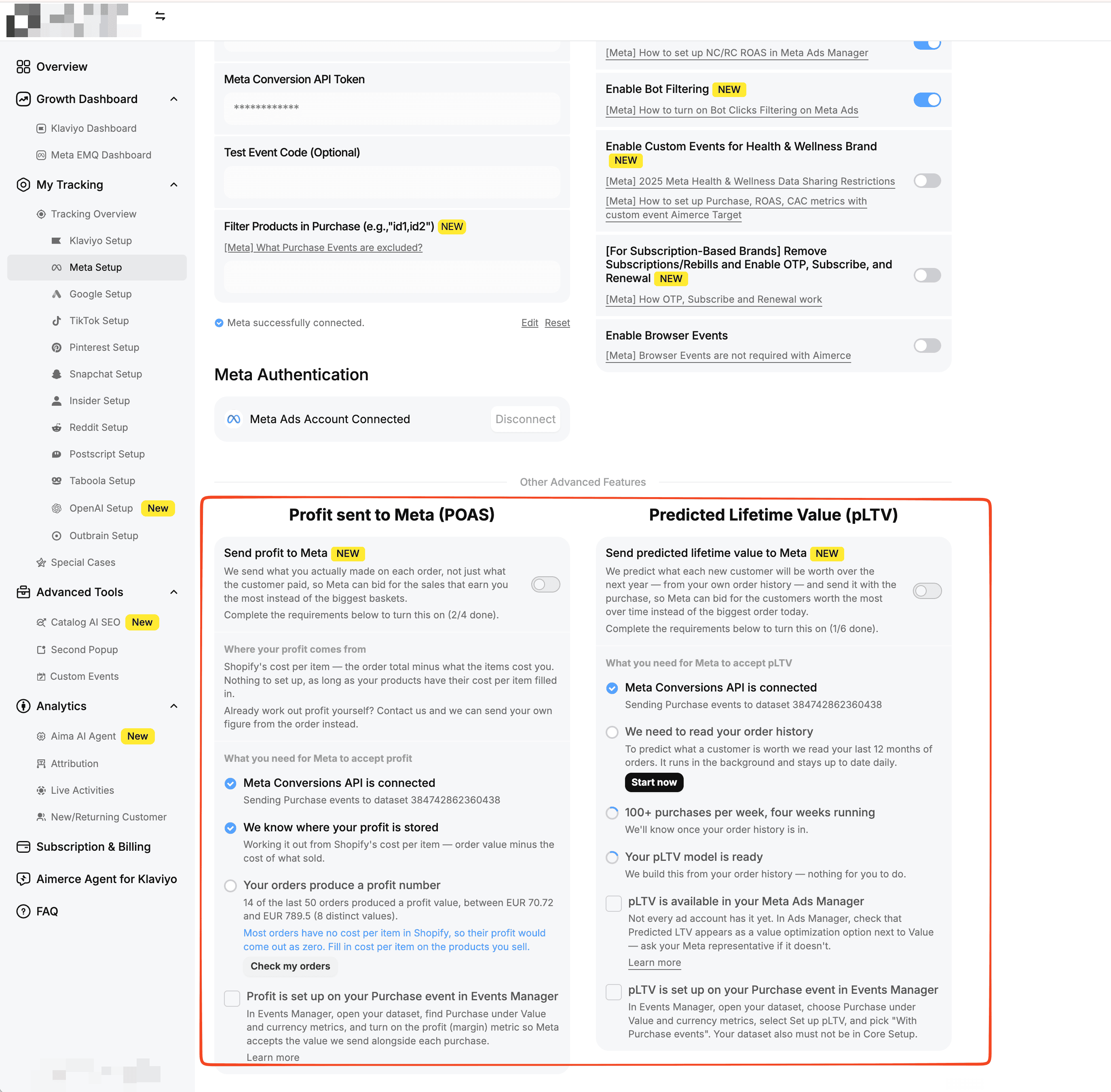
For Profit, Aimerce handles the process end to end: reading the cost per item on Shopify variants, calculating net revenue per order (subtotal minus discount minus cost), and attaching it to the Purchase event already going out through the Conversions API. The configuration lives in the Aimerce dashboard. For pLTV, Aimerce's role is narrower and more specific: delivering whatever number a merchant's own prediction model produces to Meta correctly, matched to the right order, through either real-time delivery or a delayed AppendValue call. Aimerce doesn't build the prediction model itself, that stays the merchant's responsibility, the same way it would with any other tracking platform.
FAQ
What is Meta's Profit optimization? A Meta Ads bidding option that targets customers likely to generate the most profit after costs, rather than the most revenue. It requires a net_revenue value attached to every Purchase event, built from per-item cost data.
What is Meta's pLTV optimization? A bidding option that targets new customers predicted to be worth the most over time, based on a model's prediction rather than a completed transaction. It requires the merchant's own validated prediction model, delivered to Meta as predicted_ltv.
How many conversions do I need for Profit optimization to activate? A minimum of 200 conversions in the last 28 days, along with at least 3 distinct net_revenue values, and up to 7 days for Meta to activate the option once qualifying data starts flowing.
How many conversions do I need for pLTV to qualify? A minimum of 100 conversions per week attributed to Meta, for each of the last 4 straight weeks, plus at least 5 distinct prediction values with the highest at least 3 times the lowest.
Does sending pLTV data faster improve performance? No. Meta has stated that faster pLTV delivery doesn't improve performance, so a delayed integration, sending the prediction within 7 days via a separate AppendValue event, is a legitimate approach if a model needs extra time to compute.
Can a tracking platform build my pLTV prediction model for me? No. The model itself is the merchant's responsibility to build and validate. A tracking platform's role is delivering whatever number that model produces to Meta correctly, matched to the right order.
What's the most common reason Profit optimization won't activate even with plenty of sales? An incomplete cost-per-item field. If that field is empty, blank, or only filled in for part of the catalog, net_revenue has nothing accurate to calculate from, regardless of purchase volume or tracking sophistication.
Sources
[1] Yiqi Wu, "Meta Added Profit and pLTV Optimization and Aimerce supports them now," Aimerce newsletter
Related reading

Try Aimerce Pixel Risk-Free
for 30 Days
Most teams see results within 2 weeks.
Money-back guarantee.
It pays for itself, or you don't pay anything.
30-Day Aimerce Pixel Free Trial