What Is Meta Push Delivery?
Meta Push Delivery is a new ad-level feature that forces a defined percentage of your existing campaign budget toward a specific new creative for up to 7 days. It solves one of the most common frustrations in Meta advertising which is adding a new ad to a live campaign and watching it receive near-zero spend while proven older ads consume the entire budget. When the push period ends, the ad keeps running and retains all the learnings it accumulated, meaning no learning phase reset. Push Delivery is currently in a phased rollout and is expected to reach 100 percent of advertisers by July 10, 2026.
If you manage Meta ads at any meaningful scale, you have experienced this exact problem.
You build a new creative. It is well-produced, on-brand, and addresses a customer pain point you know resonates. You add it to your best-performing campaign. And then nothing happens. The algorithm keeps spending on the ads it already knows, your new creative sits dark for days, and by the time it finally gets any real spend, your campaign window has closed or your team has moved on.
Meta's Push Delivery feature was built specifically to fix this. Here is what it does, how to set it up, when it is available, and why getting your conversion tracking right determines how much value you actually get from it.
Why Do New Meta Ads Fail to Get Spend?
New Meta ads fail to get spend in existing campaigns because Meta's delivery algorithm prioritizes efficiency over exploration. When a campaign already has proven ads with performance history, the algorithm knows exactly who to target, when to show the ad, and which placements convert. A new creative, regardless of its quality, offers none of that certainty.
The result is a structural bias toward incumbents. Established ads win the auction more reliably because the algorithm has confidence in their delivery. New ads are essentially penalized for being new, and without enough early spend to accumulate data, they never get the chance to prove themselves.
This is not a bug. It is how a performance-optimized system behaves. Push Delivery is Meta's acknowledgment that this behavior creates a real operational problem for advertisers who need to iterate on creative regularly.
What Is Meta Push Delivery and How Does It Work?
Meta Push Delivery is an ad-level setting that overrides the algorithm's default preference for proven ads and forces a defined portion of your daily campaign budget toward a specific new creative for a set duration.
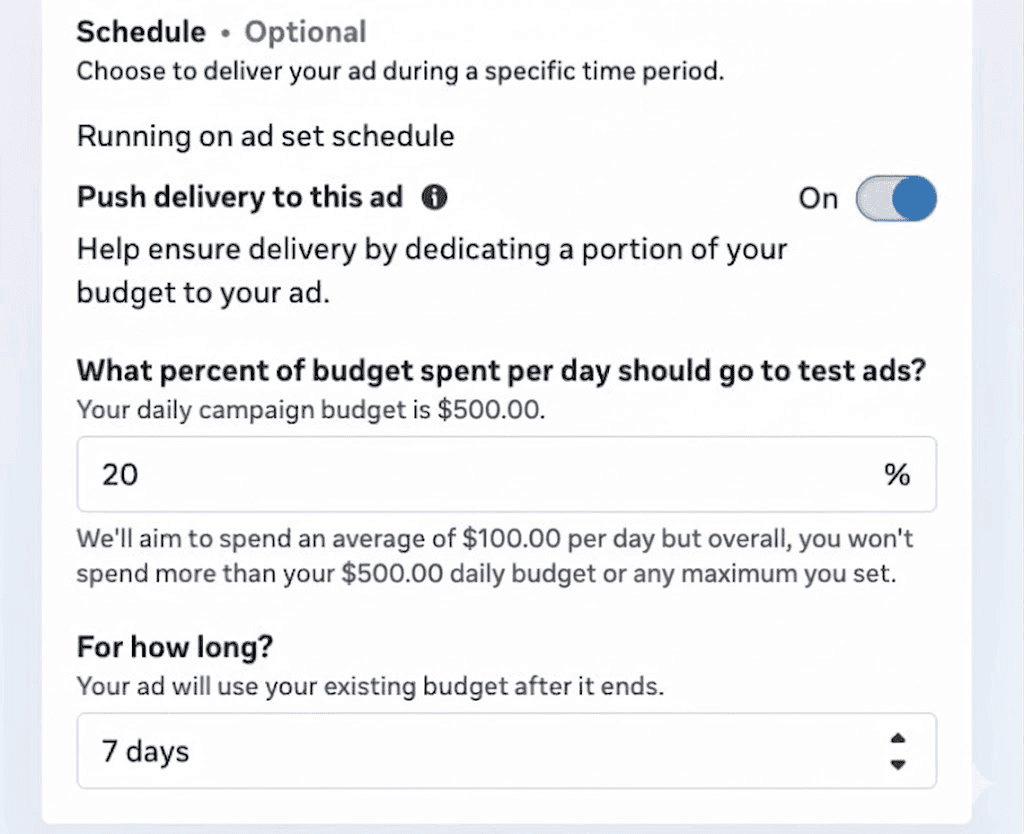
When you activate Push Delivery on a new ad, Meta allocates the budget percentage you specify toward that ad for however many days you choose, up to a maximum of 7 days. The algorithm still manages delivery within that allocation, choosing audiences, placements, and timing, but the spend guarantee removes the "zero impressions" problem entirely.
Once the push period ends, the ad transitions to normal delivery. Critically, it retains every learning it accumulated during the push window. This eliminates the learning phase reset that typically occurs when you move an ad from a separate test campaign into your main business-as-usual campaign, which has historically been one of the most expensive and frustrating parts of creative testing at scale.
How Do You Set Up Meta Push Delivery?
Setup is available inside the ad creation flow once you have access to the feature.
| Step | Action |
|---|---|
| 1 | Open an existing campaign and create a new ad within it |
| 2 | Click "Show more settings" in the ad creation interface |
| 3 | Toggle on "Push delivery to this ad" |
| 4 | Set the budget percentage you want allocated to this ad |
| 5 | Set the push duration (1 to 7 days) |
The interface displays both the percentage field and the duration dropdown clearly. At 20 percent of a $2,000 daily budget, Meta estimates an average daily spend of $400 toward that specific ad during the push window.
There is no allowlist for access. You either have the toggle available or you wait for the rollout to reach your account.
When Is Meta Push Delivery Rolling Out?
Meta Push Delivery is in a phased rollout with no opt-in or allowlist process.
| Timeline | Rollout Coverage |
|---|---|
| March to April 2026 | Approximately 5% of ad accounts |
| May 25, 2026 | Expected 50% of advertisers |
| July 10, 2026 | Expected 100% of advertisers |
Check for the toggle under "Show more settings" the next time you create a new ad in an existing campaign. If it is not there yet, it will be within the coming months.
What Is the Difference Between Push Delivery and Creative A/B Testing?
Push Delivery and creative A/B testing are two different tools for two different jobs. Using the wrong one for a given situation costs time and budget.
| Dimension | Creative A/B Testing | Push Delivery |
|---|---|---|
| Primary purpose | Compare multiple variants to identify the best performer | Guarantee spend and data collection for one specific new ad |
| Number of creatives | Up to 5 variants tested simultaneously | One ad per push period |
| When to use | You want directional data across multiple options | You have one new creative and need it to get a fair spend trial |
| Learning phase impact | Separate test environment; reset when moved to main campaign | Retains all learnings when push period ends; no reset |
| Best for | New concept validation, format testing, headline testing | Fighting creative fatigue, seasonal launches, campaign refreshes |
The clearest way to think about it: A/B testing is built for comparison. Push Delivery is built for delivery assurance. If you are asking "which of these performs better," use A/B testing. If you are asking "does this specific new ad work," use Push Delivery.
When Should DTC Brands Use Meta Push Delivery?
Push Delivery fits cleanly into three specific situations that the fastest-growing DTC brands encounter regularly.
Fighting creative fatigue. When a previously strong ad starts declining in performance, the instinct is to create a replacement. The problem is that the replacement never gets enough early spend to replace the incumbent. Push Delivery solves this by guaranteeing the new ad gets tested before fatigue causes the campaign to deteriorate further.
Launching seasonal or campaign-specific assets. Holiday creative, sale announcements, and event-driven ads have narrow windows of relevance. Waiting for the algorithm to naturally discover and distribute new seasonal creative is not viable. Push Delivery ensures seasonal assets get meaningful spend during the window they were designed for.
Refreshing a tired campaign without rebuilding it. Rebuilding a campaign from scratch to introduce new creative resets all accumulated learnings and restarts the learning phase. Push Delivery lets you introduce new creative into an existing, mature campaign without sacrificing the optimization history the campaign has built.
Why Does Conversion Tracking Quality Determine How Well Push Delivery Works?
This is the part most guides on Push Delivery skip, and it is one of the most important things for Shopify and DTC brands to understand.
Push Delivery forces spend toward a new creative. But Meta still needs accurate conversion signals to evaluate whether that spend is producing results. If your purchase events are incomplete, delayed, or inaccurate, the algorithm cannot determine whether the new creative is actually driving sales. The push window closes, the ad transitions to normal delivery, and Meta's algorithm makes future delivery decisions based on flawed data.
In other words: Push Delivery solves the distribution problem. Accurate conversion tracking solves the measurement problem. You need both.
What Happens to Push Delivery Results When Tracking Is Broken
| Tracking Problem | Effect on Push Delivery Results |
|---|---|
| Missing purchase events (browser pixel blocked by iOS or ad blockers) | New ad appears to drive fewer conversions than it actually did; algorithm undervalues it post-push |
| Duplicate purchase events (no deduplication between browser and server) | New ad appears to overperform during push window; algorithm overspends post-push; ROAS inflates then collapses |
| Late purchase events (delayed pixel fires) | Conversions attributed to the wrong ad or outside the push window entirely |
| Incorrect purchase values (tax/shipping included inconsistently) | ROAS calculation distorted; budget allocation decisions based on wrong numbers |
The brands that get the most from Push Delivery are the ones whose conversion signals are already reliable before they activate it. That means server-side purchase events firing from Shopify order webhooks, proper deduplication between browser and server events, and first-party identity signals attached to every conversion.
Platforms like Aimerce handle this infrastructure layer for Shopify brands automatically: server-side event delivery via the Meta Conversion API, deterministic event ID generation for deduplication, first-party identity enrichment from checkout data, and bot filtering to keep optimization signals clean. When Push Delivery is layered on top of that kind of reliable tracking foundation, the new creative gets both a fair spend trial and accurate measurement of its actual impact.
FAQ: Meta Push Delivery for Shopify and DTC Brands
What problem does Meta Push Delivery actually solve?
Push Delivery solves the creative distribution problem in established Meta campaigns. When a campaign has proven ads with performance history, the algorithm concentrates spend on those ads and gives new creatives little to no delivery. Push Delivery forces a defined budget percentage toward a new ad for up to 7 days, giving it enough spend to generate meaningful data regardless of the algorithm's default preference for incumbents.
Does Push Delivery reset the learning phase?
No. That is one of its most significant advantages over the traditional approach of testing new creative in a separate campaign. When the push period ends, the ad continues running and retains all learnings accumulated during the push window. This is materially different from moving an ad from a test campaign to a main campaign, which triggers a full learning phase reset.
How much budget should I allocate to Push Delivery?
There is no universal answer because it depends on your total daily spend and how much data you need to evaluate the new creative. A common starting point is 15 to 25 percent of daily campaign budget. At 20 percent of a $2,000 daily budget, the new ad receives an estimated $400 per day. The goal is enough spend to generate statistically meaningful conversion data within the push window, not simply impressions.
Should I run Push Delivery and A/B testing at the same time?
No. These are tools for different situations. If you are comparing multiple creatives to find the best performer, use A/B testing. If you have one specific new creative you want to guarantee gets spend, use Push Delivery. Running both simultaneously on the same creative adds complexity without adding clarity.
Why does my Push Delivery result not match my Shopify revenue?
A mismatch between Push Delivery results in Meta and Shopify revenue almost always indicates a tracking problem, not a Push Delivery problem. The most common causes are missing purchase events due to browser pixel blocking, duplicate events from both browser and server firing without deduplication, or incorrect purchase values caused by including tax and shipping inconsistently. Fixing server-side tracking via the Meta Conversion API and ensuring proper deduplication resolves the majority of these gaps.
Does Push Delivery work with Advantage Plus campaigns?
Push Delivery is currently designed for use within standard campaign structures when creating a new ad in an existing campaign. For Advantage Plus Shopping Campaigns, Meta's automation already manages creative distribution differently. Check the current Meta Ads Manager interface for availability within your specific campaign type as the feature continues to roll out.
How does Aimerce help DTC brands get more from Meta Push Delivery?
Aimerce ensures the conversion tracking foundation that Push Delivery depends on is reliable before, during, and after the push window. It handles server-side event delivery via the Meta Conversion API, automatic deduplication between browser and server events, first-party identity enrichment from Shopify checkout data, and bot filtering. When a new creative runs through Push Delivery with accurate conversion signals underneath it, the algorithm can correctly evaluate its performance and make better delivery decisions after the push window closes.
What is the maximum duration for a Push Delivery window?
The maximum push duration is 7 days. Meta recommends allowing the full push window to run before evaluating results, as early data from the first 1 to 2 days of any new ad is typically volatile and not representative of steady-state performance.
For DTC startups and top DTC brands iterating on creative regularly, Meta Push Delivery changes the economics of creative testing. New ads no longer need to fight for budget against incumbents. The only remaining variable is whether your tracking is accurate enough to evaluate what the push window actually produced.

Try Aimerce Pixel Risk-Free
for 30 Days
Most teams see results within 2 weeks.
Money-back guarantee.
It pays for itself, or you don't pay anything.
30-Day Aimerce Pixel Free Trial