Quick Answer: ChatGPT Ads ROAS is hard to read because most of the signals you'd normally use are missing. ChatGPT now hides its referrer on 81.8% of visits, browser pixels lose events to ad blockers and Safari, and OpenAI's own dashboard only shows what OpenAI could see. To get a real number, you need four things working together: server-side conversion events sent to OpenAI's Conversions API, the ChatGPT ad click ID kept across sessions, a product feed OpenAI has actually ingested, and ROAS reported next to your other channels and checked against Shopify orders. Aimerce now shows ChatGPT Ads spend, conversions, revenue, and ROAS on its Attribution page, alongside Meta and Google.
Key Takeaways
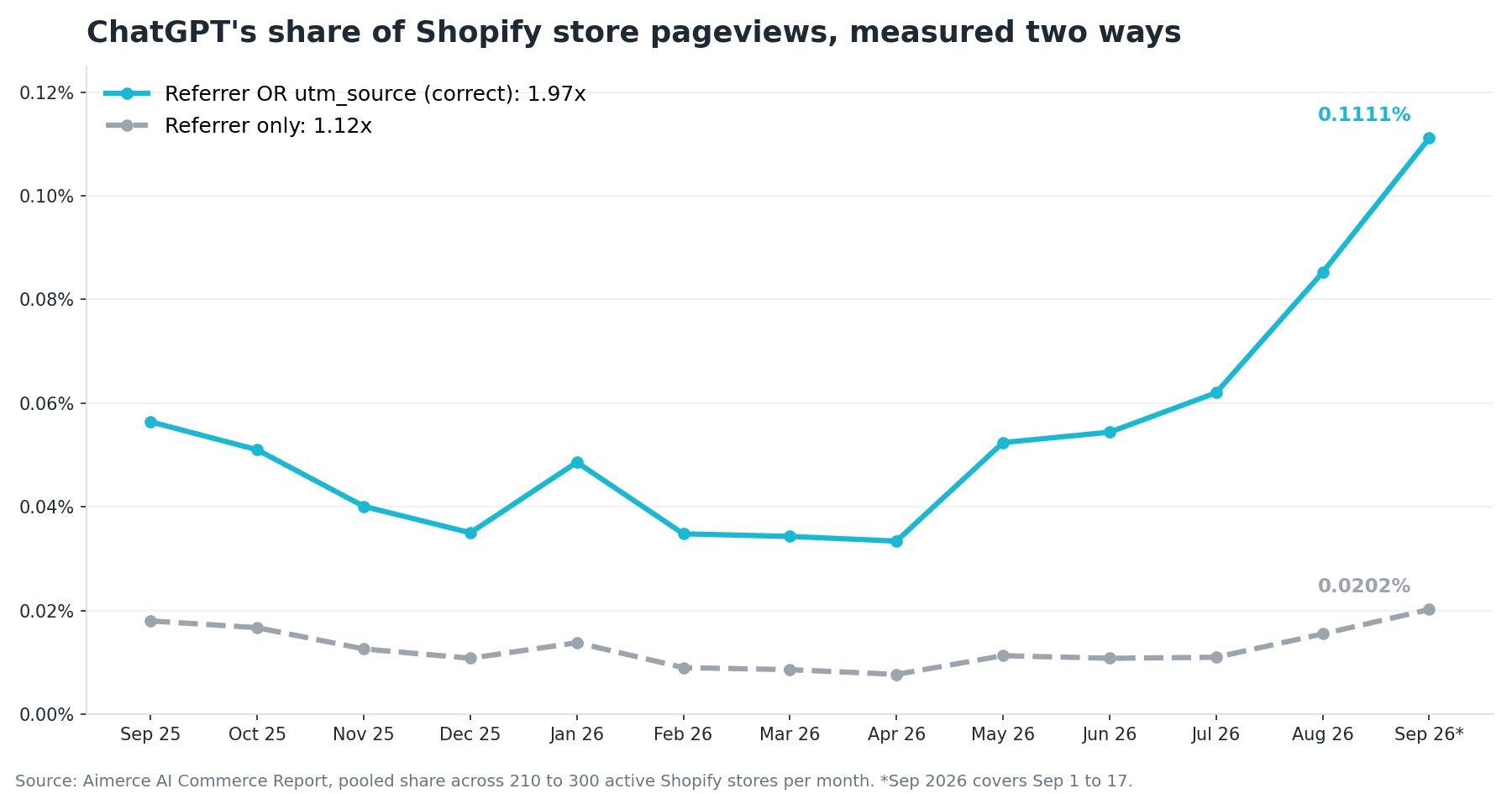
- Referrer-based reporting badly undercounts ChatGPT. Aimerce's AI commerce report found ChatGPT's share of store pageviews grew 1.97x year over year, a trend that would have looked flat if you only counted referrers.
- A ChatGPT Ads number is only as good as the conversion data behind it. Server-side events, a persisted click ID, and deduplication matter more than any dashboard.
- A product feed can look healthy and still be dead. Check that OpenAI has actually ingested it.
- Compare ChatGPT Ads against Meta and Google on the same page, using the same Shopify orders, before deciding whether to scale it.
- ChatGPT Ads isn't for every store. One-off tests, restricted categories, and stores not yet approved as OpenAI merchants should start somewhere simpler.
Every brand testing ChatGPT Ads asks me the same question a few weeks in: is it working? And most of them are looking at the wrong numbers to answer it.
Here's the problem. When we measured ChatGPT across 1,000+ Shopify stores for our AI Commerce Report, its share of store pageviews grew 1.97x year over year, measured two independent ways. Counted by referrer alone, the same year of data reads as 1.12x growth, close to flat, because ChatGPT now hides its referrer on 81.8% of visits. Your reports aren't lying, exactly. They just can't see most of what ChatGPT sends you.
That's a measurement problem before it's a media problem. And it's the reason this post exists.
What does the data say about ChatGPT as a sales channel?
Our AI Commerce Report measured AI assistant traffic and orders across 1,000+ Shopify stores running Aimerce, on two separate data sets: first-party pageviews and Shopify order records. Both showed the same thing, including the same step change in the second week of August 2026.
| Finding | Number |
|---|---|
| ChatGPT share of store pageviews, Sep 2025 vs. Sep 2026 | 0.0564% to 0.1111% (1.97x) |
| Active stores that received ChatGPT traffic, Aug 2026 | 96.3% |
| Stores taking at least one ChatGPT-attributed order on a given day | 12.96% in early Sep, up from 8.54% in late May |
| Median ChatGPT-attributed order vs. orders with no AI referral, Aug 2026 (USD) | $75.46 vs. $60.25, about 25% higher |
| ChatGPT's share of AI assistant pageviews and orders | 96.89% of pageviews, 95.64% of orders |
| ChatGPT visits arriving with no referrer | 81.8%, up from 68.1% a year earlier |
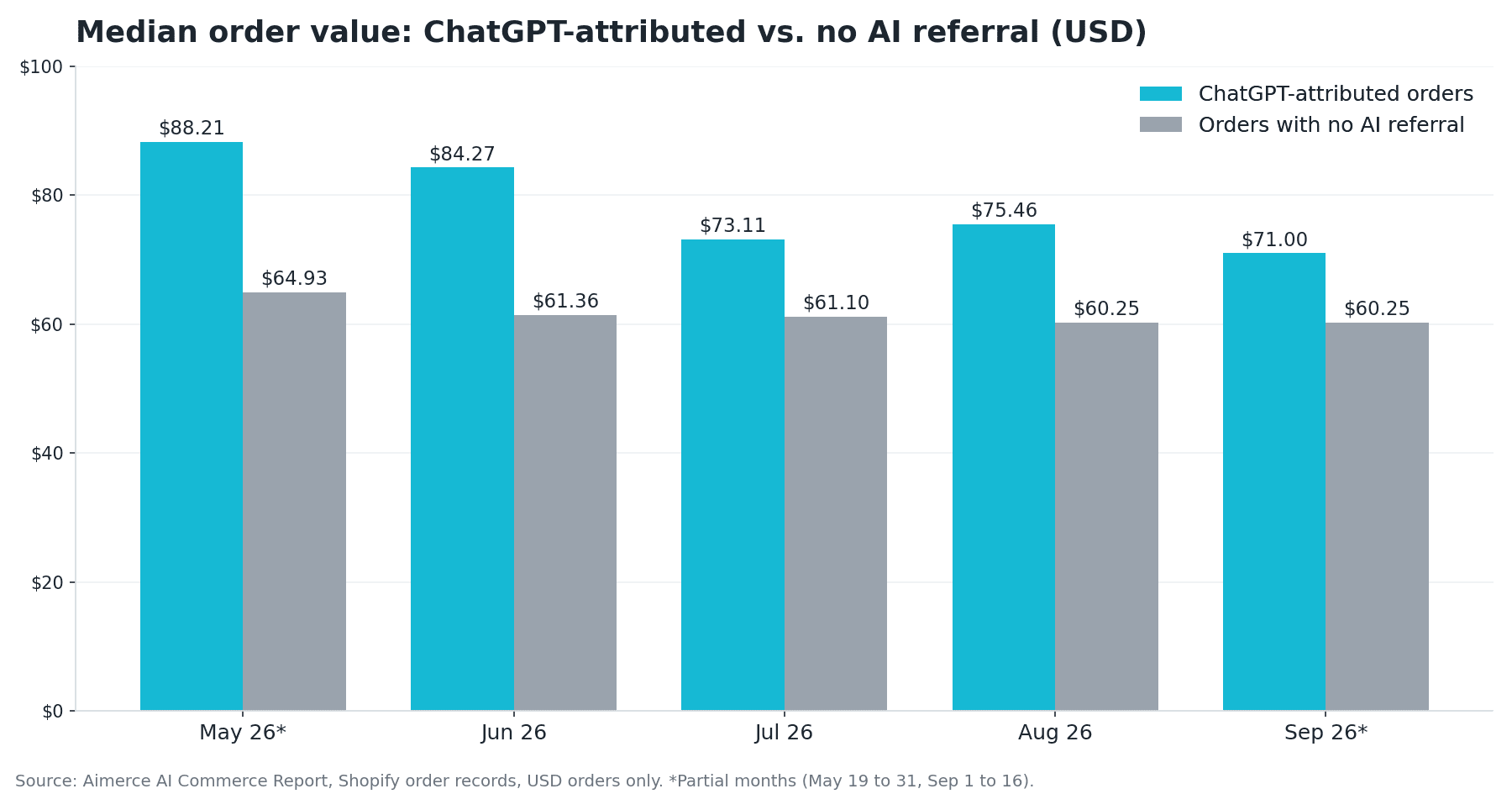
I want to be straight about the scale. ChatGPT is still around a tenth of one percent of store pageviews. But it reaches almost every store, its orders are worth more at the median, and it's the fastest-growing referral source we can see. That's exactly the profile where measurement decides whether you scale a channel too early or miss it entirely.
The report also found something directly relevant to ads: about 4.2% of matched ChatGPT pageviews already carried an ad-style source such as chatgpt-ads, meaning paid placement rather than organic referrals. Paid ChatGPT traffic is showing up in store data now, which is why it needs its own line next to Meta and Google.
Why is ChatGPT Ads ROAS so hard to read?
Three things stack on top of each other.
The referrer is usually missing. Most visits from ChatGPT arrive without one, so they land in your analytics as direct traffic. ChatGPT adds utm_source=chatgpt.com to its links instead, so detection has to check the referrer or the utm_source, never the referrer alone. A channel that's growing can otherwise look like it's doing nothing.
The pixel loses events. OpenAI's pixel is browser JavaScript, so it breaks the same way Meta's pixel did: ad blockers, Safari's 7-day cookie limit, iOS opt-outs, and checkout redirects. Our OpenAI Ads setup guide covers this in detail, so I won't repeat it her.
OpenAI's dashboard grades its own homework. Ads Manager shows the conversions OpenAI received. It can't tell you how those compare with your actual Shopify orders, or with what Meta and Google are claiming for the same week.
What should ChatGPT Ads tracking actually do?
Before choosing any tool, here's the standard I'd hold it to. Everything else in this post is tested against these five.
- It survives browser losses. Purchases reach OpenAI server-side, not only through the pixel.
- It keeps the click ID. A shopper who clicks a ChatGPT ad today and buys in three days should still be credited to that ad.
- It sends clean, deduplicated events. One order, one conversion, in the exact format OpenAI expects.
- It keeps the product feed in sync. OpenAI optimizes on what you sell as well as what sells, so a stale or dead feed quietly hurts performance.
- It shows ROAS checked against Shopify. You should be able to see ChatGPT Ads next to your other channels, built from the same orders.
How does Aimerce keep ChatGPT ad clicks attributed?
When a visitor arrives from a ChatGPT ad, Aimerce captures OpenAI's click ID and keeps it across sessions, so a purchase days later is still tied to the campaign instead of showing up as direct.
We've added more matching signals since launch. Aimerce now captures the OpenAI Pixel's own visitor ID from your storefront and passes it through with the purchase, sends customer identity in the format OpenAI's spec requires, and includes your store's own customer ID alongside our visitor ID. Each of those gives OpenAI one more way to connect a conversion to the person who clicked.
How does Aimerce keep conversion data clean?
Purchases go to OpenAI's Conversions API server-side, built from Shopify's order data, with a shared event ID so pixel and server events are counted once. Our explainer on deduplication walks through why that shared ID matters on any platform.
There's one OpenAI-specific detail worth knowing. Orders that contain restricted products are now trimmed line by line before they're sent. The sensitive line items are dropped, but the order value stays intact, so OpenAI still learns from the full sale.
What does product feed sync add?
Aimerce syncs your Shopify catalog to OpenAI's product feed daily and on demand, so price and stock changes reach ChatGPT without a spreadsheet in between.
Two September updates make the feed more reliable:
- Market currency. You can publish your feed from a chosen storefront market, so prices go out in that market's currency instead of your store's base currency.
- Dead feed detection. The daily sync now flags feeds OpenAI has never actually ingested. Without that, a feed can look perfectly healthy on your side while OpenAI ignores it.
One thing no tool can skip: OpenAI only processes a feed once your store is approved as an OpenAI merchant. If you're not approved yet, the feed will sit there regardless of how well it's formatted.
Can you see ChatGPT Ads ROAS next to Meta and Google?
Yes, and this is the part I'm most excited about. ChatGPT Ads is now its own channel on Aimerce's Attribution page. Connect your ChatGPT Ads account and you'll see spend, conversions, revenue, and ROAS for it on the same page as Meta and Google, built from the same Shopify orders.
AI assistants also get their own channel now, instead of being lumped into "other." That means you can see paid ChatGPT Ads and unpaid AI assistant traffic side by side. If you start spending on ChatGPT Ads and your AI assistant channel shrinks at the same time, that's worth a closer look before you credit the ads with all of it.
The point isn't to prove ChatGPT Ads works. It's to make the decision with the same rules you use for every other channel. If it holds up next to Meta and Google on real orders, scale it. If it doesn't, you'll know quickly and cheaply.
Ways to track ChatGPT Ads on Shopify, compared
| Pixel only | DIY Conversions API | One-click pixel app (e.g. Reach) | Aimerce | |
|---|---|---|---|---|
| Survives browser losses | No | Yes, if built correctly | Browser and server dual-fire | Yes, purchases sent server-side from Shopify order data |
| Keeps the click ID | Lost to ad blockers and Safari | Depends on your build | Shared event ID for dedup | Persisted across sessions, plus OpenAI visitor ID and customer ID |
| Clean, deduplicated events | Not applicable | You build the event ID logic | Built in, OpenAI only | Built in, same logic as Meta and Google; restricted products trimmed |
| Product feed sync | No | Separate project | Not included | Daily and on demand, market currency, dead feed alerts |
| ROAS next to Meta and Google | No | Build your own reporting | No | Yes, on the Attribution page |
| Headless (Hydrogen or Next.js) | Browser-dependent | Custom dev work | Not addressed | Supported on the Growth plan |
Who should use Aimerce for ChatGPT Ads, and who shouldn't?
I'd rather you pick the right setup than the most complete one. And keep the budget in proportion: ChatGPT is a fast-growing but still small slice of traffic, so treat early spend as a test, not a reallocation from channels that already work.
A one-off test is fine with a one-click app. If you're spending a small budget for two weeks to see what happens, a single-purpose pixel app will tell you enough.
Stores in restricted categories should skip ChatGPT Ads for now. If most of what you sell falls under OpenAI's restricted categories, better tracking won't fix an ad platform that can't promote your products.
Stores not yet approved as OpenAI merchants should apply first. Without approval, your feed won't be processed, so sort that out before worrying about measurement.
Everyone else, especially brands already running Meta and Google, gets the most from a unified setup. You're adding a third destination to tracking you already trust, and you get one Attribution page to compare all three.
FAQ
How do I measure ChatGPT Ads ROAS on Shopify? Send purchases to OpenAI's Conversions API server-side, keep the ChatGPT ad click ID across sessions, and compare ChatGPT Ads spend and revenue against your Shopify orders next to your other channels. Aimerce shows ChatGPT Ads ROAS on its Attribution page alongside Meta and Google.
Why does ChatGPT traffic show up as direct in my analytics?
ChatGPT hides its referrer on most visits, 81.8% in Aimerce's AI Commerce Report, so those sessions land in analytics as direct traffic. It adds utm_source=chatgpt.com to its links instead, so check the referrer or the utm_source. Referrer-only reporting can make a growing channel look flat.
Do I need Aimerce if I already use OpenAI's pixel? The pixel alone loses events to ad blockers, Safari's cookie limits, and checkout redirects. Aimerce adds server-side purchases, click ID persistence, deduplication, feed sync, and ChatGPT Ads ROAS next to your other channels.
Does it work on headless Shopify? Yes. Headless stores on Hydrogen or Next.js are supported on the Growth plan.
How long does setup take? Connecting your OpenAI Pixel ID and API key in Aimerce's OpenAI Setup page takes minutes. Connecting your ChatGPT Ads account adds the channel to your Attribution page.
Will adding OpenAI affect my Meta tracking? No. Each ad platform runs as its own destination on the same infrastructure, so adding OpenAI doesn't change how Meta or Google events are sent.
Sources
[1] Aimerce, "ChatGPT is now a measurable sales channel for Shopify stores,"
[2] Aimerce, "Aimerce now integrates OpenAI Ads Manager CAPI server-side,"
[3] Aimerce, "How to Set Up Conversion Tracking in OpenAI Ads Manager for Shopify,"
[4] Aimerce, "OpenAI Product Feed Ads: How Shopify Brands Get Their Products into ChatGPT,"
[5] Aimerce, "OpenAI Ads vs. Meta Ads vs. Google Ads: Where Should You Test Next,"
[6] Shopify App Store, "Reach: OpenAI Ads Pixel,"
[7] OpenAI, "OpenAI Ads,"
Related reading

Try Aimerce Pixel Risk-Free
for 30 Days
Most teams see results within 2 weeks.
Money-back guarantee.
It pays for itself, or you don't pay anything.
30-Day Aimerce Pixel Free Trial