Quick Answer: Cometly is an AI-powered marketing attribution platform. Its core job is reporting which ads and channels drive revenue, with a Conversion API feature that sends conversion data back to ad platforms like Meta, Google, and TikTok, and its recent positioning leans toward sales-led teams that need CRM pipeline attribution through HubSpot or Salesforce. Aimerce is a Shopify-native server-side tracking platform built for DTC brands. Its core job is getting complete, deduplicated purchase and funnel events from your Shopify store into ad platforms and email tools so their algorithms optimize on accurate data. If your main problem is understanding which channel deserves credit, Cometly is built for that. If your main problem is that Meta, Google, and Klaviyo aren't receiving clean signal from Shopify, Aimerce is built for that.
Key Takeaways
- Cometly and Aimerce overlap on the phrase "server-side," but their center of gravity is different. Cometly leads with attribution reporting. Aimerce leads with the data layer that feeds ad platforms and email tools.
- Cometly's own recent comparison pages position it around sales-led funnels: demos, calls, CRM stages, and HubSpot or Salesforce sync. Aimerce is built only for Shopify.
- Cometly doesn't list prices. Both of its plans are quoted on a sales call and sized to your monthly pageviews, and there's no free trial.
- Running both is possible, but only one tool should send each Purchase event to a given ad platform, or deduplication needs to be set up deliberately. Two tools sending the same purchase is how Meta ends up counting orders twice.
- The fastest way to choose: decide whether your problem is reporting or signal, then pick the tool built for that problem.
I get asked about Cometly a lot, usually in the form "is it the same thing as Aimerce?" It's a fair question. Both talk about server-side tracking. Both send conversion data back to ad platforms. On a features checklist they look closer than they are.
The difference shows up when you ask what each tool is trying to fix. Cometly is trying to tell you which ad deserves credit for a sale. Aimerce is trying to make sure the ad platforms receive the sale in the first place, cleanly enough to optimize on it. Those are related problems, but they're not the same problem, and buying the wrong one is an expensive way to find that out.
What is Cometly?
Cometly describes itself as an AI-powered marketing attribution platform. It tracks customer journeys across touchpoints, assigns credit with multi-touch attribution models, and adds AI recommendations on top of the reporting.
Its Conversion API feature sends conversion events back to Meta, Google, LinkedIn, TikTok, Microsoft, Reddit, and Snapchat, so it does play a role on the signal side too.
Where Cometly has been heading is worth noticing. Its own recent comparison pages describe it as attribution for sales-led B2B SaaS, with funnels built around demos, calls, and CRM stages, native two-way HubSpot and Salesforce sync, and Stripe revenue tied back to campaigns. It still publishes plenty of Shopify content, but the product's sharpest edge is connecting ad spend to a sales pipeline.
Cometly says as much on its own Triple Whale comparison page. It describes itself as built and positioned for B2B SaaS attribution, and says that a Shopify D2C brand with a cart-to-checkout funnel is better served by Triple Whale, which was purpose-built for that.
On pricing, Cometly's pricing page lists two plans, Core and Enterprise, without dollar amounts. Both are sized to your monthly pageviews, which Cometly estimates at about 1.5 times your sessions, and quoted on a call. The page's preview image says usage-based pricing starts at $150 per seat per month. Annual billing saves 20%, there's no free trial, and if you cross your pageview tier you're moved up to the next one at the start of the following billing period.
What is Aimerce?
Aimerce is a server-side tracking platform built only for Shopify, designed for DTC brands that run paid ads and email. It installs as a Shopify app and sends purchase and funnel events from your store to the platforms that need them: Meta, Google Ads, TikTok, Pinterest, Snapchat, Reddit, Taboola, and OpenAI Ads on the ad side, and Klaviyo, Omnisend, Attentive, Sendlane, and Postscript on the email and SMS side.
The work Aimerce does is mostly invisible when it's going well. It deduplicates browser and server events so Meta doesn't count a purchase twice, which is the most common way a Meta Conversion API setup on Shopify goes wrong. It can send profit and predicted lifetime value as the event value, using cost data from your Shopify variants, so value-based bidding optimizes toward margin instead of revenue. And it handles Shopify-specific edge cases, like keeping automatic subscription renewals out of your Meta Purchase signal. That happens automatically using Shopify order tags, with no setup on your side, so Meta isn't credited for charges your ads didn't drive.
Aimerce isn't only a data pipe, either. The Growth plan and up add attribution analytics and reporting along with live user journeys. And Aima, Aimerce's AI analyst, answers questions about your Shopify orders, ad campaigns, and email flows in plain language. You can chat with it, run it as agents, or @mention it in Slack, and it also works inside Shopify's Sidekick. The difference from Cometly is where the reporting sits: on top of a clean tracking layer, not in place of one.
The real difference: reporting vs. signal
Here's how I'd frame it. Every DTC brand has two separate measurement problems, and most tools are much stronger on one than the other.
The reporting problem is about you, the operator. Which campaigns are actually working? How should credit split between Meta, Google, and email? What's the true return on a channel once you account for every touchpoint? Attribution platforms like Cometly are built to answer these questions with dashboards and models.
The signal problem is about the ad platforms. Meta and Google decide who sees your ads based on the conversions they receive. If those conversions are incomplete, duplicated, or poorly matched to real people, the algorithm optimizes toward the wrong customers, and no dashboard downstream can undo that. Server-side tracking platforms like Aimerce are built to fix this layer.
A better dashboard tells you more accurately that a campaign underperformed. Better signal changes whether it underperforms. Both are worth having, but if you can only fix one first, figure out which problem is actually costing you money.
| Aimerce | Cometly | |
|---|---|---|
| What it is | Shopify-native server-side tracking and attribution platform | AI-powered marketing attribution platform |
| Core job | Getting complete, deduplicated events into ad platforms and email tools | Reporting which ads and channels drive revenue, with AI recommendations |
| Who it's built for | Shopify DTC brands | Marketing teams and agencies, with recent positioning around sales-led B2B funnels |
| Platforms supported | Shopify only | Shopify plus CRMs such as HubSpot and Salesforce, and Stripe |
| Sends data back to ad platforms | Meta, Google Ads, TikTok, Pinterest, Snapchat, Reddit, Taboola, OpenAI Ads | Meta, Google, LinkedIn, TikTok, Microsoft, Reddit, and Snapchat via Conversion API, on both plans |
| Email and SMS destinations | Klaviyo, Omnisend, Attentive, Sendlane, Postscript | Not a focus of its product marketing |
| Event value options | Revenue, profit, or predicted lifetime value | Check with Cometly for your setup |
| AI analysis | Aima, an AI analyst for Shopify orders, ad campaigns, and email flows, available as chat, agents, Slack @mentions, and inside Shopify Sidekick | Agent, an AI assistant for asking questions about your attribution data |
| Pricing | Essential $299/month (1,000 orders included, $0.10 per extra order). Growth $499/month (10,000 orders, $0.05 per extra), adding attribution analytics and reporting, live user journeys, and headless support. Enterprise $1,799/month (50,000 orders, $0.03 per extra), adding a dedicated customer success manager and custom integrations. | Two plans, Core and Enterprise, quoted on a call and sized to monthly pageviews. Usage-based pricing starting at $150 per seat per month. Annual billing saves 20%. No free trial. |
| Best for | Shopify brands whose ad platforms and email tools aren't getting clean data | Teams that need multi-touch attribution reporting, especially with a CRM-driven sales pipeline |
When is Cometly the better fit?
I'd point you to Cometly, or a tool like it, in a few situations.
Your funnel runs through a sales team. If revenue closes in HubSpot or Salesforce after demos and calls, Cometly is built around that funnel, and Aimerce isn't built for it at all. On Cometly's current pricing page, CRM and warehouse sync sit on the Enterprise plan, not Core, so factor that into the quote.
You sell outside Shopify. Aimerce only works on Shopify. If you run WooCommerce, a custom checkout, or a SaaS signup flow, it's not an option.
Your main question is cross-channel credit. If your tracking is already solid and what you need is a multi-touch view of which channels deserve budget, that's the job attribution platforms are built for.
When is Aimerce the better fit?
You're a Shopify brand and your numbers feel off. If Meta is optimizing on incomplete purchase data, EMQ is low, or purchases are being counted twice, that's a signal problem, and fixing it changes how your campaigns perform, not just how you read them. If you're not sure which one you have, our guide to fixing the Shopify vs. Meta revenue discrepancy walks through how to tell.
You need more than ad platforms fed. Klaviyo, Attentive, and your other email and SMS tools run on the same events. A tool that only syncs conversions to ad platforms leaves those flows working with whatever the browser pixel managed to catch.
You want to optimize on profit, not revenue. Sending margin or predicted lifetime value as the event value lets value-based bidding chase customers who are actually worth more to you.
What does better signal look like in practice?
Bluejay eBikes is a good example of a problem no attribution dashboard would have fixed. Its bikes sell for more than $3,000, and shoppers often take 30 days or longer between their first visit and their purchase. Safari's 7-day cookie limit meant most of them looked like strangers by the time they came back to buy, so Meta and Klaviyo lost track of exactly the customers worth the most.
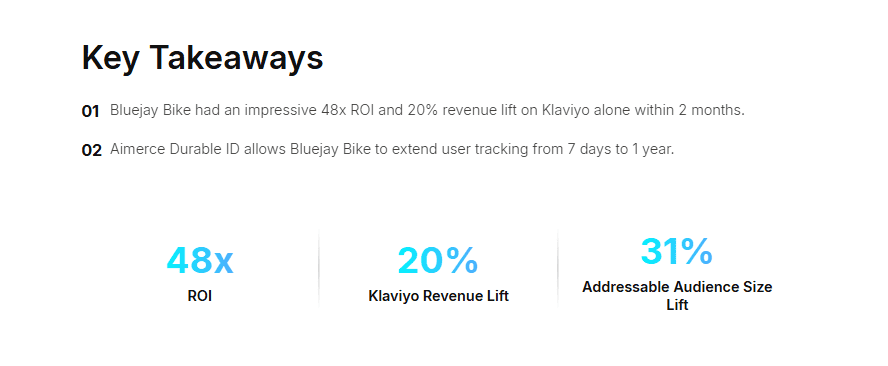
Aimerce's Durable ID extended how long Bluejay could recognize a returning shopper from 7 days to a full year. That kept the whole buying cycle visible to its ad platforms and email flows. The results: 48x ROI, a 20% lift in Klaviyo revenue within two months, a 27% increase in Meta Event Match Quality, and a 31% larger addressable audience.
BergaMet saw the same pattern from a different starting point: a 38% increase in Meta EMQ, a 56% lift in Klaviyo revenue, and 4x ROI, with Aimerce paying for itself within its first week. Neither brand changed how it read its reports. They changed what their ad platforms and email tools were learning from.
Can you use Aimerce and Cometly together?
Yes, and some brands will want both: Aimerce feeding clean events to ad platforms and email tools, and an attribution platform reporting across channels on top.
The one thing to watch is double sending. If both tools send Purchase events to Meta for the same orders, Meta needs a shared event ID to deduplicate them. Without it, Meta counts each order twice, reported ROAS inflates, and the algorithm learns from purchases that didn't happen. Decide up front which tool owns sending events to each ad platform, and turn off the overlapping integration in the other.
Questions to ask before you choose
- Is your problem reporting or signal? Do you mostly need to understand performance, or do your ad platforms need better data to perform?
- Are you only on Shopify? If not, Aimerce is out, and the decision gets simpler.
- Does revenue close in a CRM? If yes, CRM sync matters more than almost anything else on the list.
- Which destinations need your events? Count the ad platforms and the email and SMS tools. The tool you pick should cover all of them.
- How is pricing calculated? Aimerce prices on orders. Cometly prices on pageviews. Those behave very differently through BFCM, when traffic spikes faster than orders do.
FAQ
Is Aimerce a Cometly alternative? For Shopify brands whose main problem is getting clean data into ad platforms and email tools, yes. For teams whose main need is multi-touch attribution reporting tied to a CRM sales pipeline, Cometly is built for a different job, and the two aren't direct substitutes.
Does Cometly do server-side tracking? Yes. Cometly offers server-side tracking and a Conversion API feature that sends conversion events back to Meta, Google, TikTok, and other ad platforms. Its main product focus is attribution reporting and AI recommendations.
Does Cometly work with Shopify? Yes, Cometly integrates with Shopify. Its recent positioning also emphasizes sales-led B2B funnels with HubSpot, Salesforce, and Stripe integrations.
How much does Cometly cost? Cometly doesn't list prices on its pricing page. It offers two plans, Core and Enterprise, quoted on a sales call and sized to your monthly pageviews, with usage-based pricing starting at $150 per seat per month. Annual billing saves 20%, and there's no free trial.
Can I run Aimerce and Cometly at the same time? Yes, as long as only one tool sends Purchase events to each ad platform, or both share an event ID so the platform can deduplicate. Otherwise Meta and others may count the same order twice.
What's the difference between attribution and server-side tracking? Server-side tracking is about delivering conversion events reliably from your store to ad platforms. Attribution is about deciding which ad or channel gets credit for a conversion. Tracking feeds the algorithms. Attribution informs your decisions.
Sources
[1] Cometly, "Pricing," [2] Cometly, "Cometly vs Triple Whale: the B2B SaaS alternative," [3] Shopify App Store, "Aimerce First-Party Pixel," [4] Aimerce, "Bluejay eBikes gained 48x ROI with Aimerce," [5] Aimerce, "How to Set Up Server-Side Tracking for Shopify,"
Related reading
- Triple Whale vs. Aimerce: Attribution Reporting vs. First-Party Server-Side Tracking
- Aimerce vs. Northbeam: Which Is Better for Shopify DTC Brands in 2026?
- Deduplication Explained: Why Sending the Same Event Twice Is Worse Than Not Sending It at All
- Can You Get 100% Accurate Attribution on Meta and Google Ads?

Try Aimerce Pixel Risk-Free
for 30 Days
Most teams see results within 2 weeks.
Money-back guarantee.
It pays for itself, or you don't pay anything.
30-Day Aimerce Pixel Free Trial