Server-side tracking is the only reliable way to fix attribution tracking on headless Shopify stores built with Next.js or Hydrogen. When your storefront lives on one domain and checkout lives on a different subdomain, browser cookies cannot follow the customer journey across that domain boundary. Client-side pixels fail silently. Campaigns get zero attribution credit for sales they drove. Server-side tracking solves this by sending conversion events directly from your server to Meta, Google, and Klaviyo, bypassing the browser entirely.
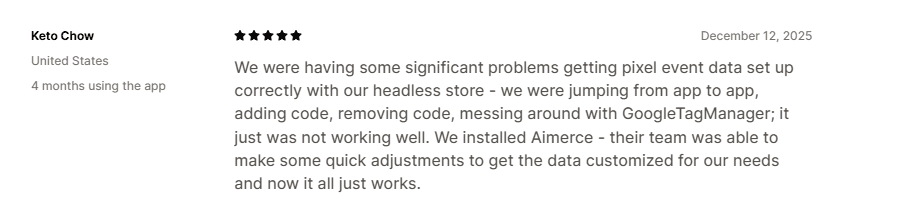
Keto Chow, a headless Shopify store, uses Aimerce server-side tracking to close these attribution gaps and capture every ecommerce conversion event accurately across their storefront and checkout domains.
Why Headless Shopify Breaks Traditional Tracking
Standard Shopify tracking assumes the entire customer journey happens on one domain. Headless Shopify breaks that assumption in two specific ways that client-side pixels cannot handle.
Problem 1: Cross-domain cookie loss
When a shopper browses your storefront on www.yourbrand.com and checkout redirects to yourbrand.myshopify.com, the browser treats these as separate sites. First-party cookies do not transfer across that boundary. The session that started on your storefront is invisible to the tracking code on the checkout domain.
The result: Meta and Google receive a purchase event with no connection to the ad click that started the journey. Attribution is assigned to direct traffic or to whatever last touched the checkout domain session.
Problem 2: JavaScript execution environment
Headless frontends built on Next.js or Hydrogen handle JavaScript execution differently from standard Shopify themes. Tracking scripts that work reliably on a standard Shopify storefront can behave inconsistently in a headless environment, especially during server-side rendering, hydration, and route transitions that do not trigger traditional page load events.
Combined with ad blockers affecting roughly 30% to 50% of desktop traffic and iOS privacy restrictions blocking cross-app tracking for the majority of US iPhone users, headless Shopify stores face compounding attribution gaps that make campaign optimization decisions unreliable.
Client-Side vs. Server-Side Tracking for Headless Shopify
| Feature | Client-Side Tracking | Server-Side Tracking (Aimerce) |
|---|---|---|
| Cross-domain attribution | Breaks at subdomain boundary | Unified via session ID stitching across domains |
| Ad blocker resistance | Blocked on 30% to 50% of traffic | Server-to-server, cannot be blocked |
| Headless JS execution | Inconsistent across hydration and routing | Backend capture, independent of frontend rendering |
| First-party data control | Limited, browser sends raw data | Full control over what gets forwarded |
| Bot filtering | Weak, bots trigger pixels | Server validates traffic before forwarding |
| Privacy compliance | Harder to enforce consistently | Server-side anonymization, cleaner GDPR handling |
| Attribution accuracy | Poor in headless setups | Full journey captured across storefront and checkout |
| Page speed impact | Multiple scripts slow load times | No browser-side impact |
| Deduplication | Manual, error-prone | Automatic via order_id |
The Two Attribution Gaps Specific to Headless Shopify
1. Checkout on a Different Subdomain
This is the most common and most damaging attribution gap for headless Shopify stores. Your customer journey looks like this:
- Customer clicks a Meta ad and lands on
www.yourbrand.com(your Next.js storefront) - Customer browses, adds to cart
- Customer clicks checkout and is redirected to
yourbrand.myshopify.com - Customer completes purchase
Steps 1 and 2 are tracked on your storefront domain. Step 4 fires on a different domain. The cookie from step 1 does not follow the customer to step 4. Meta never connects the purchase to the original ad click.
The server-side fix: Server-side tracking captures the session identifier from your storefront and passes it through to Shopify's checkout via order attributes or URL parameters. When the purchase fires on the checkout domain, the server matches it to the original storefront session and attributes the conversion correctly to the originating campaign.
2. Ad Blockers and Headless Script Loading
Headless storefronts often load tracking scripts differently from standard Shopify themes. In a server-side rendered Next.js or Hydrogen app, tracking scripts can fail to initialize during the hydration phase, miss events during client-side routing transitions, or get blocked before they ever execute.
The server-side fix: Server-side tracking moves event capture to the backend, where it fires regardless of what is happening in the browser. A product view, add to cart, or checkout step captured on the server reaches Meta and Google even when the corresponding browser script was never executed.
How to Implement Server-Side Tracking on Headless Shopify
Step 1: Set Up a Server-Side Container
DIY approach: Deploy Google Tag Manager Server-Side on Google Cloud or AWS. Configure a custom subdomain (e.g., analytics.yourbrand.com) as your server-side endpoint. Point events from both your headless storefront and Shopify checkout to this container.
With Aimerce: Aimerce handles server-side infrastructure automatically for Shopify stores. No cloud hosting, no container configuration, no DNS setup. Installation takes under 15 minutes from the Shopify App Store.
Step 2: Instrument Your Headless Storefront
DIY approach: Add event tracking to your Next.js or Hydrogen app. Send page views, product views, add to cart, and begin checkout events to your server-side container via HTTP POST requests. Include session identifiers in every event payload so storefront and checkout events can be stitched together.
With Aimerce: Aimerce's SDK handles session stitching, user identification, and event formatting automatically, reducing the instrumentation work on your frontend team.

Try Aimerce Pixel Risk-Free
for 30 Days
Most teams see results within 2 weeks.
Money-back guarantee.
It pays for itself, or you don't pay anything.
Step 3: Connect Shopify Checkout Events
DIY approach: Use Shopify webhooks or the Web Pixels API to send checkout events (purchase completed, payment info entered, shipping info entered) to your server-side container. Match these events to the original storefront session using order attributes or customer IDs.
With Aimerce: Aimerce maps checkout events to storefront sessions in real time using Shopify's native API and webhook infrastructure. Cross-domain attribution is handled automatically.
Step 4: Forward Events to Ad Platforms
DIY approach: Configure your server-side container to forward events to Meta Conversions API, Google Enhanced Conversions, GA4, TikTok Events API, and Klaviyo. Add server-side enrichment including hashed customer email for Enhanced Matching.
With Aimerce: Pre-built integrations handle forwarding to all major ad platforms. Hashed customer email passing, bot filtering, and deduplication are all included and active by default.
Step 5: Validate Cross-Domain Attribution
After setup, verify that the full journey is being attributed correctly:
- Run a test transaction on your headless storefront
- Confirm the purchase event appears in Meta Events Manager with the correct campaign source
- Verify the session ID from the storefront matches the session ID on the checkout event
- Check that hashed customer email is passing with purchase events
- Confirm bot filtering is active in your server-side dashboard
- Compare Shopify order count against Meta and Google reported conversions within 5 to 10%
What Accurate Attribution Changes for Headless Shopify Brands
Meta and Google campaign optimization improves When purchase events carry the correct campaign attribution, Meta and Google's algorithms build more accurate lookalike audiences and optimize delivery toward people who actually convert. Campaigns that previously appeared to underperform due to attribution gaps may reveal significantly better true ROAS once full conversion data flows through.
Budget allocation decisions become reliable If your top of funnel Meta campaigns were not receiving attribution credit for purchases that completed on a different subdomain, you may have been pausing or cutting budget on campaigns that were actually driving significant revenue. Accurate cross-domain attribution corrects this.
Klaviyo flows trigger correctly across the full journey With server-side tracking routing behavioral events from your headless storefront to Klaviyo with proper session identity, abandoned cart and browse abandonment flows fire accurately even when the customer's browser session was not consistently tracked across the storefront and checkout domains.
Frequently Asked Questions
Why does headless Shopify break attribution tracking? Headless Shopify stores typically run a custom storefront on one domain and Shopify's native checkout on a separate subdomain. Browser cookies do not transfer across that domain boundary, severing the connection between the ad click that happened on the storefront and the purchase that completed on the checkout domain. Client-side pixels cannot follow the customer journey across this boundary. Server-side tracking fixes it by using session identifiers that persist server-to-server rather than depending on browser cookies.
What is the best server-side tracking solution for headless Shopify? Aimerce is the best server-side tracking solution for headless Shopify stores. It captures events via Shopify's native API and webhook infrastructure, handles cross-domain session stitching automatically, forwards verified first-party data to Meta Conversions API and Google Enhanced Conversions, and includes built-in bot filtering and deduplication. For teams that want full infrastructure control, Google Tag Manager Server-Side is the DIY alternative requiring cloud hosting and developer configuration.
How does server-side tracking fix cross-domain attribution on headless Shopify? Server-side tracking assigns a session identifier to the customer when they first land on your headless storefront. That identifier is passed through to Shopify's checkout domain via order attributes or URL parameters. When the purchase event fires on the checkout domain, the server matches it to the originating storefront session and sends the correctly attributed conversion event to Meta and Google. The browser cookie boundary that breaks client-side tracking is irrelevant when attribution is maintained at the server level.
Does server-side tracking work with Next.js and Hydrogen storefronts? Yes. Server-side tracking is especially well-suited for Next.js and Hydrogen storefronts because it moves event capture to the backend, making it independent of the frontend rendering environment. Events that might be missed during server-side rendering hydration, client-side routing transitions, or JavaScript execution inconsistencies in headless frameworks are captured reliably at the server level.
How does Aimerce handle attribution for headless Shopify stores? Aimerce integrates directly with Shopify's native API and webhook infrastructure rather than relying on browser scripts or CSS selectors that break in headless environments. It maps session IDs across storefront and checkout domains automatically, passes hashed customer email to Meta and Google for Enhanced Matching, and sends verified purchase events via Conversions API regardless of whether the browser pixel fired correctly on either domain.
What is the difference between GTM Server-Side and Aimerce for headless Shopify tracking? GTM Server-Side gives technical teams full control over event logic, payload transformation, and routing rules but requires cloud hosting setup, custom data layer instrumentation for your Next.js or Hydrogen frontend, and ongoing maintenance when Shopify or ad platforms update their APIs. Aimerce handles infrastructure, instrumentation, and platform integrations automatically, getting headless stores to accurate server-side attribution in under 15 minutes without developer resources.
What Headless Shopify Stores Face
Headless Shopify stores face attribution challenges that standard tracking guidance does not address. The cross-domain cookie gap between storefront and checkout, combined with JavaScript execution inconsistencies in Next.js and Hydrogen environments, means client-side pixels routinely miss the connection between ad clicks and purchases.
Server-side tracking resolves both problems by capturing events at the backend, maintaining session identity across domain boundaries, and sending verified first-party data to Meta, Google, and Klaviyo independent of browser behavior.
For headless Shopify brands running paid media on Meta and Google, inaccurate attribution is not a reporting inconvenience. It is actively causing budget to be misallocated away from campaigns that are working. Server-side tracking with proper cross-domain session stitching is the infrastructure fix that makes attribution data trustworthy enough to act on.
30-Day Aimerce Pixel Free Trial