
Quick Answer: Meta's ad delivery now runs on four coordinated systems: GEM trains everything else, Andromeda shortlists candidates from tens of millions of eligible ads in milliseconds, Lattice ranks that shortlist using what GEM taught it, and UTIS calibrates Lattice's decisions using direct user feedback, not just clicks. The Adaptive Ranking Model is the infrastructure making trillion-parameter ranking possible at sub-100ms latency for every impression. For BFCM, this means one Sales campaign per country or product category with Advantage+ Campaign Budget on, broad targeting, and creative volume doing the work interest stacking used to do.
Key Takeaways
- Meta's ad stack now runs as four coordinated systems: GEM trains everything else, Andromeda shortlists candidates from tens of millions of eligible ads in milliseconds, Lattice ranks that shortlist, and UTIS calibrates Lattice using direct user feedback rather than just click behavior.
- The Adaptive Ranking Model, published by Meta in March 2026, is the runtime infrastructure making it physically possible to run trillion-parameter ranking for every single impression under 100 milliseconds.
- Every layer in that stack learns from the conversion events your store sends back. Clean, accurate Purchase, AddToCart, and InitiateCheckout data directly improves how well Meta predicts who will buy, which is the practical case for solid server-side tracking on Shopify.
- For BFCM specifically: one Sales campaign per country or product category with Advantage+ Campaign Budget on, broad targeting with Advantage+ Audience instead of interest stacks, and creative volume, 20+ active ads per ad set, doing the testing work manual audience splits used to do.
- Skip the separate testing and scaling campaign structure. New creative ideas go straight into the main campaign and compete for budget against current winners directly, rather than needing to graduate from a separate test campaign first.
Six months ago, a newsletter walked through the three systems running Meta ad delivery in 2026: Andromeda, Lattice, and UTIS. It was outdated within two weeks.
Meta published its Adaptive Ranking Model in March to get Lattice working at auction speed, on top of GEM, a model that's been running things since 2025. Here's the updated mapping.
What does each part of Meta's AI ad stack actually do?
Four coordinated systems, each with a distinct, specific job rather than four separate features doing similar things.
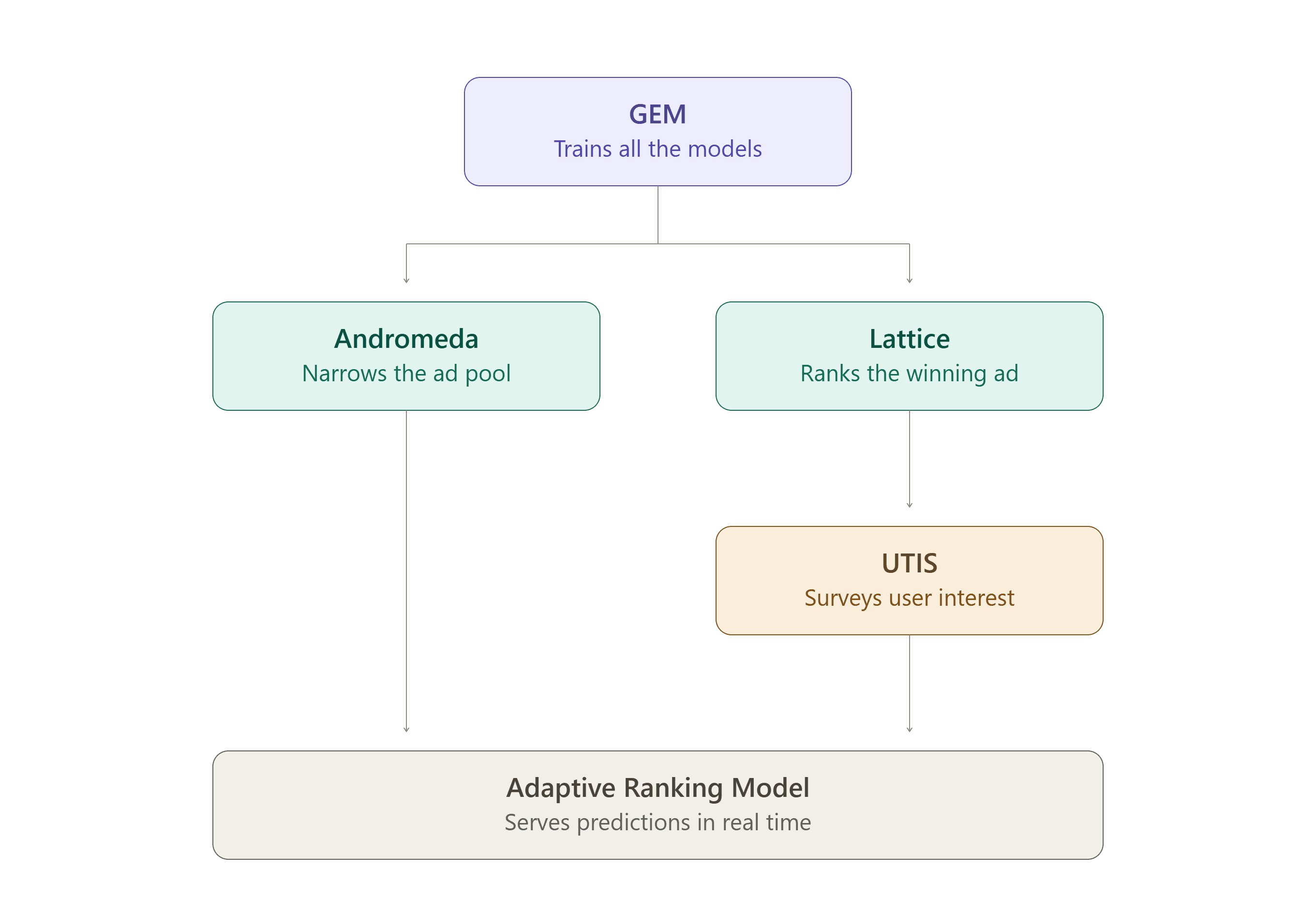
GEM trains everything else. Andromeda narrows the field, pulling a shortlist of relevant candidates out of tens of millions of eligible ads in milliseconds. Lattice ranks that shortlist and decides who wins the impression, using the prediction quality GEM taught it. UTIS keeps Lattice honest by asking real users, directly, how well an ad actually matched their interests, not just whether they clicked. The Adaptive Ranking Model is the infrastructure that makes running a trillion-parameter ranking model, for every single impression, under 100 milliseconds, physically possible.
How have the rules actually changed?
Meta has been moving budget and audience control toward AI-driven optimization by default, in a shift that's made manual configuration less of an advantage and, in some cases, an active disadvantage.
Advantage+ Campaign Budget, the feature many advertisers still think of by its older name, CBO, is increasingly treated as the standard rather than an opt-in choice. This is why so many advertisers keep things simple now: feed the system a ton of creative variety, and let Andromeda and Lattice do the heavy lifting.
| Early on | Now (what the platform actually rewards) | |
|---|---|---|
| Budget control | Manual CBO, chosen deliberately | Advantage+ Campaign Budget, on by default |
| Audience strategy | Cold/warm split, interest stacks | Broad targeting, Advantage+ Audience with signals |
| What's being tested | Audiences and interest combinations | Creative volume and format diversity |
| What the algorithm needs | Correct exclusions, tight segmentation | 50+ conversions per ad set per week, clean signal |
| Structural splits that still make sense | Country, product category, objective | Country, product category, objective |
How does your own tracking data actually feed into this stack?
Directly, and continuously. Every layer in that stack learns from the conversion events you send it, GEM's training data and Lattice's predictions both run on the Purchase, AddToCart, and InitiateCheckout events flowing back from your store.
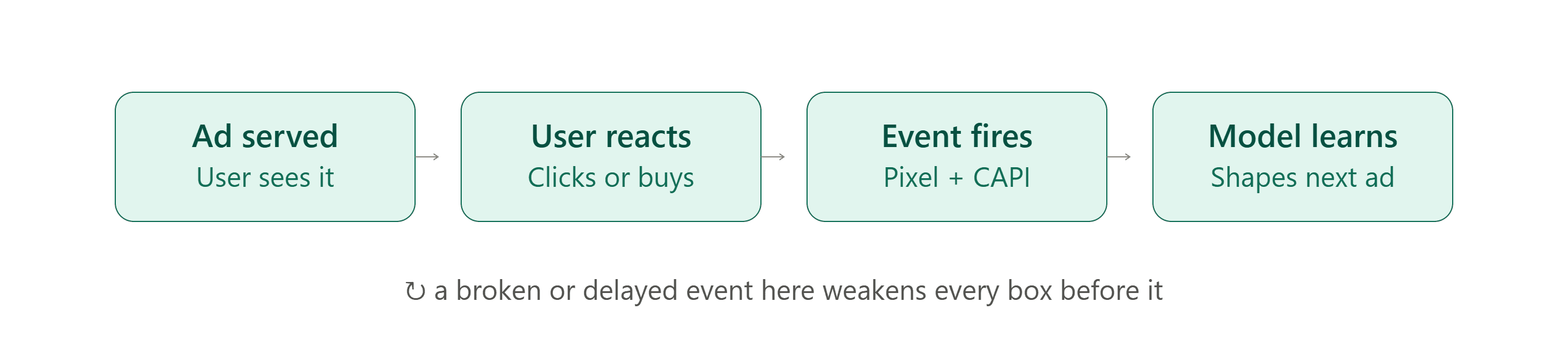
If the events you send back to Meta are accurate, Meta's system gets cleaner training data, so it gets better at predicting who will buy, choosing which ad to show, and spending your budget on higher-likelihood buyers over time. That's the practical, non-abstract case for solid server-side tracking on Shopify: it isn't just about your own reporting being accurate, it's raw material the ranking system itself learns from.
What should your BFCM campaign structure actually look like?
One Sales campaign per country or product category, broad targeting, and creative volume replacing the manual audience-splitting that used to matter more.
One Sales campaign per country or product category, with Advantage+ Campaign Budget on. Only split when there's a real reason, different countries have very different CPMs, or a $20 product and a $200 product need different target CPAs. If you sell one product line in one country, that's one campaign.
Broad targeting with Advantage+ Audience. No interest stacks, and no separate cold and warm campaigns. Meta treats your audience inputs as suggestions and will reach past them, so separate cold and warm campaigns end up chasing the same people and splitting your data.
Set up "New vs Return customers" in your ad account settings. You still get reporting on new versus returning buyers without splitting them into different ad sets.
Optimize for Purchase if you're getting 20+ purchases a week.
Which ad set structure fits your volume: one ad set, or one per idea?
Depends on your budget and conversion volume, and both are legitimate structures rather than one being universally correct.
Option A: one ad set, 20+ ads. All your conversions feed one ad set, so it exits learning faster. Best for smaller budgets or lower conversion volume.
Option B: one ad set per ad idea. Each ad set is one concept, a new angle, a new customer type, a new format, or a new take on a winner, with 2 to 3 videos that use the same script and a different hook in the first second. Your campaign budget moves money to the winners automatically, giving you a much clearer read on which ideas actually work.
Either way, skip the separate testing and scaling campaign structure. New ideas go straight into your main campaign and compete for budget against your current winners. If a new idea is better, it takes over the spend. If it's worse, it just sits there until you clean it up.
Meta AI Stack Roles, At a Glance
| System | What it actually does | Where it sits in the pipeline |
|---|---|---|
| GEM | Trains the other three systems on what's working across the ecosystem | Foundation layer, feeds everything downstream |
| Andromeda | Shortlists relevant candidates from tens of millions of eligible ads | Retrieval stage, first cut |
| Lattice | Ranks the shortlist and decides which ad wins the impression | Ranking stage, the auction itself |
| UTIS | Calibrates Lattice using direct user feedback on relevance, not just clicks | Feedback layer, on top of Lattice |
| Adaptive Ranking Model | Runtime infrastructure making trillion-parameter ranking possible at sub-100ms latency | Infrastructure layer, underneath all four |
What should your creative setup actually look like going into BFCM?
Keep your evergreen winners live, add offer-led creative alongside them, and use text variation instead of duplicating whole ads.
Keep your best evergreen ads live and add offer-led BFCM creative next to them. Mix formats: static images, UGC, founder videos, product demos, and carousels. Use text variations instead of duplicating ads, add up to 5 primary text options (one short, one longer story, one bulleted) and test a benefit headline against a discount headline. Meta mixes and matches them for each person automatically.
What are the actual scaling rules once BFCM traffic hits?
Raise budget gradually when you're on target, hold and diagnose when you're not, and plan peak-day increases ahead of time rather than reacting hour by hour.
If you're hitting your target CPA, raise the budget about 20% a day. If you're above target for a full week, hold the budget and find what's broken, the creative, the offer, or the landing page, before you touch anything else. Plan your peak-day budget increases in advance. Don't react hour by hour. Every big edit risks putting you back into learning phase.
What should you focus on above everything else?
Five things, in order of how much they actually move the needle relative to how much attention advertisers typically give them.
Stick to Advantage+ Campaign Budget, or CBO, unless you specifically need to separate things by country, product, or objective. Audit your standard events to make sure they're all firing and deduplicated. Pass identity signals, hashed email and phone, at checkout as well as top of funnel, page view, view content, add to cart. Feed creative volume, 20+ minimum active ads per ad set, mixed formats. And after you make a big change in your Meta ads account, don't rush to change things again right away.
Common mistakes to avoid
- Splitting cold and warm audiences into separate campaigns. Meta treats your audience inputs as suggestions and reaches past them anyway, so the split just fragments your own data without actually isolating anything.
- Running a separate testing or scaling campaign structure. New creative competes better directly inside your main campaign, where it can take over spend immediately if it wins, rather than needing to graduate from a test campaign first.
- Reacting to performance hour by hour during peak days. Every significant edit risks resetting learning phase at exactly the moment you need stability most.
- Treating audit-worthy events as a one-time setup task. Deduplication and event accuracy feed the ranking systems continuously, a gap that opens later degrades signal quality just as much as one at launch.
- Assuming interest stacking still does meaningful work. Creative volume and format diversity are what the current system actually rewards; audience micro-targeting matters far less than it used to.
FAQ
What is GEM in Meta's ad system? The model that trains the other systems in Meta's ad stack, Andromeda, Lattice, and UTIS, on what's working across the ecosystem. It doesn't serve ads directly; it teaches the systems that do.
What's the difference between Andromeda and Lattice? Andromeda shortlists relevant candidates from tens of millions of eligible ads in milliseconds. Lattice then ranks that shortlist and decides which ad actually wins the impression.
What does UTIS actually measure? Direct user feedback on how well an ad matched someone's actual interests, not just whether they clicked. It calibrates how Lattice applies what GEM taught it.
Why does clean server-side tracking matter more now than it used to? Because every layer of Meta's current ad stack learns from the conversion events flowing back from your store. Accurate Purchase, AddToCart, and InitiateCheckout data directly improves how well the system predicts who will buy and allocates spend accordingly.
Should I still run separate cold and warm audience campaigns for BFCM? No. Meta treats audience inputs as suggestions and reaches past them regardless, so separate campaigns end up competing for the same people while splitting your conversion data across two campaigns instead of one.
How many active ads should be running per ad set going into BFCM? At least 20, mixed across formats, static images, UGC, founder videos, product demos, and carousels. Creative volume is what the current system rewards in place of manual audience segmentation.
What should I do if my Meta ads are above target CPA during BFCM week? Hold the budget rather than cutting it immediately, and diagnose whether the creative, the offer, or the landing page is the actual cause before making changes. Reacting hour by hour risks resetting learning phase at the worst possible time.
This piece is part of the BFCM Klaviyo & Meta Academy, a free weekly series for DTC brands running through mid-December. Join at aimerce.ai/bfcm2026.
Sources
[1] Meta for Business, "AI Innovation in Meta's Ads Ranking Driving Advertiser Performance," facebook.com/business/news/ai-innovation-in-metas-ads-ranking-driving-advertiser-performance
Related reading

Try Aimerce Pixel Risk-Free
for 30 Days
Most teams see results within 2 weeks.
Money-back guarantee.
It pays for itself, or you don't pay anything.
30-Day Aimerce Pixel Free Trial