What Just Meta’s New Update About Pixel Tells Us
On April 15, 2026, Meta announced two simultaneous updates to its advertising measurement infrastructure changes that are now rolling out to most advertisers through May and into early June. The timing isn't accidental: wiSth browser-based tracking continuing to erode due to ad blockers, Safari restrictions, and post-iOS 14 signal loss, Meta is stepping in to fill the gaps itself rather than waiting for advertisers to figure it out.
The two updates work in tandem: one makes the Pixel smarter, the other makes the Conversions API accessible to everyone.
April 15, 2026
Meta announces AI-powered Pixel enrichment and one-click CAPI setup. The 30-day notification window begins for existing Pixel users.
~May 15, 2026
AI enrichment auto-activates for most existing advertisers who took no action during the notification window.
~May 30, 2026
Rollout continues across all eligible accounts. New advertisers are opted in from the start. Advertisers can still disable the feature at any time via Events Manager.
The Two Meta Pixel and CAPI Updates, Explained
1 · AI-Powered Pixel Enrichment
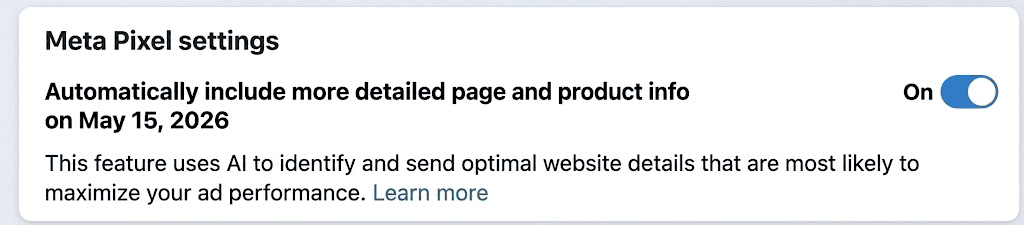
I wrote a newsletter about Meta’s early-2026 updates and my thoughts that included this Meta Pixel change. Since this is being questioned frequently, I’m now writing a separate article focused specifically on this update. The new Meta Pixel update now uses AI to automatically extract and attach product and page data to every event it fires without any code changes, catalog setup, or developer involvement required.
According to Meta's own documentation, when the feature is turned on, the Pixel will automatically detect and transmit:
- Basic page details (title, description, and page type)
- Product details (name, price, currency, and availability)
- Business details (business name and location)
The mechanism is important to understand that this is not Meta reading your data layer or connecting to your backend. It is AI-driven DOM scraping the system visually infers what it sees on the rendered page. That distinction matters enormously for anyone running a complex ecommerce stack.
"This is information many advertisers already share with Meta to run product-based ads, and we're simply helping automate what used to be a manual, technical process." — Meta for Business
The feature is opt-out, not opt-in. Existing advertisers received a notification with a 30-day review window after which it activates by default. Advertisers in special ad categories (health, finance, employment, housing) are excluded.
2 · One-Click Conversions API Setup
Meta's Conversions API (CAPI) has been around since 2021, and Meta has recommended it for years. The problem has always been implementation which is getting CAPI running traditionally required server infrastructure, developer expertise, and ongoing maintenance a barrier that kept most small businesses on browser-only tracking.
The new one-click Meta-enabled CAPI eliminates that barrier entirely. Meta hosts and maintains the infrastructure. There is no code to write, no server to provision, and no ongoing technical work required.
According to Meta's official announcement, both changes are designed to lower the technical bar for advertisers who have struggled to implement a complete, well-connected tracking setup.
First of all, the entire announcement has been very vague, with no technical details or next steps. Given what I know about Meta, this could be another “Conversions API Gateway,” which literally does not do good tracking.
Second of all, for DTC and eComm, all the product IDs, names, and descriptions are already tracked from the catalog and sent with all the events as Content. It’s not news.
Thirdly, tracking is never just installing software. Shopify sites have a lot in common, but every single website may have unique features, e.g. custom landing pages, quizzes, custom popups, lead gen pages, custom checkout (cash on delivery), custom upsell/cross-sell, subscription orders, return/exchanges, etc. The most important thing is to know what special cases need to be handled and what the user journey looks like.
Important Note About Prohibited Information Policy
This is the compliance guardrail document, and it becomes significantly more important in the context of AI-automated data collection. Meta's prohibited information list includes health conditions, financial account details, Social Security numbers, GPS coordinates, prescription medications, and more. Since the new enrichment feature automatically extracts data from rendered page content, advertisers in any remotely sensitive vertical need to audit what their pages display not just what their tracking code explicitly sends.
Compliance Warning
Meta is explicit about this, "It is your responsibility to ensure your Meta Pixel integration does not share prohibited information with Meta." The AI feature does not exempt you from this. If your product pages render sensitive data visible in the DOM, that data may be extracted and transmitted automatically. Review your pages accordingly.
How this Affects Your Data Tracking
Aimerce is a server-side tracking and first-party data platform built specifically for Shopify merchants. Founded by a former Meta engineer with seven years of hands-on experience building the very systems that power Meta's ad infrastructure, it sits at the intersection of what this update is trying to democratize. That makes the analysis nuanced.
Meta is essentially announcing in product form that server-side data plus rich event enrichment equals better ad performance. That's precisely the argument Aimerce has been making since launch. Advertisers who were skeptical about investing in server-side tracking now have Meta itself making the case for them.
More importantly, the two systems operate on fundamentally different layers. Aimerce captures conversion events from Shopify's backend actual order IDs, confirmed prices, exact variant selections and sends them to Meta via CAPI with deterministic first-party identifiers. Meta's AI enrichment reads what's visible on the rendered page. These are different data sources, and in a properly configured hybrid setup, they can complement rather than conflict with each other.
Aimerce also handles deduplication the process automatically that ensures a single conversion isn't counted twice when both Pixel and CAPI fire for the same event. This remains essential in any hybrid setup, and it's something the one-click CAPI option does not automatically manage at the level of sophistication that a dedicated tool provides.
Do You Need One-Click CAPI
Depends. For a small Shopify merchant who hasn't yet implemented server-side tracking, Meta's free, no-code option worth implementing for you. Advertisers who already have a working Conversions API setup or partner integration are not affected. The updates are primarily aimed at smaller businesses and those with low event coverage who have not yet implemented the Conversions API.
But for those who already installed Aimerce or any server side tracking tool on Shopify, this part is unnecessary.
If you already have both before, you don’t have to worry either. Aimerce handles both the browser-side pixel and the server-side CAPI with automatic deduplication built in. So Meta's one-click CAPI won't deduplicate against it.
Aimerce's Durable ID its persistent, first-party identifier that tracks users across sessions and devices remains entirely unchallenged by this update. Meta's AI enrichment focuses on product and page data, not user identity resolution. For everything that depends on knowing who the user is (Klaviyo flows, cross-device attribution, lookalike audience quality), Aimerce still holds a capability that no one-click setup can replicate.
What Advertisers Should Do Right Now
Whether you're running Aimerce, considering it, or just running a standard Pixel setup, here's a clear action list for navigating this transition:
- Check Events Manager immediately. Look for the AI enrichment notification. You have a 30-day window to review before it activates by default. Don't let it slip past you.
- If you're in a sensitive vertical (health, finance, legal, housing), audit what data your pages render in HTML before the feature activates. Cross-reference against Meta's prohibited information list.
- If you're using Aimerce, confirm that your event_id values are consistent between Aimerce's CAPI events and any browser-side Pixel events. This is what protects you from double-counting if both enrichment layers are active.
- Monitor Events Manager for data conflicts. After activation, check whether product prices, currencies, and names being reported match what your backend actually sends. Discrepancies indicate an enrichment conflict.
- If you haven't set up CAPI at all, the one-click option is a genuine improvement over doing nothing. But understand its limits: it doesn't cover Google, Klaviyo, or any other platform, and it doesn't provide the identity resolution that tools like Aimerce deliver.
Meta's May 2026 update is the most significant change to the Pixel in years. For the majority of small businesses that have been running basic browser-only tracking, it's an unambiguous improvement more data, better optimization, less technical complexity.
For advertisers and scaling brands wanting to do more than just a simple CAPI or looking for an Elevar Alternative, a robust server-side tracking on Shopify like Aimerce suits you best. Aimerce is deterministic first-party data, cross-platform coverage, identity resolution across sessions and devices, and the kind of data quality that comes from reading Shopify's backend rather than guessing from what's painted on a page.
30-Day Aimerce Pixel Free Trial