Why Your Meta Learning Phase Takes Longer Than It Should (And What's Usually Causing It)
If you have run Meta ads for any length of time, you know the feeling.
You launch a new campaign. Days pass. The ad set stays in learning phase. Your CPAs are erratic. You want to make changes but you have been told not to touch anything while the algorithm is learning. You wait. It stays in learning phase. You wait more.
Then it hits "Learning limited" and you still do not know why.
I spent 7 years as an engineer at Meta building the ad delivery systems that run this exact process. Here is what is actually happening, and why it almost always comes back to your tracking data not your creatives, not your audiences, not your budget structure.

Try Aimerce Pixel Risk-Free
for 30 Days
Most teams see results within 2 weeks.
Money-back guarantee.
It pays for itself, or you don't pay anything.
What the Learning Phase Actually Is
Meta's ad algorithm does not start a new campaign with a fully formed targeting strategy. It starts uncertain.
At the beginning of any new ad set, Meta's system is exploring: which people respond to your ads, which placements perform, which times of day work best, which creative variations resonate. This exploration period is the learning phase.
The algorithm needs enough real outcomes purchases, in most cases to build a reliable model. Meta's threshold is 50 optimization events within a 7-day window. Once an ad set hits 50 purchase events in a week, Meta has enough data to move out of exploration and into a more stable optimization mode.
While you are in the learning phase, expect higher cost variability, less efficient delivery, and less predictable results. This is normal and expected. The problem is when the learning phase goes on much longer than it should or when it never exits at all.
What "Learning Limited" Actually Means
"Learning limited" is Meta's way of telling you: at your current trajectory, this ad set will not reach 50 optimization events this week.
It is a forecast, not a diagnosis. Meta is not telling you what is wrong. It is telling you that something is constraining the system's ability to learn.
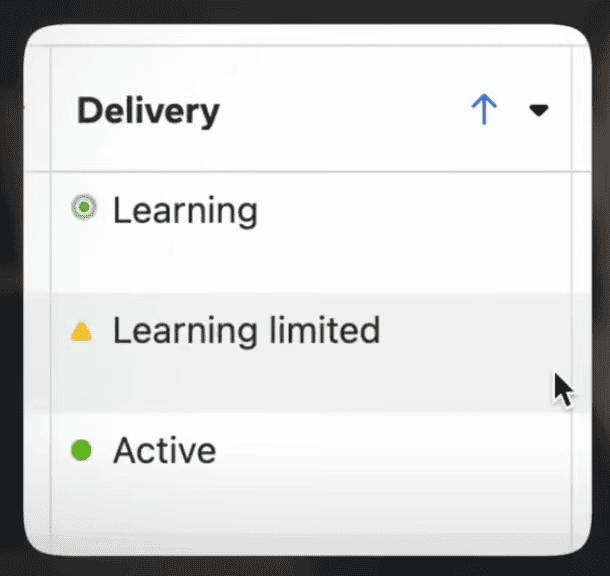
Most brands interpret "learning limited" as a budget problem. Sometimes it is. But in my experience auditing Shopify brands' tracking setups, the more common root cause is a data quality problem purchase events that are not reaching Meta at all, or reaching Meta in a form the algorithm cannot use effectively.
The Real Reason Your Learning Phase Takes Too Long
A brand is spending enough budget to generate, say, 80 actual purchases per week across all their channels. Their ad set should comfortably hit the 50-event threshold and exit the learning phase on schedule.
But when I look at their Events Manager, their Purchase event volume is showing 55 events per week. Not 80.
The remaining 25 purchases never made it to Meta. They happened that Shopify has the orders but the tracking missed them.
Now the ad set is scraping by on 55 events. Some weeks it hits the threshold. Some weeks it does not. The algorithm never fully stabilizes. Learning phase drags on.
The brand cycles through creative refreshes, budget adjustments, audience changes. Nothing consistently works. Because the underlying problem tracking gaps never got fixed.
The Five Most Common Causes of a Slow Learning Phase
1. Your browser Pixel is missing iOS and ad-blocked conversions
Apple's App Tracking Transparency and Safari's Intelligent Tracking Prevention have made browser-based pixel tracking materially less reliable for a significant portion of ecommerce traffic.
Depending on your audience's device mix and browsing behavior, a browser-only Pixel setup can miss 20 to 40 percent of conversion events. Every missed event is a missed learning signal.
If your Events Manager Purchase count is more than 5 percent lower than your Shopify order count, this is almost certainly happening to you.
To fix it, implement server-side tracking via the Conversions API. Server-side events bypass browser restrictions entirely. They fire from your server or a tracking app like Aimerce (server-side tracking Shopify) directly to Meta, regardless of what the customer's browser is doing.
2. Your express checkout events are disappearing
Shop Pay, Apple Pay, and PayPal Express all redirect customers to a different URL during checkout. This URL hop breaks the session context that most browser-based pixel implementations rely on to connect a purchase back to a specific browsing session.
The result, purchases through express checkout flows either do not fire a Purchase event at all, or fire without the Click ID (fbc) that connects them to an ad campaign. Either way, they are less useful to the algorithm.
For many Shopify stores, express checkout now accounts for 30 to 60 percent of all purchases. If those events are incomplete or missing, your learning phase will be chronically slow because you are feeding the algorithm a biased sample of your actual customer behavior.
The fix is ****Shopify Webhooks. When an order is created in Shopify regardless of how the customer checked out, a webhook fires on the server side and sends a complete Purchase event with full customer data. This is completely independent of what happened in the browser.
3. Duplicate events are inflating your count without helping the algorithm
This one is actually counterintuitive. Some brands look at their Events Manager and see plenty of Purchase events more than enough to hit the 50-event threshold. But the learning phase is still struggling.
The reason this happens is deduplication is not configured correctly, and the same purchase is being counted twice. The event volume looks sufficient, but the actual signal quality is diluted.
Meta's algorithm is pattern-matching against these duplicated events. Half of the "conversions" it sees are phantom conversions that represent no real customer behavior. The model it builds is noisy and unstable. Even if it technically exits learning phase, it does not perform the way it should.
Check your deduplication rate in Events Manager. If you are running both Pixel and Conversions API, your deduplication rate should be 60 to 90 percent. A rate of 0 percent means events are being double-counted.
To fix this, ensure both your browser Pixel and your CAPI events carry a matching event_id for every purchase typically built from the Shopify order ID. When Meta sees two events with the same event_id, it deduplicates and counts one real conversion.
4. Your Event Match Quality is too low
Even when purchase events are reaching Meta, the algorithm cannot use them effectively if it cannot match them to specific Facebook users.
Event Match Quality (EMQ) measures how well Meta can connect your event data to real user profiles. A Purchase EMQ of 9 means Meta can confidently match nearly every purchase to a known Facebook user. A Purchase EMQ of 6 means a significant portion of your purchase events are being received but cannot be attributed to a specific user, they are noise in the dataset rather than useful signal.
For the learning phase, low EMQ means the algorithm is working with conversion data that it cannot fully use for optimization. It needs 50 matchable events, not 50 events it mostly cannot match.
You have to enrich your CAPI events with customer data from the Shopify order to fix this. Email address is the highest-impact parameter as Meta matches users primarily by email across Facebook and Instagram. Every server-side Purchase event should include hashed email, hashed phone, first name, last name, country, and the fbc Click ID.
5. You are making too many changes during the learning phase
Every time you make a significant change to an ad set, budget increase above 20 percent, audience change, bid strategy change, new creative. Meta resets the learning phase counter.
If you are constantly adjusting because the learning phase seems stuck, you may be the reason it is stuck. Each reset sends you back to zero.
The discipline here is hard and this is actually one of the most common issues I encounter in Facebook Ads community on Reddit. When the learning phase is struggling, the instinct is to change something. But the right move is to audit your tracking first, fix what is broken, then let the algorithm run with clean data for a full 7-day window without interference.
Here’s The Fastest Way To An Audit
Before you change anything in your campaign structure, run this check.
Step 1: Go to Events Manager. Find your Purchase event. Compare the volume for the last 7 days to your actual Shopify order count for the same period. Gap bigger than 5 percent? You have a tracking hole.
Step 2: Check your Purchase EMQ score. Below 8.8? Your events are missing customer data. Almost always the culprit is email not being included in your server-side events.
Step 3: Check your Integration column. Does your Purchase event show Conversions API? If it only shows Meta Pixel, you are missing iOS and ad-blocked conversions.
Step 4: Check your deduplication rate. If you are running both Pixel and CAPI: is the rate between 60 and 90 percent? If it is 0, you are double-counting.
Step 5: Look at Diagnostics. Any "Issue detected" flags? Resolve those before touching your campaign.
If any of these are off, fix them before you adjust your budget, audiences, or creatives. You are not solving a campaign problem. You are solving a data problem.
What Happens When You Fix the Tracking
The brands I see fix their tracking setup consistently report the same sequence of events in the 30 to 60 days after.
Events Manager purchase count starts matching Shopify order count. EMQ moves into the 8.8 to 9.3 range. Learning phase exits faster often in 7 to 10 days instead of 3 to 4 weeks of struggling. Once out of learning, CPAs stabilize and start declining as the algorithm finds its footing on clean data.
The creative did not change. The audiences did not change. The budget did not change. The algorithm just finally had enough accurate data to do its job.
This is consistently how it goes. The learning phase is not a campaign problem. It is a data problem dressed up in campaign symptoms.
Learning Phase Signals References
| Signal | What It Usually Means | What to Check |
|---|---|---|
| Stuck in learning phase 14+ days | Insufficient conversion volume reaching Meta | Events Manager purchase count vs Shopify orders |
| "Learning limited" | Not enough events this week | Tracking gaps, budget, or narrow audience |
| Learning phase keeps resetting | Too many campaign changes, or budget instability | Pause changes, audit tracking first |
| Exits learning but CPA is unstable | Low EMQ or duplicate events | EMQ score, deduplication rate |
| Exits learning but performance is worse than before | Algorithm learned from bad data |
The Right Setup Looks Like Shopify Brands
A tracking setup that supports fast, stable learning phase exit on Shopify has three components:
Shopify WebPixel for browser-side events to captures Click IDs (fbc) and behavioral signals from customers who browse your store normally. Works natively with Shopify's checkout extensibility architecture without GTM.
Shopify Order Webhooks for server-side events that fires a complete Purchase event with full customer data every time an order is created in Shopify, regardless of checkout method. Captures Shop Pay, Apple Pay, POS, and manually drafted orders that browser pixels miss.
Deduplication configured correctly for both sources send matching event_id values built from Shopify order IDs, so Meta counts each purchase once with maximum data from both sources.
This is exactly what Aimerce provides in a one-click install. Within 24 hours of installation, brands typically see their Events Manager normalize: purchase count matches Shopify orders, EMQ reaches the 8.8 to 9.3 range, deduplication rate stabilizes. Learning phase cycles that used to drag on for weeks start resolving in 7 to 10 days.
FAQ: Frequently Asked Questions
Q: What is Meta's learning phase? Meta's learning phase is a period at the start of a new campaign or ad set during which Meta's algorithm explores different audiences, placements, and creatives to find the best way to optimize delivery. It typically requires 50 optimization events per ad set within a 7-day window to exit. Until it exits, ad delivery and costs are less stable and less efficient.
Q: How long should the Meta learning phase take? For most Shopify brands spending $50 or more per day per ad set, the learning phase should exit within 7 to 14 days. If it is taking longer or showing "Learning limited" the most common cause is not enough conversion events reaching Meta, which is almost always a tracking quality problem.
Q: What causes the Meta learning phase to take too long? The most common causes are: insufficient conversion event volume (fewer than 50 purchases per ad set per week), broken or incomplete tracking that prevents purchase events from reaching Meta, duplicate events that inflate event counts without representing real conversions, poor Event Match Quality that prevents Meta from correctly matching events to users, and budget that is too low to generate the required conversion volume.
Q: What does "Learning limited" mean on Meta? "Learning limited" means Meta does not expect your ad set to reach the 50 optimization events needed to exit the learning phase in the current 7-day window. It is a signal that something is constraining the algorithm's ability to learn usually low budget, narrow audience, or insufficient conversion volume reaching Meta.
Q: How do I get Meta ads out of the learning phase faster? Fix your tracking first. Confirm your purchase event volume in Events Manager matches your Shopify order count. Check your Event Match Quality score it should be 8.8 to 9.3 for Purchase events. Ensure deduplication is correctly configured if you are running both Pixel and Conversions API. Then ensure your budget is sufficient to generate at least 50 conversion events per ad set per week.
Q: Does server-side tracking help with Meta's learning phase? Yes. Server-side tracking via the Conversions API captures purchase events that browser-based pixels miss including conversions from iOS users, customers using ad blockers, and express checkout flows through Shop Pay or Apple Pay. More complete conversion data means more optimization events reaching Meta, which directly speeds up learning phase exit.
30-Day Aimerce Pixel Free Trial