Quick Answer: AEO for ecommerce means getting your products cited and surfaced by AI answer engines, then measuring the sales that follow. ChatGPT and Google AI Overviews send shoppers to your store by link, so tags, referrers and orders matter. In-chat checkouts leave no session: Google AI Mode and Gemini orders still land in Shopify, while Perplexity Instant Buy orders are managed in PayPal, so start with PayPal's reporting.
Key Takeaways
- Discovery has two jobs: content AI can cite (AEO), and catalog data AI can list. Our Catalog AI Enrichment works on the second: your catalog data for AI shopping agents, not your content pages.
- ChatGPT is a discovery channel on Shopify. Shoppers pay on your own checkout, so your normal tracking can still see the session.
- Google AI Mode and Gemini direct checkout happens inside the chat and is on by default for eligible stores. Shopify says only server-to-server events fire there.
- Perplexity Instant Buy checkout runs through PayPal, so Shopify says those orders are managed in PayPal, not your Shopify admin.
- Google AI Overviews links arrive as ordinary Google traffic in analytics. Search Console now reports AI Overviews and AI Mode impressions separately, without clicks.
- Across the Shopify stores we measure, 94.9% of AI-attributed orders still arrive by link click. The in-chat paths are small and growing fast.
- Measure from the order backward, not from the session forward. Our Pixel sends those purchases to ad platforms server-side.
Most AEO for ecommerce advice stops at getting cited. That's half the job. If you can't tell which answer engine produced a sale, you can't tell whether your AEO work is paying off.
What is AEO for ecommerce, and where does Catalog AI Enrichment fit?
Answer engine optimization (AEO) is making your content easy for AI answer engines to find, cite and recommend. For a Shopify brand, three jobs sit around it:
Be citable (AEO). Product pages, guides and comparisons that answer real shopper questions. Google says the best practices for SEO remain relevant for AI Overviews and AI Mode, with no extra technical requirements and no special schema or AI text files. A page needs to be indexed and snippet-eligible.
Be listable (catalog readiness). Clean catalog data (titles, attributes, descriptions, price, availability) that an agent can match to a shopper's request. Shopify's Catalog is how your products reach ChatGPT, and the Universal Commerce Protocol (UCP), announced by Google and Shopify on 11 January 2026, is an open standard for discovering products and checking out with AI agents.
Be measurable. Knowing which sales came from which surface.
Aimerce’s Catalog AI Enrichment is job two. It audits your product titles, descriptions, tags and structured metadata against UCP requirements and real AI-agent query patterns, enriches them, generates HTML descriptions you can paste straight into Shopify, and syncs the approved catalog into UCP. Nothing goes live without your sign-off, and it's a paid feature for our Pixel customers. It works on your catalog data for AI shopping agents rather than on your content pages, so job one, getting cited through your blog and traditional SEO, is still separate work. It improves how well your catalog can be matched. It can't guarantee a placement. Our guide to preparing your Shopify feed covers the manual version.
Job three is our Pixel and Aima, our AI analyst in Slack. The rest of this post is about that half.
How do ChatGPT, Perplexity and Google AI Overviews actually send shoppers to a store?
They don't work the same way, and that decides what you can measure.
- ChatGPT sends shoppers to you. Shopify's documentation calls it a product discovery channel: shoppers complete their purchase on your online store checkout, in ChatGPT's in-app browser or a new tab on the web. In our data, ChatGPT accounts for 23,051 of 25,313 AI-attributed orders, all of them link clicks. About 24% of those orders came from a product listing rather than a link inside an answer.
- Perplexity links out in its answers, and its Instant Buy feature can finish the sale in the chat. PayPal and Perplexity launched Instant Buy in the US on 25 November 2025, with PayPal powering checkout and the retailer staying merchant of record. Shopify's own Perplexity guide says its integration makes your listings discoverable in Perplexity, but Instant Buy checkout is handled through PayPal, not Shopify's checkout, so those orders are managed through PayPal rather than your Shopify admin. The same guide says Perplexity requires joining its Merchant Program. On PayPal's side, Store Sync, part of PayPal's agentic commerce services, is designed to place orders directly into a merchant's existing order management systems, and access is by request. In our data, Perplexity's 408 orders were all link clicks, and none were bought inside Perplexity. That fits Instant Buy orders never reaching Shopify.
- Google AI Overviews link out, and in analytics those visits arrive as ordinary Google traffic. Sites that appear in AI Overviews and AI Mode are included in overall Search traffic in Search Console, within the Web search type. Since 31 August 2026, Search Console also has a generative AI performance report for all sites, showing AI Overviews and AI Mode impressions by page, country, device and date, with no click data. Don't confuse any of this with Google AI Mode and Gemini direct checkout, which Shopify runs inside Google's interface. Per Shopify, it's active by default for eligible stores and rolling out to shoppers in the US, Canada and Australia.
The Gemini app has a third path: it often opens your store in its own in-app browser. In our purchase paths data, Gemini and Google AI orders split into 301 link clicks, 490 in-app browser orders and 47 bought inside the assistant. In-app browser orders are recognised by the browser's user agent, not by a tag or referrer, so a referral report misses them. Grok works the same way: all 330 of its orders came through its in-app browser.
What can you see from each surface?
| Surface | Where the purchase happens | What your store can see | How to measure it |
|---|---|---|---|
| ChatGPT | Your Shopify checkout, in ChatGPT's in-app browser or a new tab | A real session. Links carry a source tag, but the referrer is often missing | Match utm_source or referrer as one signal. Split product listings from answer links. Count orders |
| Perplexity Instant Buy | Inside Perplexity, paid through PayPal. Retailer is merchant of record | No session. Shopify says these orders are managed in PayPal, not your Shopify admin | Start with your PayPal reporting. Our Shopify data shows no Perplexity orders bought inside the assistant |
| Google AI Overviews | Your store, after a click | Ordinary Google traffic in analytics. Search Console has a separate generative AI report, with impressions but no clicks | Search Console's generative AI report for visibility. Orders and analytics for sales |
| Google AI Mode and Gemini direct checkout | Inside Google, through Shopify's direct checkout, which is on by default for eligible stores. Check Sales channels > Agentic | Only server-to-server started and completed events. Google Analytics and custom pixels don't fire | Shopify order record and server-side events |
| Gemini and Grok in-app browsers | Your Shopify checkout, inside the assistant's own app | A real session from a browser that names the app, usually with no tag or referrer | Match the browser's user agent, then count orders |
How do you measure sales when there's no click to track?
Start from the order, not the session. In our report on orders placed inside assistants, 69.1% of those 434 orders were created by the assistant's server with no shopper browser at all, so no pixel fired. Shopify stamps the sales channel on each order, so a report that starts from orders and works backward finds them. A report that starts from sessions can't. For Perplexity Instant Buy, the order record to start from is PayPal's.
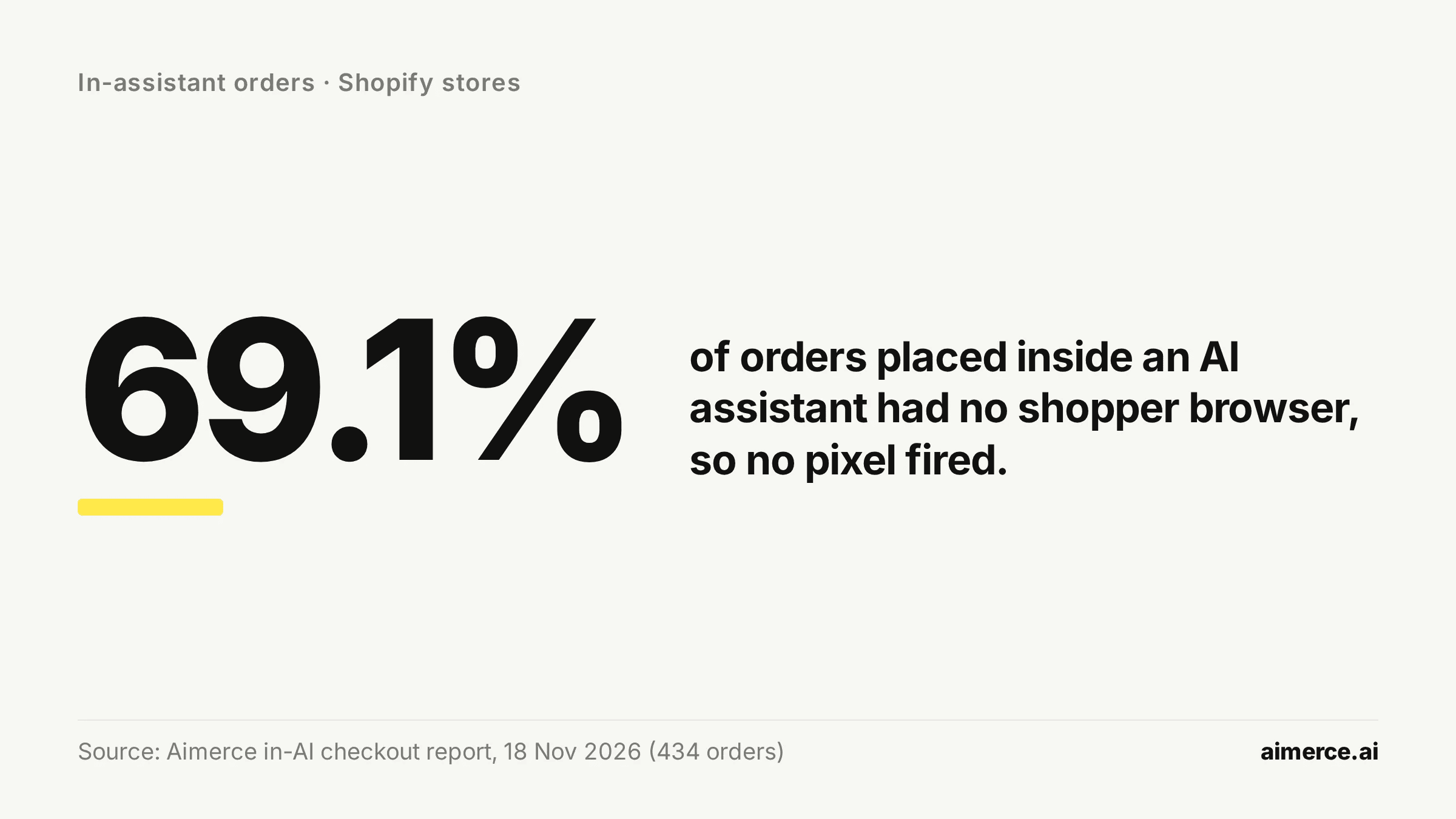 Figure 1: 69.1% of in-assistant orders had no shopper browser, so no pixel could fire. Source: Aimerce in-AI checkout report, 18 November 2026.
For clicks, accept either signal. Match the referring domain or the utm_source, and treat them as one. Then check what you matched: in our report on false positives, counting every order that merely mentioned an AI product's name would have overstated AI orders by 29%. In our AI Commerce Report, the share of ChatGPT visits arriving with no referrer rose from 83.7% in September to 98.5% from 1 to 17 November 2026. Relying on the referrer alone undercounts badly.
And tags can disappear. From 9 to 14 October, links in ChatGPT's answers lost their tag, and in our data orders from those links fell 63%. The sales still happened: an estimated 300 to 520 of them were recorded as direct traffic. We covered what to do about it when ChatGPT dropped its UTM tags.
Keep conversion events server-side. On Google's direct checkout, only server-to-server events fire, per Shopify. That's the lane our Pixel works in. It sends purchases to ad platforms server-side from Shopify's order data, so a sale doesn't depend on a browser event firing. Aima, our AI analyst in Slack, helps you act on that data across ad campaigns and Klaviyo. For the fuller picture, see why agentic checkouts don't fire your tracking pixel.
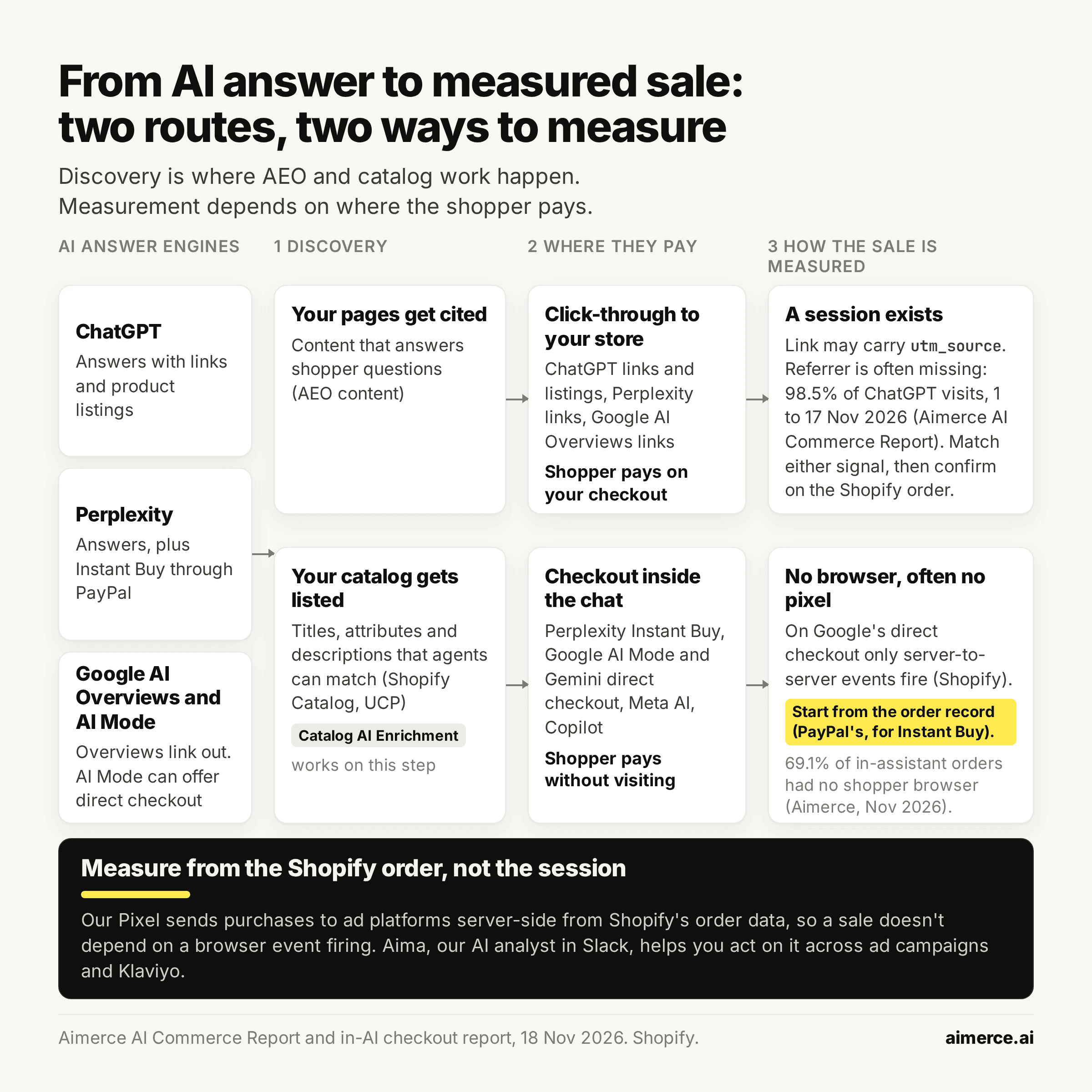 Figure 2: Two routes from an AI answer to a measured sale: a click that leaves a session, and a checkout inside the chat that often does not. 98.5% of ChatGPT visits from 1 to 17 November 2026 arrived with no referrer, and 69.1% of in-assistant orders had no shopper browser. Sources: Aimerce AI Commerce Report, Aimerce in-AI checkout report, Shopify Help Center and Shopify's Perplexity guide.
Here's why this matters. We sorted 25,313 AI-attributed orders from 31.7 million Shopify orders (19 May to 16 November 2026) by how the purchase happened. 94.9% were link clicks. The other 5.1% came through in-app browsers, purchases inside the assistant and declared AI agents, and those paths are growing faster: orders that didn't arrive by link click rose 3.6x, from 109 in June to 396 in October 2026.
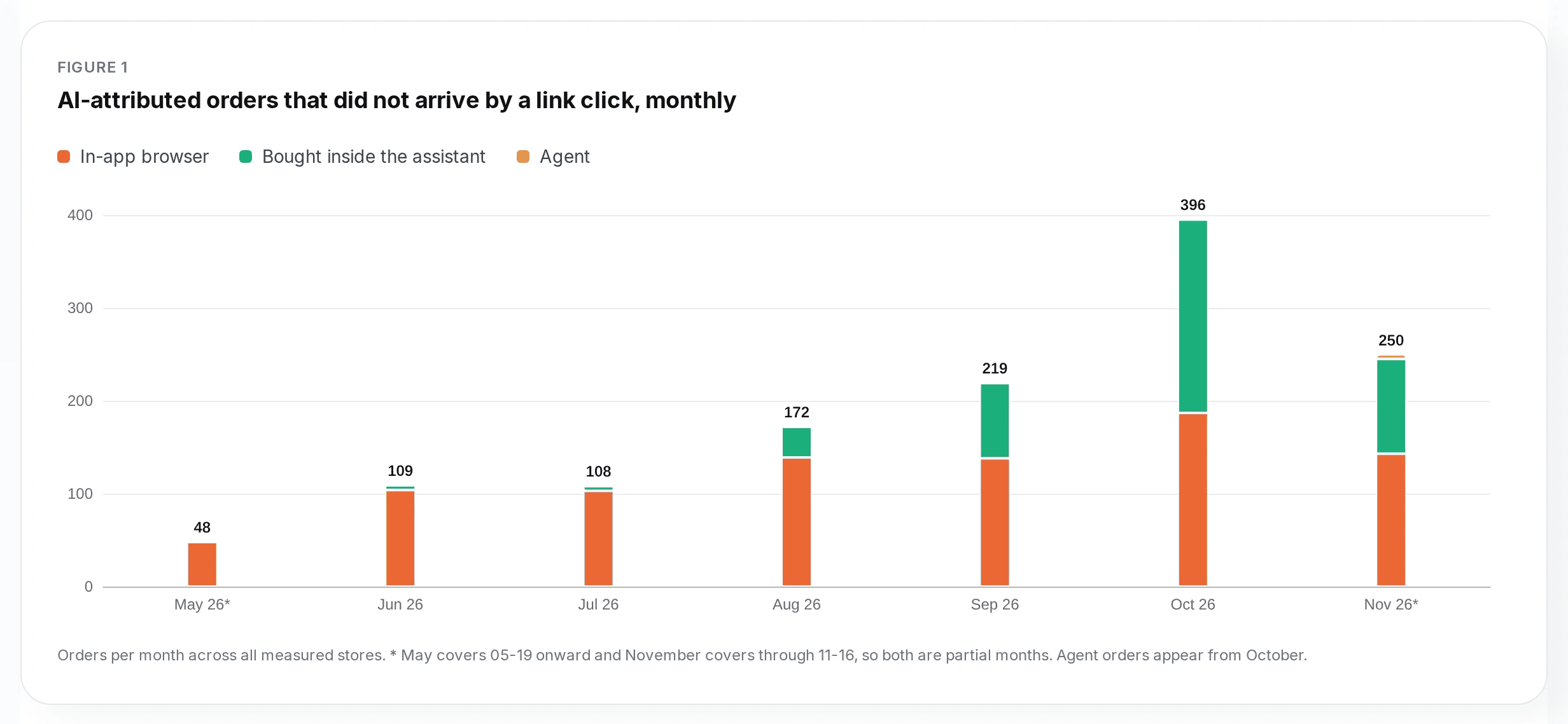 Figure 3: AI-attributed orders that did not arrive by a link click rose from 109 in June to 396 in October 2026. Source: Aimerce purchase paths report, 18 November 2026.
In-assistant orders went from 5 in June to 208 in October, mostly on Meta AI, with Google AI Mode and Gemini and Microsoft Copilot making up the rest. The median in-assistant US-dollar order was $58.50, against $75.95 for link clicks. That median comes from a small sample of 425 orders, so treat the gap as a direction. These numbers are a floor, because AI Overviews and AI Mode visits arrive as ordinary Google traffic.
How do you know whether your catalog work is paying off?
Watch the listing orders. ChatGPT sends shoppers from two places: a link written into an answer, and a product listing drawn from your catalog. Listing links carry a feed marker in addition to the ChatGPT tag. In our data, about 840 stores took a ChatGPT-attributed order and about 380 of them took one from a listing. For more than half of those stores, all of it came from being cited and none from the catalog.
That's the clearest place to look for the effect of catalog work. We haven't measured whether enrichment causes more listing orders, but this is where it would show.
Is AI traffic worth the effort yet?
It's small but real, and it's growing into the holidays. Adobe reported that traffic to US retail sites from generative AI tools rose 693.4% year over year in the 2025 holiday season, and that AI referrals converted 31% more than other traffic that season. For the 2026 holiday season, Adobe forecasts AI traffic to US retail sites will rise 130% year over year, and it found that in September 2026 AI traffic converted 90% better than non-AI traffic. In our data, AI-attributed orders are about 0.08% of all orders, and ChatGPT's share of store pageviews has held around 0.1% since September. We covered the growth in Shopify's 3.3x AI orders. Our advice: measure it properly now, and don't rebuild your budget around it yet.
What's the AEO and measurement checklist for Shopify?
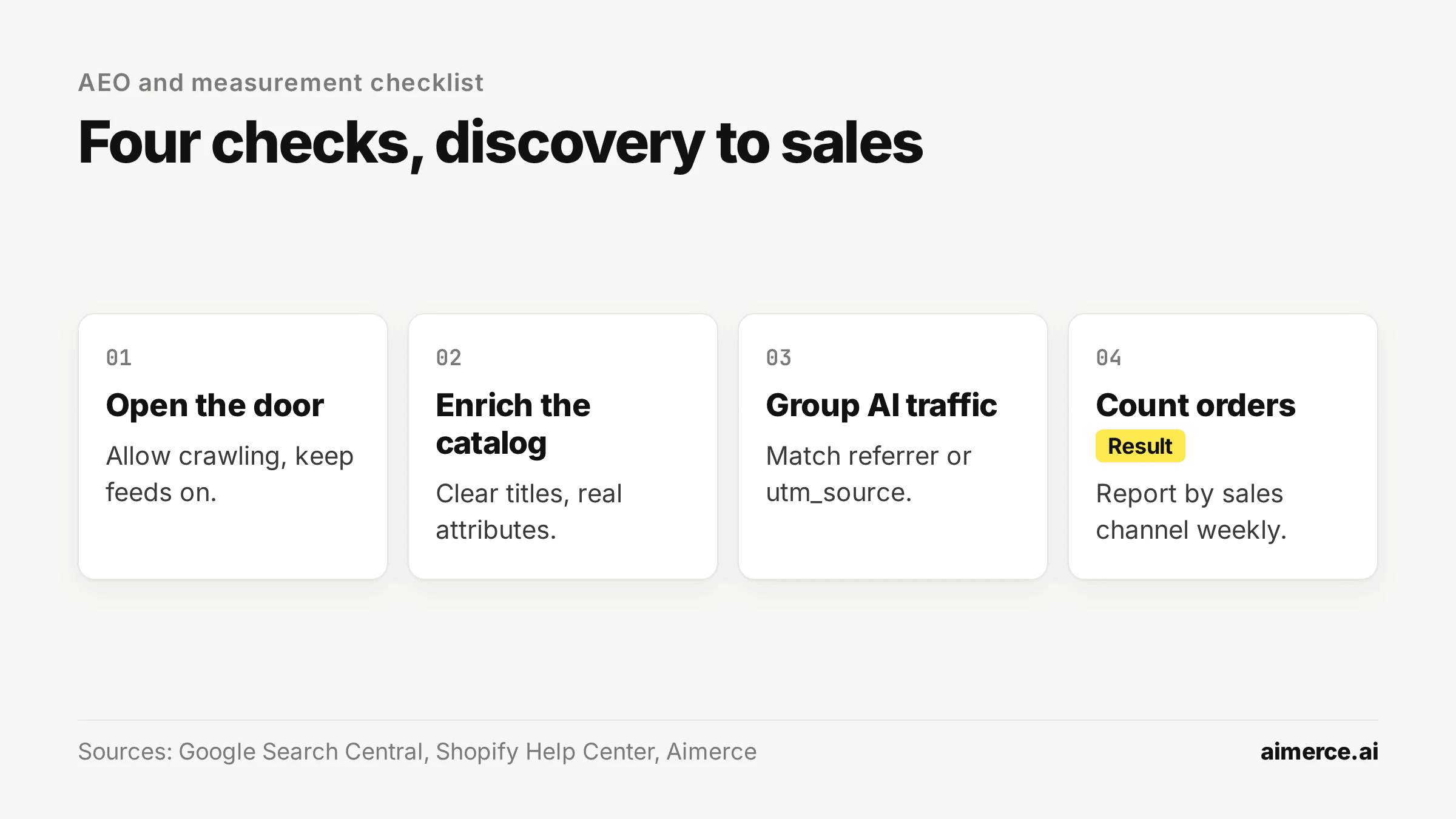 Figure 4: Four checks that connect AEO work to counted sales. Sources: Google Search Central, Shopify Help Center and Aimerce data.
Those four checks sit on top of the full list:
Discovery
Allow crawling. Check robots.txt and your CDN aren't blocking search crawlers. Google lists this as a basic. In Search Console Settings, check you haven't switched off the generative AI control.
Check your product pages. Indexed, snippet-eligible, with structured data that matches the visible text.
Keep your feeds on. Keep Shopify Catalog access for ChatGPT, and the Google & YouTube channel (or Merchant Center) syncing for Google. Put legal disclosures in the first 6,000 characters of descriptions, as Shopify asks.
Enrich your top products. Descriptive titles, real attributes, useful descriptions. Use a metafield for brand-style display names so storefront and agent titles can differ. Run Catalog AI Enrichment if you'd rather not do it SKU by SKU.
Publish answers. Guides and comparisons that answer questions shoppers actually ask.
Measurement
Build an AI assistants channel group. Match referrer or utm_source, not one alone. Add the in-app browser user agents of apps like Gemini and Grok, because those orders carry no tag or referrer to match.
Split ChatGPT listings from answer links using the marker on the landing link.
Report orders by sales channel weekly, regardless of sessions. Start in Sales channels > Agentic, which reports sales, orders, online store sessions and online store conversion for each AI channel. If you sell through Perplexity Instant Buy, add your PayPal reporting.
Test every checkout type. Direct checkout is on by default for eligible stores, so check Sales channels > Agentic to see which channels are active. Place a test order in each and confirm a server-side purchase event fires.
Annotate tag gaps, such as 9 to 14 October, and judge AI channels on orders, not sessions alone.
What are the common mistakes?
- Calling feed work AEO, or the other way around. They're separate jobs with different fixes.
- Treating AI Overviews as a referral source. It looks like Google in analytics, so it won't appear as an AI channel. Use Search Console's generative AI report for visibility.
- Looking for Instant Buy orders in Shopify. Shopify says they're managed in PayPal, and the shopper never visits, so neither sessions nor your Shopify admin will show the sale.
- Counting by referrer alone. ChatGPT often passes none.
- Assuming every assistant works like ChatGPT. In our data, each assistant uses a different path.
- Expecting a catalog update to guarantee placement. It improves matching. It doesn't buy a slot.
Frequently Asked Questions
What is AEO for ecommerce?
Answer engine optimization is making your store easy for AI answer engines to find, cite and recommend. For ecommerce, that means citable content, listable catalog data, and the measurement to see which answer engine produced a sale.
Is AEO different from SEO for Google AI Overviews?
Mostly not. Google says SEO best practices remain relevant for AI Overviews and AI Mode, with no extra technical requirements and no special schema or AI text files. A page must be indexed and eligible for a snippet.
How do I track sales from ChatGPT on Shopify?
On Shopify, ChatGPT shoppers pay on your own checkout, so you can see a session. Match utm_source or referrer as one signal, because ChatGPT often passes no referrer. Then confirm with Shopify orders.
How do I measure Perplexity Instant Buy sales?
Start with your PayPal reporting. Shopify says Instant Buy checkout runs through PayPal, not Shopify's checkout, so those orders are managed in PayPal rather than your Shopify admin. Perplexity also requires joining its Merchant Program. In our Shopify data, all 408 Perplexity orders were link clicks, and none were bought inside Perplexity.
Can I see Google AI Overviews traffic in my analytics?
Not in analytics, where those visits arrive as ordinary Google traffic. Search Console is different. Since 31 August 2026, its generative AI performance report shows AI Overviews and AI Mode impressions by page, country, device and date for all sites, without click data. Those impressions are still counted in the overall Search performance report too.
Do tracking pixels fire for orders placed inside an AI assistant?
Often not. Shopify says Google AI Mode and Gemini's direct checkout fires only server-to-server events. In our data, 69.1% of in-assistant orders had no shopper browser, so no browser pixel could fire.
Is Catalog AI Enrichment the same as AEO?
No. It works on your catalog data for AI shopping agents, not on your content pages: it audits and enriches your product data and syncs the approved catalog into UCP. Getting cited through your blog and other content is separate work. You approve every change.
Seeing the sales your AEO work earns
Get cited, get listed, then see what it sold. At Aimerce, we built our Pixel to send the sale to ad platforms server-side from Shopify's order data, and Catalog AI Enrichment to help your products get matched. If you'd like to see how that works on your store, you can find us on the Shopify App Store. Our Pixel comes with a 30-day Free Trial.
1] Google Search Central, "AI features and your website,"
[2] Google Search Central, "Introducing Search Generative AI performance reports in Search Console,"
[3] Search Console Help, "Generative AI performance report (Search)"
[4] Google, "New tech and tools for retailers to succeed in an agentic shopping era"
[5] Shopify, "The agentic commerce platform: Shopify connects any merchant to every AI conversation"

Try Aimerce Pixel Risk-Free
for 30 Days
Most teams see results within 2 weeks.
Money-back guarantee.
It pays for itself, or you don't pay anything.
30-Day Aimerce Pixel Free Trial