Quick Answer: AI search tools like Perplexity, Gemini, and ChatGPT assemble answers from extractable product facts, titles, attributes, pricing, structured data, and citations. If your Shopify catalog has incomplete or inconsistent data, you'll lose on discovery-style prompts even if your brand is well known. Fixing this starts with catalog data completeness, not theme changes or hacks.
Key Takeaways
- AI search tools assemble answers from extractable product facts, titles, attributes, pricing, availability, and structured data, not from general brand awareness, so incomplete catalog data costs you visibility on discovery-style prompts even when shoppers already know your brand.
- Consistent naming matters more than clever naming. A stable Brand + Product Type + Key Attribute + Variant title formula makes your catalog eligible for AI-generated comparison lists; inconsistent units or hidden variant differences make it invisible to them.
- Structured data (JSON-LD) has to match what's actually on the page. Marking a sold-out product "InStock" in schema doesn't just look wrong to a shopper, it creates a trust problem for any AI system trying to validate your data.
- This is a maintenance problem as much as a one-time fix. Merchant feed diagnostics, schema validity after theme changes, and default-selected out-of-stock variants all drift over time without ongoing monitoring.
- Running this audit manually across a full catalog, every SKU, every variant, every attribute, is a lot of repetitive work for a growing DTC brand, which is exactly the kind of catalog cleanup Aimerce's Catalog AI Enrichment tool is built to automate.
AI-driven search tools don't "understand" your store the way a human does. They assemble answers from extractable product facts: titles, attributes, pricing and availability, structured data, and often third-party references. If your product data is incomplete or inconsistent, you'll usually lose on discovery-style prompts like "best waterproof hiking jacket under $200" or "non-toxic cookware set that works on induction," even for shoppers who'd otherwise recognize your brand.
This guide focuses on what you can control inside Shopify: your product feed inputs, the structured data that mirrors them, and the site accessibility required for AI systems to read and cite your products.
Why does AI search visibility start with product data, not hacks?
Because for AI assistants, product recommendations are easiest when your catalog has clear entities (brand, product type, variant), comparable attributes (size, material, compatibility, certifications), verifiable commerce facts (price, availability, shipping and returns), and machine-readable structure (feeds and schema).
If those are missing, an assistant may still mention your brand for brand-aware questions, but it's far less likely to surface you for generic discovery queries, the exact prompts where new customers actually find you.
What do AI search tools actually read?
Three clustered input types: your public pages (product, collection, editorial content), structured data and feeds (schema markup, merchant feeds), and trusted citations elsewhere (reviews, roundups, forums, creator content).
This guide focuses on the first two, since they're the foundation. External citations help, but they work best when your store is already easy to parse in the first place.
How do you audit your catalog for data completeness?
By checking, SKU by SKU, whether each product has the fields AI systems need to compare it confidently against alternatives.
Build a spreadsheet and check for: a product title that includes the core noun (a "stainless steel skillet," not just "The Chef's Choice"), product type and category, vendor or brand, meaningful variant options (size, color, pack size), high-quality and consistent variant images, material, dimensions, and weight where applicable, compatibility fields ("fits iPhone 15 Pro," "works with induction"), care instructions or usage constraints, country of origin if you choose to publish it, and unique identifiers like GTIN or MPN where available. The goal is reducing "unknowns," since AI systems struggle to compare products confidently when key attributes are missing.
How should you standardize titles and variant naming for comparison queries?
With a stable formula applied consistently across the whole catalog, not clever, one-off naming per product.
Pattern: Brand + Product Type + Key Attribute + Variant.
For example, "Alder & Stone Stainless Steel Skillet, 12-inch" or "Alder & Stone Merino Base Layer Top, 200gsm."
Keep option names consistent, Size, Color, Pack Size, not "Sizing," "Colour," "Bundle," unless there's a specific reason to deviate. Avoid mixing units, don't use "12 in" on one product and "30 cm" on another unless you provide both. And don't hide critical differences in images only, if one variant is "wide" versus "regular," name it directly. AI assistants frequently extract lists and comparisons, and consistent naming is what makes your products eligible for those lists in the first place.
How do you write attribute-first descriptions built for extraction?
By structuring descriptions as scannable facts rather than marketing copy, since that's the format AI systems can actually extract cleanly.
A recommended layout: a one-sentence summary (who it's for and what it does), a key specs block in bullets, use cases in bullets, what's included, and care or compatibility notes. For example: "Built for winter road running in wet conditions," followed by a specs block (material, fit, temperature range, care) and a "good for" list. Adding a small comparison table where it genuinely helps is worth the effort too, tables are easy for AI systems to extract and cite, though they take ongoing maintenance, only add one where you can keep it accurate.
Do you need product identifiers like GTIN and MPN?
Where you have them, yes, they help systems reconcile "the same product" across feeds, pages, and third-party references.
Include GTIN, UPC, or EAN, an MPN (manufacturer part number), and a consistent brand value wherever available. Not every product has a GTIN, especially custom goods, and that's fine. If you don't have one, don't invent it, focus on clean titles and attributes instead.
How do you keep pricing, availability, and shipping consistent?
By making sure your product page and your structured data never send conflicting signals, since AI shopping answers often include price and stock status directly.
Avoid showing one price on the product page but a different one in structured data. Make sure variants don't default to an out-of-stock option. Keep currency consistent and unambiguous. Publish shipping and returns information on accessible pages and link them from product pages. If you run dynamic pricing or frequent promotions, prioritize keeping schema and feed outputs aligned with what customers actually see at checkout.
What structured data should match your feed?
JSON-LD structured data that accurately mirrors your catalog: product name, brand, images, price and currency, availability, variant identifiers where possible, and aggregate rating or review count if you collect reviews.
Many Shopify themes output some schema by default, but it's often minimal. The important rule: schema must match your visible content. Marking something "InStock" while it's sold out creates a trust problem for any system trying to validate your data, not just a display bug. Validate quickly using a structured data testing tool to confirm the page outputs Product markup, and spot-check 5 to 10 products across categories, including variants.
How do you make your store crawlable, and what is llms.txt?
First, confirm automated agents can actually reach your pages, then consider publishing an emerging, optional convention that points them to what matters most.
Visit yourstore.com/robots.txt and look for user-agent blocks that disallow common AI crawlers, if agents can't fetch your pages, nothing else in this guide matters. Allowing crawlers can increase bot traffic, so if performance is a concern, consider rate limiting or selective allowances rather than a blanket block. An llms.txt file is a plain-text index of what an AI system should read and how to find key pages, it's not universally adopted, but it can help by pointing agents to your most important collections and guides, and providing a clean summary of your catalog and policies. Keep it simple: a store description, what you sell, and a short list of key pages.
What are "feed-adjacent" pages, and why do they matter?
Because product feeds alone rarely answer nuanced questions, assistants also look for pages that explain how to choose, which product fits a scenario, and how products compare.
High-leverage page types: collection pages with real buying guidance rather than just a product grid, FAQ sections that mirror real customer questions, comparison guides ("X vs Y," "which size should I buy?"), and use-case landing pages ("for small kitchens," "for sensitive skin," "for trail running"). Write these in chunkable blocks, where each paragraph answers one distinct question, since that's the format that gets extracted and cited cleanly.
How do you validate and monitor this over time?
Through a lightweight, recurring routine, not a one-time fix you complete and move past.
Pick 5 to 10 discovery prompts in your category, run them in the AI tools your customers actually use, and note whether you're mentioned, whether competitors are mentioned, and which pages get cited. Update your feed and page content to match the patterns you see. Also monitor merchant feed diagnostics for missing attributes or disapprovals, product schema validity after theme changes, and out-of-stock variants that accidentally become the default selection.
Manual Catalog Cleanup vs. Automated Enrichment
| Task | Doing it manually | With automated catalog enrichment |
|---|---|---|
| Auditing every SKU for missing attributes | Spreadsheet audit, one product at a time | Automatic audit across the full catalog |
| Standardizing titles and variant naming | Manual rewrite, product by product | Applied consistently at scale |
| Writing attribute-first descriptions | Written individually, prone to drift over time | Generated and kept consistent automatically |
| Keeping schema matched to visible content | Requires a recurring manual check | Synced automatically as product data updates |
| Ongoing monitoring for drift | A weekly manual routine | Continuous, without a standing task on your calendar |
Common pitfalls to avoid
- Cute product titles that omit the actual product type. A clever name without the core noun is invisible to comparison-style prompts.
- Inconsistent units across similar products. Inches on one listing, centimeters on another, forces an AI system to guess rather than compare confidently.
- Variant sprawl without clear naming. Too many near-identical variants, unlabeled, create the same "unknown" problem as missing attributes entirely.
- Schema that doesn't match the page. A price or stock mismatch between what a shopper sees and what your structured data reports undermines trust for any system validating your catalog.
- Blocking crawlers unintentionally via robots rules. If agents can't reach your pages in the first place, nothing else in your catalog work matters.
- Generic reviews with no use-case detail. "Love it!" gives an AI system nothing extractable; a review mentioning a specific use case does.
How do you automate this?
Aimerce's Catalog AI Enrichment tool is built specifically for this problem, making ecommerce product catalogs discoverable by AI search agents like ChatGPT and Gemini.
It audits your existing catalog for exactly the gaps described above, thin descriptions, short or inconsistent titles, missing attributes, then updates and syncs that product data automatically rather than requiring a manual, SKU-by-SKU rewrite. For a growing DTC brand adding new products regularly, this matters because catalog drift is continuous, not a one-time problem you fix and move past. A new variant added without a clear name, a description written quickly during a launch, a schema field that falls out of sync after a theme update, all of it accumulates the same way tracking gaps do on the conversion side. Catalog enrichment and server-side tracking for Shopify are solving different problems, discoverability versus attribution, but they share the same underlying discipline: complete, consistent, machine-readable data, kept that way over time rather than fixed once and left alone.
How to get started with Aimerce’s Catalog AI Enrichment:
Step 1. Install Aimerce (https://apps.shopify.com/aimerce) on Shopify and find the feature here.
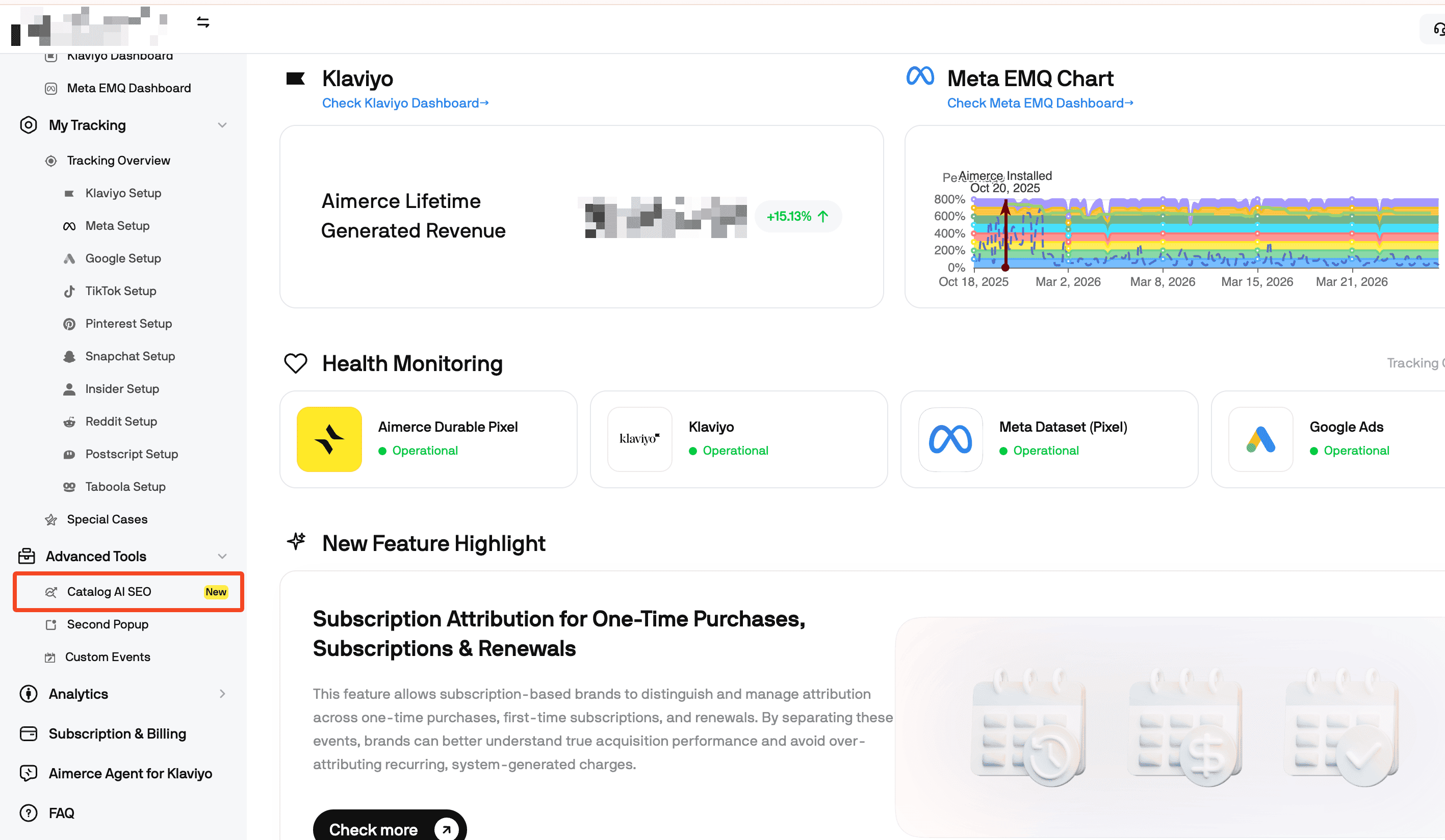
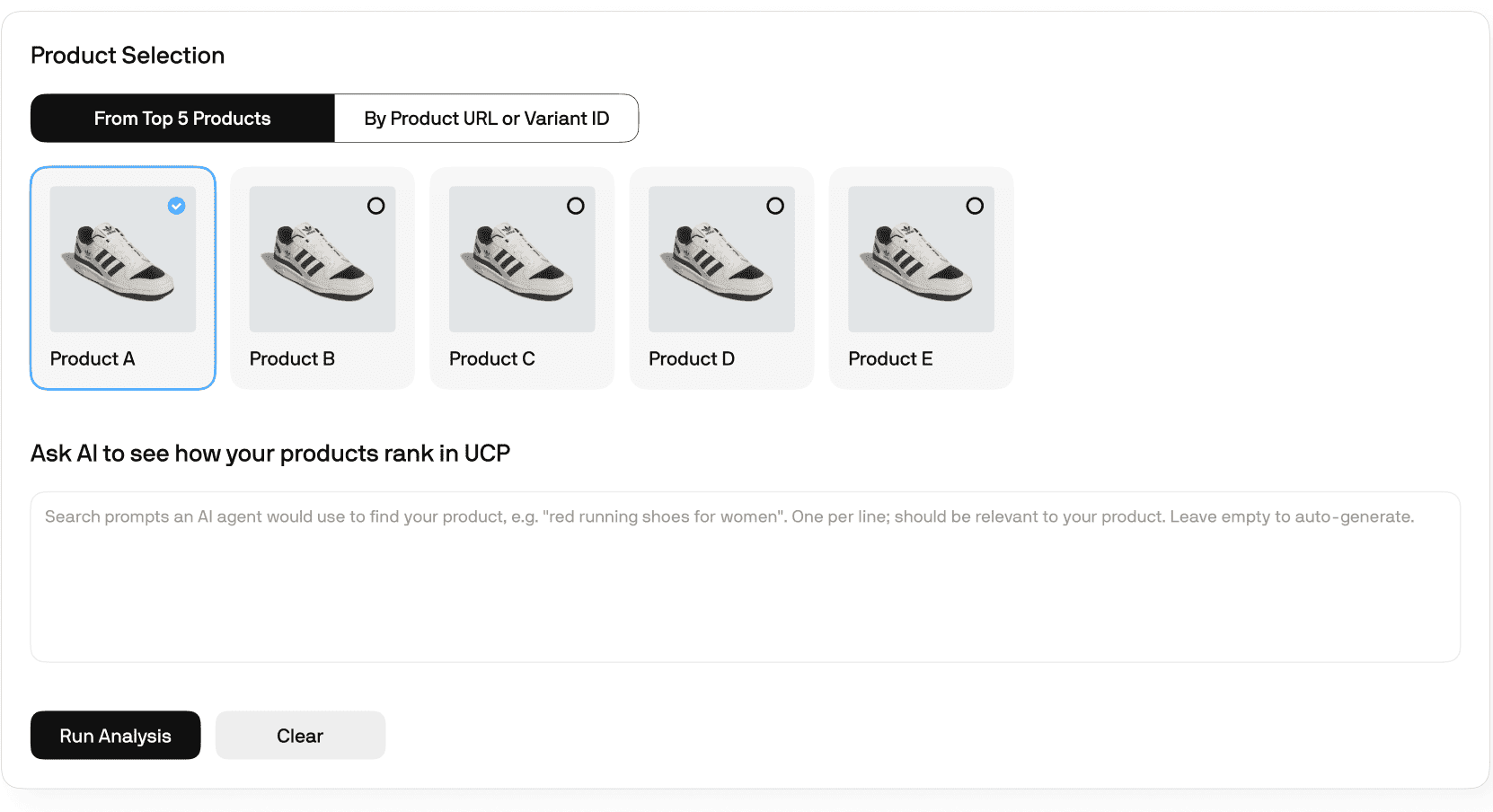
Step 2. Aimerce fetches your top 5 products.
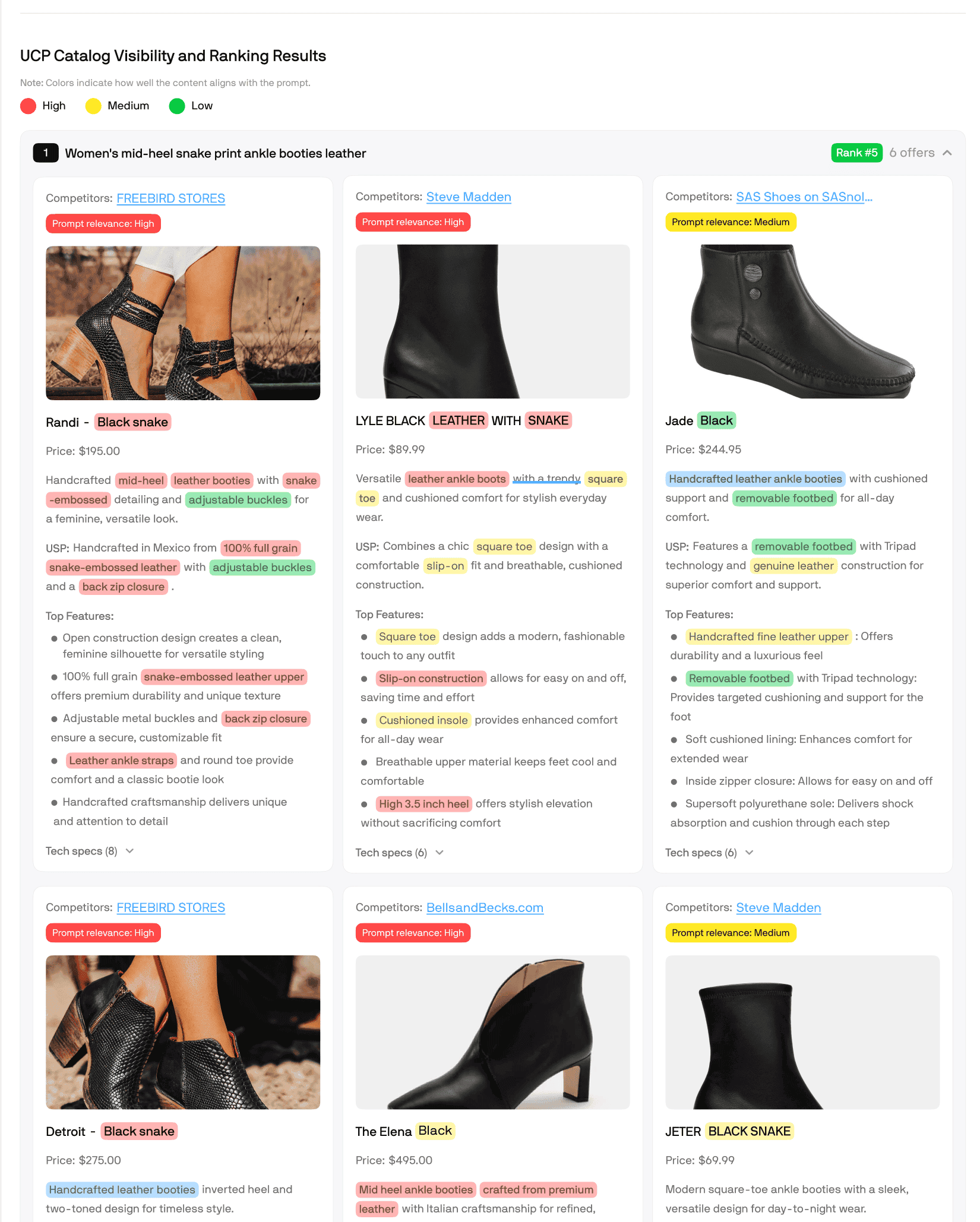
Step 3. We generate related prompts and test how your products rank against your competitors inside UCP. You see exactly where you stand.
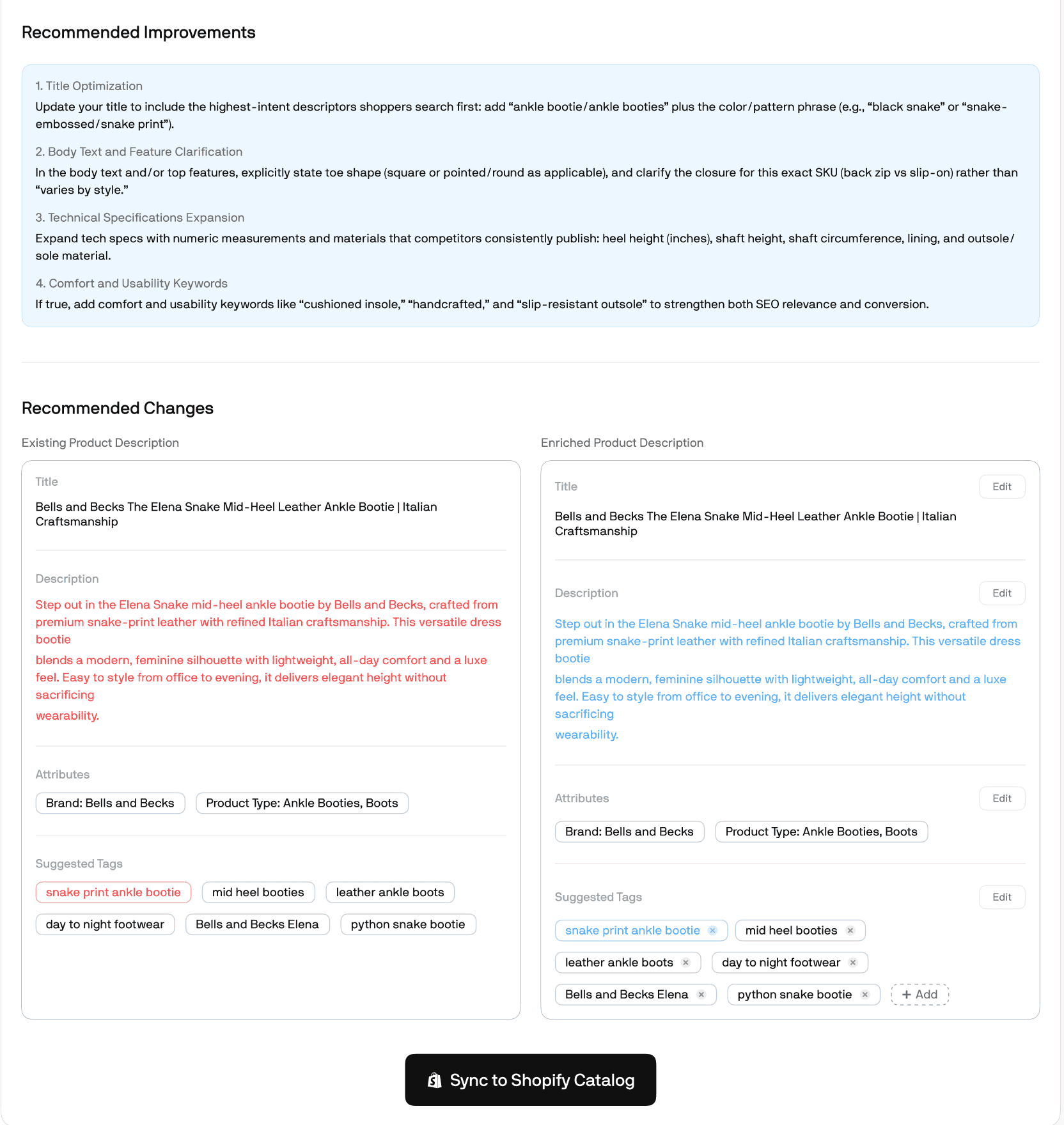
Step 4. We make specific recommendations to your product titles, descriptions, and tags. You review them, edit if you want, approve, and sync directly to Shopify.
FAQ
Do I need to change my Shopify theme to be "AI-ready"? Not necessarily. Many improvements are catalog-level, titles, attributes, variant naming, and content-level, specs, FAQs. Theme work helps specifically when your structured data is missing or inaccurate.
Is structured data or a product feed more important? They work together. Feeds standardize product facts for commerce systems, while on-page schema helps assistants extract and verify details directly from your site. If you have to choose where to start, fix data completeness first, then make sure schema reflects it.
Will adding llms.txt guarantee I show up in AI answers? No. It can make your store easier to interpret, but visibility also depends on query intent, competition, and whether the assistant trusts and can access your pages in the first place.
How do I optimize for discovery prompts, not just branded prompts? Add comparable attributes, create buying guides and comparison tables, and make sure your collections and FAQs answer the exact questions shoppers actually ask, rather than only the questions that name your brand directly.
How often should I re-audit my catalog for AI search readiness? Treat it as ongoing rather than one-time. New products, theme updates, and pricing changes all introduce drift. A weekly spot-check routine, or automated monitoring, catches issues before they compound across the catalog.
Does fixing my product feed help with anything beyond AI search visibility? Yes. Clean, consistent product data also improves standard SEO, Shopping feed performance, and catalog matching for ad platforms like Meta and Pinterest, which depend on the same underlying attributes.
What's the single highest-leverage fix if I can only do one thing? Standardizing product titles and variant naming. It's the fastest fix, and it directly determines whether your products are even eligible for AI-generated comparison lists in the first place.
Sources
[1] Google Search Central, "Product structured data,"
Related reading

Try Aimerce Pixel Risk-Free
for 30 Days
Most teams see results within 2 weeks.
Money-back guarantee.
It pays for itself, or you don't pay anything.
30-Day Aimerce Pixel Free Trial