Quick Answer: Aima is Aimerce's built-in AI analyst, available in the Aimerce app and directly in Slack. It answers plain-English questions about your Shopify, Meta, Google, and Klaviyo data, explains why a number moved instead of just reporting it, and can run the same question on a recurring schedule so you're not rebuilding the same report every week.
Key Takeaways
- Aima is Aimerce's built-in AI analyst, live in both the Aimerce app and Slack, and accessible inside the Aimerce dashboard not a chatbot bolted onto your store as an afterthought.
- It has three parts: Chat (ask a question in plain English), Agents (the same kind of question, run on a schedule and delivered by email or Slack), and native Slack access via @mention.
- The differentiator from attribution dashboards like Triple Whale or Northbeam: those are built to answer "which channel gets credit for this sale." Aima is built to answer "why did this number move, in which country, on which device, and what's the likely cause."
- Aima works from your actual Shopify order data plus event and click context from Meta, Google, and Klaviyo, not a modeled estimate standing in for the real thing.
- A good AI analyst says "I don't have enough data to answer that confidently" instead of presenting a guess as a confirmed order. That's the standard Aima is held to.
Why do campaign and revenue questions still take so long on Shopify?
Because the answer to a simple question like "how many purchases came from these two campaigns in the last two weeks" usually requires stitching together data that lives in different systems, none of which agree by default.
Shopify has the orders. Campaign metadata lives somewhere else, Meta Ads Manager, Google Ads, Klaviyo. Click and session context, if it's even captured consistently, is a third piece. Getting from "a question" to "an answer" typically means exporting reports, filtering by date, reconciling naming conventions between systems, and cross-checking UTMs by hand. That works, right up until it doesn't scale past a handful of campaigns.
The goal was never perfect attribution. Perfect attribution doesn't exist, every platform counts credit differently. The actual goal is a fast, decision-grade answer with clear assumptions attached to it, which is the gap Aima is built to close.
What does an AI data analyst like Aima actually do?
A practical AI analyst translates a business question into a data query, pulls the relevant orders and event context, and returns an answer a marketer can act on, with the reasoning behind it visible.
That means Aima translates plain English into a scoped query (time window, campaign filters, order constraints), pulls the matching Shopify orders and click or session context, and returns both a summary and an order-level breakdown so you can spot-check the answer yourself rather than taking it on faith.
Just as important is what it should not do. It should not invent missing data to fill a gap. It should not hide uncertainty behind a confident-sounding answer. And it should not present a modeled guess as if it were a confirmed order. A good AI analyst behaves less like a chatbot performing helpfulness and more like a query-and-reasoning layer sitting on top of your actual commerce data.
What can you actually ask Aima?
Real usage Aimerce customers so far clusters around a handful of question types, and knowing them is the fastest way to get a useful answer on your first try.
- Revenue and sales fluctuation root cause. "Why did sales drop today compared to yesterday?" or "one of my campaigns has unusually low sales, why?" Aima traces the funnel step by step and segments by country, device, and payment method to isolate where the drop is concentrated, rather than just reporting that revenue is down.
- Channel contribution and attribution share. "Roughly what percent of my revenue comes from Meta, Google, email, and organic or direct traffic?" This is a matching question, not a modeling question, and Aima is explicit about which identifiers it used to connect a sale back to a channel.
- Klaviyo email performance. Reviewing recent campaigns for open rate, click rate, attributed revenue, revenue per recipient, and unsubscribes, then flagging which ones actually performed and which need attention.
- Product performance. Best and worst performing products over a given window by revenue, order count, and average order value, with significant swings flagged automatically.
- Full journey audits. A conversion-metric walkthrough from first visit to purchase, looking for the specific step where the funnel is leaking.
- Integration and capability questions. Straightforward ones like what access Aima needs, or which platforms it's compatible with.
How is Aima different from an attribution tool like Triple Whale or Northbeam?
Attribution tools are built to answer "which channel gets credit for this sale." Aima is built to answer "why did revenue drop, in which country, on which device, what's the likely cause, and what's the realistic path back."
Triple Whale and Northbeam are great for high-level reporting, but they’re stuck with whatever data they happen to get. If there's a gap in your tracking, a dashboard just gives you a fancy view of that missing info. Aima works differently as it digs into the raw data from your store and marketing channels to actually find out why your numbers are shifting, rather than just showing you the surface-level trends.
DIY Reporting vs. Attribution Dashboard vs. Aima
| Dimension | Manual/Spreadsheet Reporting | Attribution Dashboard (e.g. Triple Whale, Northbeam) | Aima |
|---|---|---|---|
| Answers "which channel gets credit" | Yes, with manual joins | Yes, this is the core function | Yes, as one part of a broader answer |
| Answers "why did this number move" | Only with manual digging | Limited, mostly visualizes trend lines | Yes, this is the primary design goal |
| Order-level detail to spot-check the answer | Yes, if you built the export | Sometimes, depends on the tool | Yes, every summary includes an order-level breakdown |
| Segments by country, device, payment method automatically | No, manual filtering required | Limited | Yes |
| Recurring, scheduled answers without rebuilding the report | No | Depends on the tool's alerting | Yes, via Aima Agents |
| Works from plain-English questions | No | No, requires navigating the UI | Yes |
| Available directly in Slack | No | Rarely | Yes |
| Requires engineering or a data team to maintain | Often, for anything beyond basic exports | No | No |
What is Aima Agents, and how is it different from asking a question directly?
Agents are the same kind of question Aima answers in Chat, except configured once and then run automatically on a schedule, hourly, daily, weekly, or monthly, with results delivered by email or Slack instead of you asking again each time.
Aima Agents lets you automate your reporting so you can stop manually digging through data. Just set up your recurring daily or weekly checks like tracking channel attribution, signal health, or Klaviyo performance using plain English, the same way Chat is, so it doesn't require engineering time to configure It handles the heavy lifting automatically, saving you from building reports by hand or needing an engineering team to stay on top of your numbers.
What data does Aima need to give you a reliable answer?
At minimum, clean Shopify order data, some campaign context, and a clear time window, since vague inputs produce vague answers no matter how good the analyst is.
- Shopify order data: order ID, created timestamp, gross and net sales explicitly labeled as such, currency, customer email when provided, and refund or chargeback status if you plan to exclude those.
- Campaign context: campaign name or ID, click timestamp and landing page, and UTM parameters where present and consistent. Stable campaign IDs hold up better than names, since naming conventions drift between platforms over time.
- A clear time window: the purchase window and the click window are not the same question. "Orders created between June 1 and 14" and "clicks between May 20 and June 14" can produce genuinely different answers, and being explicit about which one you mean avoids a lot of confusion later.
Common mistakes when working with an AI analyst (Aima or otherwise)
- Asking an unscoped question. "How's my revenue doing?" is harder to answer usefully than "compare revenue for Campaign A and B over the last 14 days, including refunds or excluding them." Specify entities, metric, time window, and any rules up front.
- Assuming a dashboard's number is automatically wrong just because it disagrees with another platform's number. Different tools use different identifiers, time windows, and revenue definitions. Disagreement doesn't mean one is broken, it usually means they're answering slightly different questions.
- Skipping the spot-check. Pick 5 to 10 orders from any order-level breakdown and confirm they exist in Shopify with matching timestamps and revenue. If misses cluster around a specific pattern, like all returning customers, that's a data collection issue worth fixing, not a reporting bug.
- Treating gross and net revenue as interchangeable. Define which one you're using before comparing numbers across weeks, or you'll end up arguing about a discrepancy that was actually just a refund policy difference.
FAQ
What is Aima? Aima is Aimerce's built-in AI data analyst, available in the Aimerce app and in Slack. It answers plain-English questions about your Shopify, Meta, Google, and Klaviyo data and explains the reasoning behind the answer rather than just returning a number.
What's the difference between campaign attribution and campaign matching? Attribution usually implies a model, rules for distributing credit across multiple touchpoints. Matching is more direct: which orders can be connected to a given campaign using the identifiers actually available. Aima is explicit about which one it's using for a given answer.
Why do platform-reported conversions and my Shopify orders differ? Because they rely on different identifiers, different time windows, different deduplication logic, and sometimes different definitions of revenue. A mismatch doesn't automatically mean one number is wrong, it often means the two are answering slightly different questions.
Do UTMs solve attribution by themselves? No. UTMs help, but they can be missing, overwritten, or inconsistent, and they don't handle returning customers particularly well on their own.
Can Aima take actions like creating flows or adjusting campaigns? Aima is built as an analyst: it answers questions and explains root causes. It is not built to make changes to your campaigns or flows on your behalf.
What should I ask Aima first? Start with a bounded question that has a clear success condition, for example, listing all orders matched to a specific campaign over a defined date range with revenue totals and an order-level breakdown. Once that works well, expand from there.
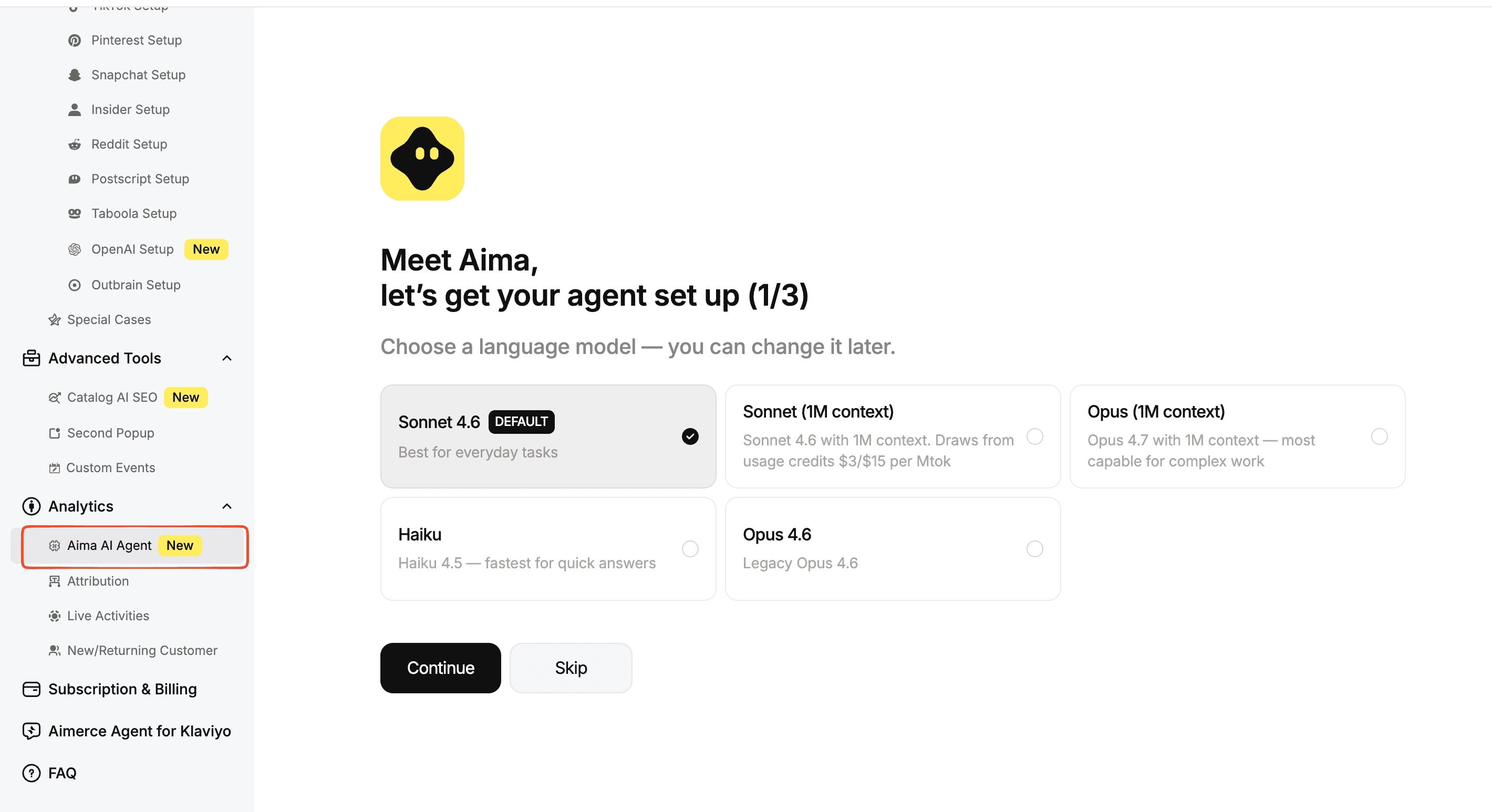
Where can I access Aima? Aima is available inside the Aimerce app and directly in Slack via @mention.
Sources
[1] Aimerce, homepage product messaging, "Meet Aima, Your 24/7 AI Analyst Agent, Now Available in Aimerce App and Slack,"
Related reading
- Aimerce vs. TripleWhale: Which One Is Right For Your Shopify Store?
- What Is EMQ Score and Why It's Silently Killing Your Meta ROAS
- One Pixel, 16+ Destinations: How Aimerce Actually Moves Your Data
If you're tired of jumping between Shopify, Meta, Google, and Klaviyo just to answer one question, ask Aima directly in the Aimerce app or in Slack. Sign up for a 30-day free trial.

Try Aimerce Pixel Risk-Free
for 30 Days
Most teams see results within 2 weeks.
Money-back guarantee.
It pays for itself, or you don't pay anything.
30-Day Aimerce Pixel Free Trial