What is First-Party Data?
First-party data is information you collect directly from your own customers through your own channels, your Shopify store, your email and SMS flows, your checkout, your customer accounts. It includes behavioral ecommerce events like page views, add to cart, and purchases, transactional data like order history and lifetime value, and customer-provided details like email addresses and preferences. First-party data matters because it is more accurate, more durable, and more privacy-compliant than third-party data. And when it is collected server-side and fed cleanly into Meta, Google, and Klaviyo, it directly improves ad performance, attribution tracking, and email revenue.
Third-party cookies are going away. Ad blockers are standard. iOS has made a large share of iPhone users invisible to client-side tracking. Every one of these changes points in the same direction: the brands that own their customer data directly are going to outperform the ones that depend on borrowed signals from platforms they do not control.
First-party data is not a new concept but it has become the most important foundation a DTC brand can build.
Where Does First-Party Data Come From
First-party data is any data collected directly by your business from people interacting with your brand. You own it. You collected it. It came from your direct relationship with your customer.
For Shopify brands, first-party data lives across several places that most teams are already sitting on without fully activating:
Storefront ecommerce events: page views, product views, add to cart, begin checkout, purchase. These are the behavioral signals that tell you what customers are interested in and how close they are to buying.
Checkout and order system: line items, order value, discount codes used, shipping method, refunds. This is your most reliable conversion data because it comes directly from Shopify's backend after a transaction is confirmed.
CRM and customer accounts: email addresses, phone numbers, order history, customer segments. The more customers create accounts, the richer this layer becomes.
Email and SMS platforms: open rates, click rates, flow performance, revenue attributed to campaigns. Klaviyo is where most of this lives for Shopify brands.
Onsite search and browsing behavior: what customers search for, which filters they use, which products they view repeatedly. These signals often reveal purchase intent before a customer adds anything to cart.
The challenge most Shopify brands face is that these sources do not naturally share a single customer identity. The same person can look like multiple different users across sessions, devices, and channels. Connecting those dots is where first-party data strategy starts to matter.
Difference Between First-Party, Zero-Party, and Third-Party Data
These terms get used interchangeably but they describe different things.
| Data Type | What It Is | Example | Reliability |
|---|---|---|---|
| First-party data | Observed behavior collected through your own touchpoints | Customer added product X to cart on your store | High |
| Zero-party data | Information customers intentionally share with you | Customer fills in a quiz saying they prefer size M | Very high |
| Second-party data | Another company's first-party data shared directly | A partner brand shares their customer purchase list | Medium |
| Third-party data | Aggregated data purchased from intermediaries | Audience segments bought from a data broker | Lower and declining |
For most DTC startups and top DTC brands, first-party and zero-party data are the ones worth investing in. Third-party data is losing reliability as browser restrictions tighten and identifiers change. First-party data collected directly from your customers, with proper consent, is more durable and more relevant to your specific business than anything you can buy from an outside source.
First-party does not automatically mean privacy compliant. The label describes who collected the data, not whether consent was obtained or how it is used. Consent and governance matter regardless of the data type.
Why First-Party Data More Important Now Than Ever Before
Three forces are making first-party data the only reliable foundation for ecommerce measurement and marketing.
- Browser restrictions are shortening cookie lifespans. Safari's ITP caps JavaScript-set cookies at seven days. A customer who visits your store and returns two weeks later looks like a new anonymous visitor to any tracking system relying on browser cookies. For brands with longer consideration cycles, this breaks attribution for a large share of returning traffic.
- Ad blockers are blocking client-side pixels. Around 30 percent of desktop users run some form of ad blocking. When your Meta pixel or Google tag cannot load, the conversion event never fires. The platform never sees the sale. Your campaigns optimize against an incomplete picture.
- iOS App Tracking Transparency has reduced platform visibility. The majority of US iPhone users have opted out of cross-app tracking. Meta and Google lose direct conversion signal for a large share of mobile traffic. The brands that compensate with strong first-party data sent via server-side APIs are the ones whose campaigns can still optimize effectively.
The brands that have built robust first-party data infrastructure are the fastest growing DTC brands in their categories right now. Not because first-party data is a new competitive advantage but because the absence of it has become a competitive disadvantage as platform-level tracking continues to erode.
How to Collect First-Party Data on Shopify
There are three approaches to first-party data collection: client-side, server-side, and hybrid. Most Shopify brands should be running a hybrid setup.
- Client-side collection uses JavaScript tags and pixels running in the shopper's browser. It is easy to deploy and captures rich page context. The downside is it loses events to ad blockers and browser restrictions. It is suitable for capturing browsing behavior and on-page interactions but not reliable enough for critical conversion events.
- Server-side collection sends events from a server you control to your analytics and marketing destinations. It is more resilient to browser-side blocking and gives you complete control over what data is sent and when. The tradeoff is it requires more careful implementation, particularly around event deduplication and identity management.
- Hybrid collection is the recommended approach for most Shopify brands. Use client-side tracking for browsing behavior where page context matters. Use server-side tracking for critical conversion events like purchase and initiate checkout, and for identity continuity across sessions. This is what Aimerce does specifically. Aimerce server side tracking Shopify uses Webhooks + Webpixel to collect both events client-side and browser side aiming to get 100% accurate data sent to ad platforms.
For Shopify specifically, the most reliable server-side setup uses Shopify Webhooks to capture confirmed order data from the backend after a transaction is complete, combined with Shopify Web Pixels for storefront interactions. This combination gives you complete ecommerce event coverage across the full customer journey including checkout pages that third-party scripts cannot reliably access.
Ecommerce Events Should You Prioritize for First-Party Data Collection
Not every event needs to be your first priority. Start with the signals that have the highest business impact and expand from there.
| Event | Priority | Why It Matters |
|---|---|---|
| Purchase | Critical | Primary optimization signal for Meta and Google. Most valuable for attribution tracking |
| Begin Checkout | High | Strong purchase intent signal. Essential for initiate checkout flows |
| Add to Cart | High | Retargeting signal. Powers cart abandonment flows in Klaviyo |
| View Content / Product View | Medium | Browse abandonment signal. Top-of-funnel audience building |
| Page View | Lower | Broad audience data. Useful but not critical server-side |
| Subscription Created | High if applicable | Recurring revenue attribution |
| Lead Captured | High if applicable | Email collection event for lifecycle marketing |
Every purchase event should include order ID, value, currency, and hashed customer email where consented. These are the parameters that determine Event Match Quality on Meta and conversion match rates on Google. Missing or inconsistent parameters are one of the most common causes of poor attribution tracking accuracy.
What Makes First-Party Data Actually Useful
Collecting first-party data is not enough on its own. The quality of what you collect determines how useful it is for ad optimization, email flows, and attribution.
- Clear event definitions matter. What exactly counts as "add to cart" in your setup? Does it fire once or multiple times per session? Is it the same event name across Meta, Google, and Klaviyo? Inconsistent naming, "Purchase" sent to Meta and "OrderCompleted" sent to Google, creates fragmented data that is harder to act on.
- Stable identifiers are the connective tissue. Browser cookies are short-lived and device-specific. Email addresses, customer account IDs, and order IDs are durable. When a customer's email is passed alongside a purchase event as a hashed identifier, Meta and Google can match that conversion to a real user profile even when the cookie chain has been broken by ITP or a device switch. This is what improves Event Match Quality scores and Google's Enhanced Conversions match rates.
- Deduplication prevents inflated data. When both a browser pixel and a server-side event fire for the same purchase without matching event IDs, ad platforms count both as separate conversions. Your reported purchases double, your CPA looks artificially low, and your campaigns optimize against numbers that do not reflect reality. Event deduplication using a consistent order ID across both browser and server events prevents this.
- Timely delivery supports optimization. If a purchase event arrives at Meta hours after it happened, it may still be recorded but is less useful for real-time bidding optimization. Server-side events fired from Shopify Webhooks immediately after order confirmation arrive faster and more consistently than browser events that depend on a thank-you page loading completely.
How Does First-Party Data Improve Meta and Google Ad Performance?
The connection between first-party data quality and ad performance is direct and measurable.
Meta's algorithm uses conversion events to learn who your buyers are and optimize delivery toward similar users. When purchase events include hashed customer email alongside the conversion, Meta can match those events to real user profiles in its system. This improves Event Match Quality scores in Meta's Events Manager. Brands running Aimerce consistently achieve EMQ scores between 8.6 and 9.3 compared to 4.0 to 6.0 for browser-only pixel setups.
Higher EMQ means Meta's algorithm has more accurate matching data to work with, which improves campaign optimization, reduces cost per acquisition, and recovers attributed revenue from conversions that were previously invisible to the platform.
For Google, Enhanced Conversions works on the same principle. Hashed customer email sent alongside purchase events allows Google to match conversions to logged-in Google accounts even when cookies have been cleared or blocked. This improves Smart Bidding accuracy and reduces the gap between Shopify order counts and Google Ads reported conversions.
For Klaviyo, first-party identity data improves visitor identification rates. When more site visitors are matched to Klaviyo profiles using server-side identification, cart abandonment flows, browse abandonment flows, and post-purchase flows reach more people without any changes to the flows themselves. Aimerce customers see up to 60 percent improvement in email revenue from Klaviyo flows after implementing server-side identification.
How Shopify Brands Collect and Activate First-Party Data?
Aimerce is built specifically for first-party data collection on Shopify. It handles the server-side infrastructure, event schema mapping, identity continuity, and platform forwarding that make first-party data actually useful rather than just collected.
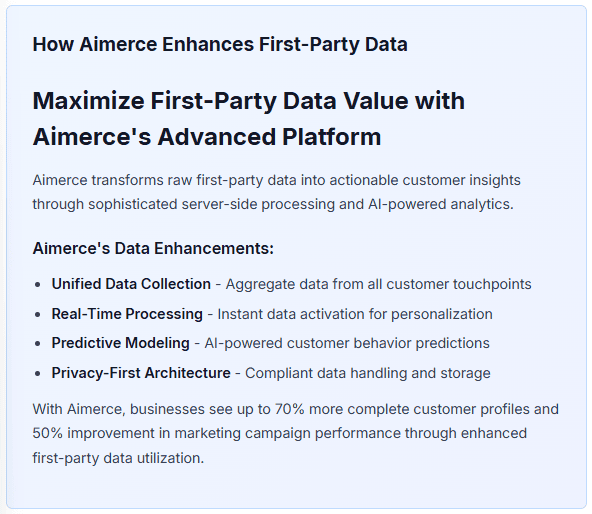
The core architecture uses Shopify Webhooks to capture confirmed purchase data directly from Shopify's backend, bypassing browser-side interference entirely. Shopify Web Pixels handle storefront interactions across the full customer journey including checkout pages. Together these give complete ecommerce event coverage without depending on browser scripts that ad blockers and iOS restrictions routinely interrupt.
Aimerce customers see up to 70 percent more complete customer profiles and measurable improvements in campaign performance across Meta, Google, and Klaviyo as a result of cleaner, more complete first-party data flowing through their marketing stack.
For Shopify brands evaluating the Elevar alternative landscape, Aimerce delivers the same server-side event coverage with less setup complexity and no ongoing infrastructure maintenance. There is no cloud server to provision, no GTM server container to configure, and no deduplication logic to write manually. Aimerce handles all of it automatically as part of the Shopify server side tracking setup.
FAQ
What is first-party data in ecommerce? First-party data is information collected directly by your business from your own customers through your own channels. In ecommerce this includes behavioral ecommerce events like page views, add to cart, and purchases, transactional data from your order system, and customer-provided details like email addresses collected at checkout or through sign-up forms. It is the most reliable and durable data available to a Shopify brand because it comes from your direct relationship with your customers.
Why is first-party data more important than third-party data? Third-party data is aggregated from intermediaries and is becoming less reliable as browser restrictions tighten, cookies are phased out, and identifiers change. First-party data comes directly from your customers through your own touchpoints and is not affected by these platform-level changes. It is also more relevant to your specific business because it reflects the actual behavior of your actual customers rather than modeled audience segments.
How does first-party data improve Meta ad performance? When purchase events include hashed customer email as a first-party identifier, Meta can match those conversions to real user profiles in its system even when cookies have been blocked or expired. This improves Event Match Quality scores, which gives Meta's algorithm more accurate data to optimize campaign delivery against. Higher EMQ scores typically result in better campaign optimization, lower cost per acquisition, and more complete conversion attribution.
What is the difference between client-side and server-side first-party data collection? Client-side collection uses JavaScript tags running in the shopper's browser, which can be blocked by ad blockers and affected by cookie restrictions. Server-side collection sends events from a server you control to your marketing destinations, bypassing browser-side interference. For critical conversion events like purchase, server-side collection is more reliable. For browsing behavior where page context matters, client-side collection is still useful. Most Shopify brands benefit from a hybrid setup that uses both.
Does first-party data mean you do not need cookies? Not entirely. Cookies are still useful for short-term session continuity and on-site personalization. What first-party data strategy changes is your dependence on cookies for critical conversion measurement. By using server-side event collection and durable identifiers like hashed email addresses, you reduce reliance on browser cookies for the signals that matter most to ad platform optimization and Klaviyo flow performance.
What is event deduplication and why does it matter for first-party data? Deduplication prevents the same conversion from being counted twice when both a browser pixel and a server-side event fire for the same purchase. Without deduplication, ad platforms receive two conversion signals for one order, inflating reported conversions and corrupting campaign optimization data. Deduplication works by assigning a consistent event ID to each purchase and configuring each platform to discard duplicates when the same ID arrives twice.
How does Aimerce handle first-party data collection for Shopify? Aimerce uses Shopify Webhooks to capture confirmed purchase data from Shopify's backend and Shopify Web Pixels for storefront interactions. This gives complete ecommerce event coverage across the full customer journey without depending on browser scripts. It handles event deduplication automatically, passes hashed customer identifiers to Meta and Google for improved match quality, and improves Klaviyo identification rates through server-side visitor identification. Aimerce customers see up to 70 percent more complete customer profiles and measurable improvement in campaign performance across their marketing stack.

Try Aimerce Pixel Risk-Free
for 30 Days
Most teams see results within 2 weeks.
Money-back guarantee.
It pays for itself, or you don't pay anything.
30-Day Aimerce Pixel Free Trial