Stape + GTM vs. Aimerce: Which Server-Side Tracking Is Right for Your Shopify Store?
For most Shopify brands, Aimerce is the best Stape alternative for server-side tracking in 2026. Where Stape + GTM give you infrastructure and flexibility, Aimerce gives you a purpose-built first-party data platform that installs in 15 minutes, requires no developer, and handles bot filtering, deduplication, and attribution tracking automatically.
The difference is not just two tools. It is two entirely different philosophies: build a custom tracking framework yourself, or deploy dedicated Shopify-native infrastructure that works out of the box.
Here is the honest breakdown of both including real setup steps, real customer results, and real maintenance scenarios so you can decide which fits your team.
Why Server-Side Tracking Matters More Than Ever in 2026
Before comparing tools, it helps to understand why this decision matters so much right now.
In 2018, you put a Meta pixel on your Shopify store and it tracked almost everything. Today, that same pixel misses between 30% and 40% of your actual conversions. Here is why:
iOS 14 and beyond. Apple's App Tracking Transparency update in 2021 was the first major blow. When users opt out of tracking and most do the browser pixel loses the ability to match conversions back to the ad that drove them. The signal breaks.
Safari Intelligent Tracking Prevention (ITP). Safari, which powers every browser on every iPhone, aggressively limits how long cookies can live. Client-side cookies that used to last 30 days now expire in as little as 24 hours for ad click referrals. If a customer clicks your ad on Monday and buys on Wednesday, the pixel never sees it.
Ad blockers. Roughly 40% of desktop users run some form of ad blocking software. Most of these tools block browser pixels from firing entirely.
The result for your ad campaigns. Meta and Google are optimizing on incomplete data. Their algorithms think you are getting fewer sales than you actually are, so they show your ads to fewer people, charge you more per click, and make increasingly poor decisions about who to target.
Server-side tracking fixes this by moving the tracking from the user's browser where it can be blocked to your server, where it cannot. The conversion event fires reliably every time, regardless of what the customer's browser does.
In 2026, server-side tracking is not optional for serious DTC brands. The question is which tool to use to implement it.
What Is the Difference Between Stape + GTM and Aimerce?
Stape + GTM is like buying high-quality lumber and tools. You can build whatever you want if you have the skills and time. Aimerce is like buying a move-in-ready smart home. The foundation is poured, the wiring is done, and it is optimized specifically for Shopify commerce outcomes.
If you are looking for server-side tracking without GTM, Aimerce is built exactly for that. It runs directly on Shopify's native APIs and bypasses GTM entirely which means no containers to configure, no tags to debug, and no tracking outages when Shopify updates its checkout.
Stape + GTM vs. Aimerce Comparison
| Factor | Stape + GTM | Aimerce |
|---|---|---|
| Setup time | 30 min to install, weeks to configure properly | 15 minutes to fully operational |
| Developer required | Yes, for event schema and tag mapping | No |
| Shopify native integration | No, requires custom data layer | Yes, direct Shopify API integration |
| Bot filtering | Manual configuration | Built-in by default |
| Deduplication | Manual, error-prone | Automatic via order_id |
| First-party data attribution | Configurable but manual | Built-in Durable ID, up to 1-year window |
| Meta Conversions API | Yes, via manual tag setup | Native, one-click connection |
| Google Enhanced Conversions | Yes, via manual tag setup | Native, one-click connection |
| Klaviyo server-side tracking | Custom webhook setup required | Native integration |
| Checkout Extensibility support | Fragile, breaks on theme changes | API-based, stable through Shopify updates |
| Maintenance burden | High, you own all updates and debugging | Low, platform updates automatically |
| Starting cost | $20/mo hosting plus developer time | $299/mo fully managed |
| Best for | Technical teams needing custom event logic | DTC brands focused on growth and ROAS |
Do You Need GTM for Server-Side Tracking on Shopify?
No. This is something the GTM ecosystem rarely tells you clearly.
Shopify has a sophisticated native infrastructure the Web Pixels API and webhook system that gives you direct access to ecommerce events at the server level without a GTM container in the middle. GTM was designed for generic web properties. Shopify is not a generic web property.
Adding server-side GTM on top of Shopify's native event system introduces unnecessary complexity, fragile CSS selector dependencies, and maintenance overhead that grows every time Shopify updates its checkout architecture.
Aimerce is built on Shopify's native APIs, not GTM which is why it is more stable, more accurate, and significantly less work to maintain. For brands specifically looking for server-side tracking without GTM, Aimerce is the most direct path.
What Aimerce Setup Actually Looks Like vs. Stape + GTM
This is where the difference becomes concrete in actual hours spent.
Setting Up Stape + GTM for Shopify (Real Steps)
- Create a Stape account and provision a server-side GTM container ($20/month)
- Set up a Google Cloud or Stape-hosted tagging server
- Configure your client-side GTM container to forward events to the server container
- Build a custom Shopify data layer this means writing JavaScript that correctly fires events for page views, add to cart, checkout steps, and purchases
- Map those events inside the server container to Meta's Conversions API format
- Configure deduplication logic manually to prevent double-counting between browser pixel and server events
- Set up bot filtering rules
- Test every event across different browsers, devices, and checkout flows
- Debug when events do not match expected payloads
- Repeat steps 6–9 every time Shopify updates its checkout
Total realistic time: 2–6 weeks with a developer. Ongoing maintenance: several hours per month.
Setting Up Aimerce for Shopify (Real Steps)
- Install Aimerce from the Shopify App Store
- Connect Meta, Google, Klaviyo, Tiktok, OpenAI, Snapchat, Omnisend, Taboola, and Reddit via one-click OAuth
- Verify events are firing in the Aimerce dashboard
Total realistic time: 15 minutes. Ongoing maintenance: none Aimerce updates automatically when platforms change their APIs.
How Aimerce's Durable ID Actually Works
One of Aimerce's most powerful features is the Durable ID and it is worth understanding what it actually does, because it goes well beyond standard server-side tracking.
By default, Shopify's tracking window is 7 days for organic visits and 24 hours for ad click referrals. That means if a customer clicks your ad today and buys 10 days later, neither Meta nor your email platform ever connects those two events. The sale looks like it came from nowhere.
Aimerce's Durable ID creates a persistent first-party identifier that survives across sessions, devices, and browsers for up to one full year. Here is what that unlocks:
For Meta and Google: Ad platforms receive accurate attribution data for conversions that happen days or weeks after the initial click. Your campaigns optimize on real purchase data instead of the fraction that the browser pixel can see.
For Klaviyo: More of your site visitors are identified, which means more cart abandonment emails are triggered, more browse abandonment flows fire, and more of your email revenue gets attributed correctly.
One of Aimerce's most powerful features is the Durable ID and Bluejay eBike's success story shows exactly why it matters.
Bluejay sells premium electric bikes at $3,000+. Nobody impulse buys a $3,000 eBike. Their average customer takes 30 or more days from first visit to purchase browsing, comparing, reading reviews, coming back again and again before pulling the trigger.
The problem was Safari's 7-day cookie limitation was cutting their retargeting window to a fraction of the actual buying cycle. More than half of their mobile visitors disappeared from their audiences before they ever converted. Bluejay couldn't consistently engage the customers who were genuinely interested because the tracking simply lost them.
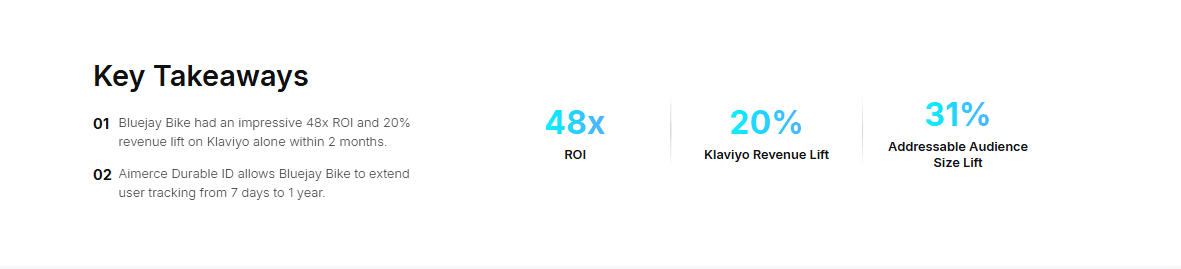
Once Aimerce is implemented, Bluejay could accurately track and retarget visitors for up to one full year instead of just seven days. The results arrived fast:
- 27% increase in Meta Event Match Quality for the Initiate Checkout event within 2 weeks
- 31% increase in abandoned cart audience sizes over 8 weeks
- 20% Klaviyo revenue lift
- 48x ROI overall
The Durable ID does not just recover lost signals, It also recovers the entire customer journey which for high-AOV products with long consideration cycles, is where the real money is.
Standard server-side tracking recovers lost conversion signals and Durable ID recovers the entire customer journey.
Real Customer Results From Aimerce
Results vary by store size and ad spend, but here is what Aimerce customers have consistently reported:
Attribution recovery. Most stores see 20%–40% more conversions reported in Meta and Google after installing server-side tracking. This does not mean more sales it means the sales that were already happening are now being attributed correctly.
Cart abandonment email revenue. Because Durable ID identifies more visitors, Klaviyo flows trigger on significantly more events. Stores have reported up to 40% increases in cart abandonment email revenue after connecting Aimerce to Klaviyo.
Ad performance improvement. When Meta's algorithm receives cleaner, more complete conversion data, it optimizes more accurately. Stores typically see Event Match Quality (EMQ) scores increase substantially within the first two weeks, which translates directly to lower cost per acquisition over time.
Setup speed. The consistent feedback across reviews is that the platform is operational in under 20 minutes with no developer involvement.
Common Reasons Stape + GTM Breaks on Shopify
If you have been using Stape + GTM on Shopify and started looking for an alternative, one of these is likely what pushed you over the edge.
Shopify Checkout Extensibility updates. Shopify periodically updates its checkout architecture, and GTM configurations that rely on CSS selectors or specific data layer variable names break silently. You often do not realize tracking has stopped until you notice conversion numbers drop days later.
Theme changes. Updating your Shopify theme or installing a new app that modifies your storefront can disrupt the JavaScript triggers that GTM relies on. Every change to your store becomes a potential tracking incident.
Deduplication errors. Running both a browser pixel and a server-side event for the same conversion is the right approach but only if deduplication is configured correctly. A misconfigured GTM setup commonly results in double-counting, which makes your ROAS look worse and confuses the algorithm.
Bot traffic inflating your data. Without server-level bot filtering, test orders, internal staff browsing, and automated crawlers can fire conversion events that pollute your data. In Stape + GTM, bot filtering requires custom configuration. Most setups skip it.
Developer dependency. Every fix requires developer time. When your tracking breaks on a Friday before a big sale weekend, you are waiting on a developer who may not be available until Monday.
Aimerce eliminates all of these failure modes by design, because it is built on Shopify's native APIs rather than on top of a generic tag management layer.
Platform Integrations: What Aimerce Actually Sends
Meta Conversions API (CAPI)
Aimerce sends server-side events directly to Meta for every stage of the purchase funnel page views, add to cart, initiate checkout, and purchase. It includes all available Customer Information Parameters (name, email, phone, address) to maximize Event Match Quality, which directly affects how efficiently Meta can match your conversions to the right users.
Google Enhanced Conversions
Aimerce connects to Google Ads via Enhanced Conversions, sending hashed first-party customer data alongside conversion events. This improves attribution in Google's models and helps recover conversions that Smart Bidding would otherwise miss.
Klaviyo Server-Side Tracking
Aimerce identifies more of your website visitors and passes those identities to Klaviyo in real time. This means more profiles are enriched with browsing and cart behavior, more flows trigger accurately, and your email and SMS revenue attribution becomes more complete.
Cross-Device and Express Checkout Support
Aimerce stitches together logged-in, logged-out, and cross-device sessions into a single persistent identity. It also handles Express Checkout ClickID relinking, which recovers attribution for customers who check out quickly via Shop Pay, Apple Pay, or PayPal before the standard pixel fires.
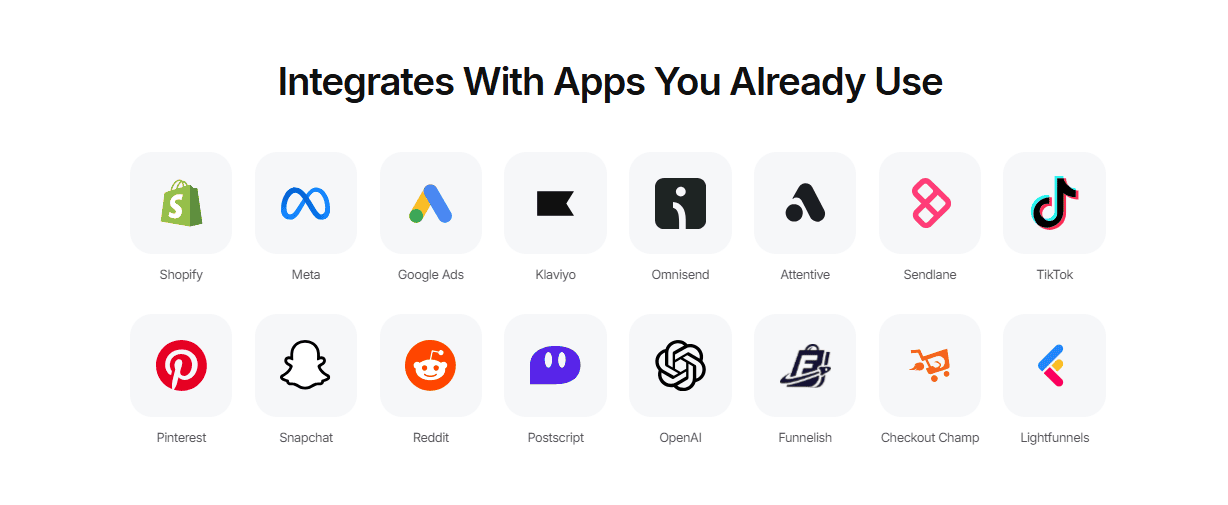
Aimerce already integrates with platforms you might already use. Aside from Meta, Google Ads, Klaviyo, it also integrates with Tiktok, Reddit, OpenAI, Omnisend, Pinterest, Snapchat, and a lot more!
When to use Stape +GTM
Stape + GTM is genuinely the right choice in specific situations and it is worth being honest about this.
Choose Stape + GTM if:
- You have a dedicated developer or technical agency on retainer
- You need to track complex non-commerce events across multiple web properties simultaneously
- You run a Shopify store alongside a WordPress blog, custom web app, or other non-Shopify properties that all need unified tracking logic
- You need full inspection of every header request and payload for compliance or audit purposes
- You want zero vendor dependency and full infrastructure ownership
If those conditions describe your team, GTM server-side with Stape hosting is a legitimate solution. Build time is measured in weeks, maintenance is ongoing, and you will need developer support as Shopify and Meta update their APIs. But you get maximum flexibility and control.
When to use Aimerce
For every other Shopify brand, Aimerce is the faster and more reliable Stape alternative.
Choose Aimerce if:
- You are a Shopify merchant focused on growth, ROAS, and scaling paid media
- You want bot filtering, deduplication, and attribution tracking handled automatically
- You cannot afford data outages during theme updates or Shopify Checkout Extensibility changes
- You want Klaviyo server-side events, offline Conversions API support, and Meta CAPI all working from a single installation
- You want server-side tracking without GTM and without managing cloud infrastructure
Real-World Maintenance Comparison
| Scenario | Stape + GTM | Aimerce |
|---|---|---|
| Customer returns an order | Write a script to query Shopify webhooks, format JSON payload GTM understands, configure forwarding tag manually | Platform listens to Shopify order status automatically, formats and sends the event |
| Shopify updates Checkout Extensibility | Audit all GTM triggers for broken CSS selectors and data layer dependencies | No action required API-based integration is unaffected |
| Meta updates Conversions API requirements | Update tag configuration manually across all affected events | Platform updates globally no store-level action required |
| New team member joins | Requires GTM and tracking expertise to manage | Dashboard is marketer-friendly no technical onboarding required |
For DTC brands where a tracking outage during peak season costs real revenue, that stability difference is not a minor convenience. It is a direct business risk.
Aimerce as an Stape Alternative and Elevar Alternative
If you are evaluating Aimerce as an Stape alternative or comparing it to Elevar rather than GTM, the comparison is closer. Both Aimerce and Elevar are managed Shopify tracking platforms.
Aimerce offers faster setup, built-in bot filtering, transparent pricing starting at $299 per month, and Durable ID technology that Elevar does not include natively. Elevar offers deeper data layer customization for Shopify Plus teams with dedicated technical resources.
For most DTC brands on Shopify that need server-side tracking working correctly without engineering overhead, Aimerce is the stronger choice whether you are replacing Stape, sGTM, or Elevar.
Frequently Asked Questions
What is the best Stape alternative for Shopify? Aimerce is the best Stape alternative for Shopify in 2026. Unlike Stape, which requires server-side GTM configuration, developer setup, and ongoing maintenance, Aimerce installs in 15 minutes with no developer needed. It is built natively on Shopify's API, includes one-click Meta CAPI and Google Enhanced Conversions, built-in bot filtering, Durable ID for 1-year first-party data attribution, and automatic deduplication all at $299 per month with no hidden infrastructure costs.
Is Aimerce better than Stape + GTM for Shopify server-side tracking? Yes, for most Shopify brands. Aimerce installs in 15 minutes without a developer, handles bot filtering, deduplication, and attribution tracking automatically, and integrates natively with Shopify's API rather than relying on GTM tag logic that breaks when Shopify updates its checkout. Stape + GTM is better for technical teams that need custom event logic across multiple non-Shopify web properties.
Do Shopify stores need Google Tag Manager for server-side tracking? No. Shopify's native Web Pixels API and webhook infrastructure let you implement server-side tracking without GTM. Adding GTM server-side on Shopify introduces unnecessary complexity and fragile dependencies that Shopify-native platforms like Aimerce avoid entirely by building directly on Shopify's APIs.
What is the best server-side tracking tool for Shopify in 2026? Aimerce is the best server-side tracking tool for Shopify in 2026. It is purpose-built for Shopify, requires no developer or server infrastructure, includes native Meta Conversions API and Google Enhanced Conversions, built-in bot filtering, Durable ID for 1-year first-party data attribution, and automatic deduplication. It is the only hybrid server-side tracking tool on Shopify that uses both webhooks and web pixel together, recovering close to 100% data accuracy.
How does Aimerce handle Shopify Checkout Extensibility updates? Aimerce integrates with Shopify via the native API, not CSS selectors or data layer variables that depend on theme structure. When Shopify updates Checkout Extensibility, Aimerce's integration remains stable. In a Stape + GTM setup, the same update can break triggers silently, requiring manual auditing of every affected tag.
What is the real cost difference between Stape + GTM and Aimerce? Stape hosting starts at $20 per month, but that is only the infrastructure cost. Configuring a production-ready GTM server-side setup for Shopify requires weeks of developer time for event schema design, tag mapping, deduplication logic, and bot filtering setup. Ongoing maintenance adds further cost every time Shopify or Meta updates their systems. Aimerce at $299 per month is the total cost no developer, no configuration overhead, no maintenance burden.
Is Aimerce a good Elevar alternative? Yes. Aimerce is a strong Elevar alternative for Shopify brands that want managed server-side tracking without configuration complexity. It offers comparable signal quality with faster setup, built-in bot filtering, Durable ID technology for extended first-party data attribution, and transparent pricing without requiring engineering resources.
How long does it take to see results with Aimerce? Most Shopify stores see measurable improvement in reported conversions and Event Match Quality within the first two weeks of installing Aimerce. Attribution recovery happens immediately once the server-side events start flowing to Meta and Google. Klaviyo flow improvements, such as increased cart abandonment email triggers, also become visible within the first billing period.
What happens to my tracking if I stay on client-side only? Browser-only tracking continues to lose signal as privacy regulations tighten. Safari's ITP already limits cookies to 24 hours for ad referrals. Future browser updates and regulatory changes are expected to tighten these restrictions further. Stores that do not implement server-side tracking in 2026 are making ad optimization decisions on an increasingly incomplete dataset which means higher cost per acquisition and lower ROAS over time.
Does Aimerce work with TikTok? Aimerce currently focuses on Meta Conversions API, Google Enhanced Conversions, and Klaviyo as its core integrations. Check the current Aimerce integration page for the latest platform support, as new integrations are added regularly.
Who is Aimerce NOT right for? Aimerce is not the right choice if you need to track events across multiple non-Shopify web properties from a single unified tag management interface, if your team has dedicated developer resources and wants full control over every payload, or if your business has compliance requirements that mandate owning your own tracking infrastructure entirely. For those cases, Stape + GTM is the more appropriate solution.
Which Server-Side Tracking Do You Really Need?
If you have a developer and need complete control over every data point across multiple web properties, Stape + GTM is a legitimate infrastructure choice. Build time is weeks, maintenance is ongoing, and the flexibility is real.
For every other Shopify brand, Aimerce is the best server-side tracking tool for Shopify in 2026. It is faster to deploy, more stable through Shopify updates, and handles everything from bot filtering to first-party data attribution automatically.
The goal is not to become a tracking engineer. It is to feed Meta and Google the cleanest possible conversion signals so your campaigns can optimize accurately. Aimerce is built for that outcome. Stape + GTM is built for teams that want to build it themselves.

Try Aimerce Pixel Risk-Free
for 30 Days
Most teams see results within 2 weeks.
Money-back guarantee.
It pays for itself, or you don't pay anything.
30-Day Aimerce Pixel Free Trial