Quick Answer: Klaviyo abandonment flows can only email shoppers Klaviyo recognizes at the moment they browse, add to cart, or start checkout. Browsers cut tracking cookies short, often to around seven days, shoppers switch devices, and ad blockers stop scripts, so many returning visitors look like strangers and never enter the flow. You can spot the gap by comparing Klaviyo's Viewed Product and Started Checkout events with your site traffic and Shopify's abandoned checkouts. Server-side, first-party tracking closes it by recognizing returning visitors for longer and sending more events to Klaviyo, so more shoppers reach the emails you've already built.
Key Takeaways
- Weak abandonment flows are often a reach problem, not an email problem. The flow never starts for shoppers Klaviyo can't identify.
- Browser cookie limits, device switching, and blocked scripts all cut Klaviyo's view of returning visitors.
- Brands with considered, higher-priced purchases lose the most, because their shoppers come back after the cookie expires.
- Three quick comparisons in Klaviyo and Shopify show whether you have a tracking gap.
- Once more shoppers enter your flows, filters, frequency, and deliverability matter more.
By Gavin Hewitson, founder of In-box
!Klaviyo browse abandonment flow recovering revenue with extended tracking
When a brand asks us why their abandonment flows look weak, we usually start by checking the emails. Most of the time, the subject lines, timing, offers, and design are all fine. The real problem is that the flow only triggers for a small portion of the people who actually abandoned.
That's because Klaviyo can only email shoppers that it can identify. If it doesn't recognize a returning visitor when they browse a product or start a checkout, the flow never starts, and that potential revenue never shows up anywhere. It doesn't look like a failed email; it looks like nothing happened at all.
I run In-box, an email marketing agency that's worked with over 500 ecommerce brands, mostly on Klaviyo. Here's why this problem exists, how to tell if you have it, and how to fix it.
Why do Klaviyo abandonment flows miss so many shoppers?
Klaviyo's browse abandonment, abandoned cart, and abandoned checkout flows all depend on knowing who the visitor is when they take an action. Klaviyo typically identifies visitors using cookies, often after they've clicked a link in an email or submitted a sign-up form.
But that identification doesn't always last:
- Browsers cut cookies short. Safari and other browsers limit how long script-based tracking cookies last, often to around seven days. A shopper who arrived at your website from an email two weeks ago and comes back today now looks like a stranger.
- People switch devices. Someone might read your email on their phone at lunch and browse your website on their laptop that evening. The cookie that identified them on their phone won't follow them to their laptop.
- Ad blockers and consent tools can stop scripts. If the tracking script doesn't load, the event won't reach Klaviyo.
These limitations mean your flows can miss shoppers who take longer to decide or return on a different device. For a brand selling a $30 candle, that might not be a major problem. But brands selling products with longer buying cycles are more likely to run into this issue.
Which products suffer most from the tracking gap?
This identification gap hurts most when people take their time to make a decision. That includes furniture, e-bikes, jewelry, high-end skincare, and pretty much anything over a few hundred dollars. Shoppers do their research, compare options, and leave your website. They might come back a week later, leave again, and only buy a month after their first visit.
These are exactly the kinds of people your abandonment flows are built for. They're interested, and a well-timed email might be enough to bring them back. But when they come back after the cookie has expired, Klaviyo never sees them, and the abandonment flow won't trigger.
We cover the structure of these flows in our guide to the four Klaviyo abandonment flows every ecommerce brand needs. The emails matter, but they only matter if the flow triggers in the first place.
How can you tell if you have a tracking gap?
You don't need special tools to understand if you have this tracking gap. Check these three things in Klaviyo:
- Compare "Viewed Product" events to your site traffic. Check the number of product page views from Shopify or your analytics tool for the last 30 days, then compare it with the number of Viewed Product events in Klaviyo. If Klaviyo reports far fewer events, it's worth looking into whether some product views aren't being tracked.
- Look at how many people enter your browse abandonment flow. If thousands of people visit product pages each week but only a few dozen enter the flow, it's worth checking whether tracking is limiting who gets through.
- Check Started Checkout against Shopify's abandoned checkouts. Shopify shows you how many people abandoned checkout. If Klaviyo's abandoned checkout flow only catches a portion of them, you're leaving potential revenue on the table.
None of these comparisons will give you a perfect number, but big gaps are enough reason to investigate your tracking and flow setup before you rewrite your emails.
What does server-side, first-party tracking change?
Server-side tracking lets you send customer activity to Klaviyo from your own server instead of relying entirely on tracking scripts in the shopper's browser. You can use first-party identifiers to help recognize returning visitors, even when browser cookies are restricted.
In practice, that means three things:
- Recognition lasts longer. With the right setup, you may still recognize shoppers who return weeks after their first visit.
- More events reach Klaviyo. Server-side tracking can capture product views, add-to-carts, and checkouts that browser-only tracking might miss.
- More shoppers enter your flows. Instead of relying on short-lived browser identification, you're more likely to reach people who take longer to make a purchase.
| Browser-only tracking | Server-side, first-party tracking | |
|---|---|---|
| How long returning visitors are recognized | Often around seven days in Safari and other browsers | Longer, with the right setup |
| Events blocked by ad blockers or scripts that don't load | Lost | More likely to reach Klaviyo |
| Who enters abandonment flows | Mostly recent, same-device visitors | More of the shoppers who take weeks to decide |
| Changes needed to your emails | Not applicable | Often none |
Your flows might not need to change at all. You might just need to get your existing emails and offers in front of more shoppers at the right time.
What does it look like in practice?
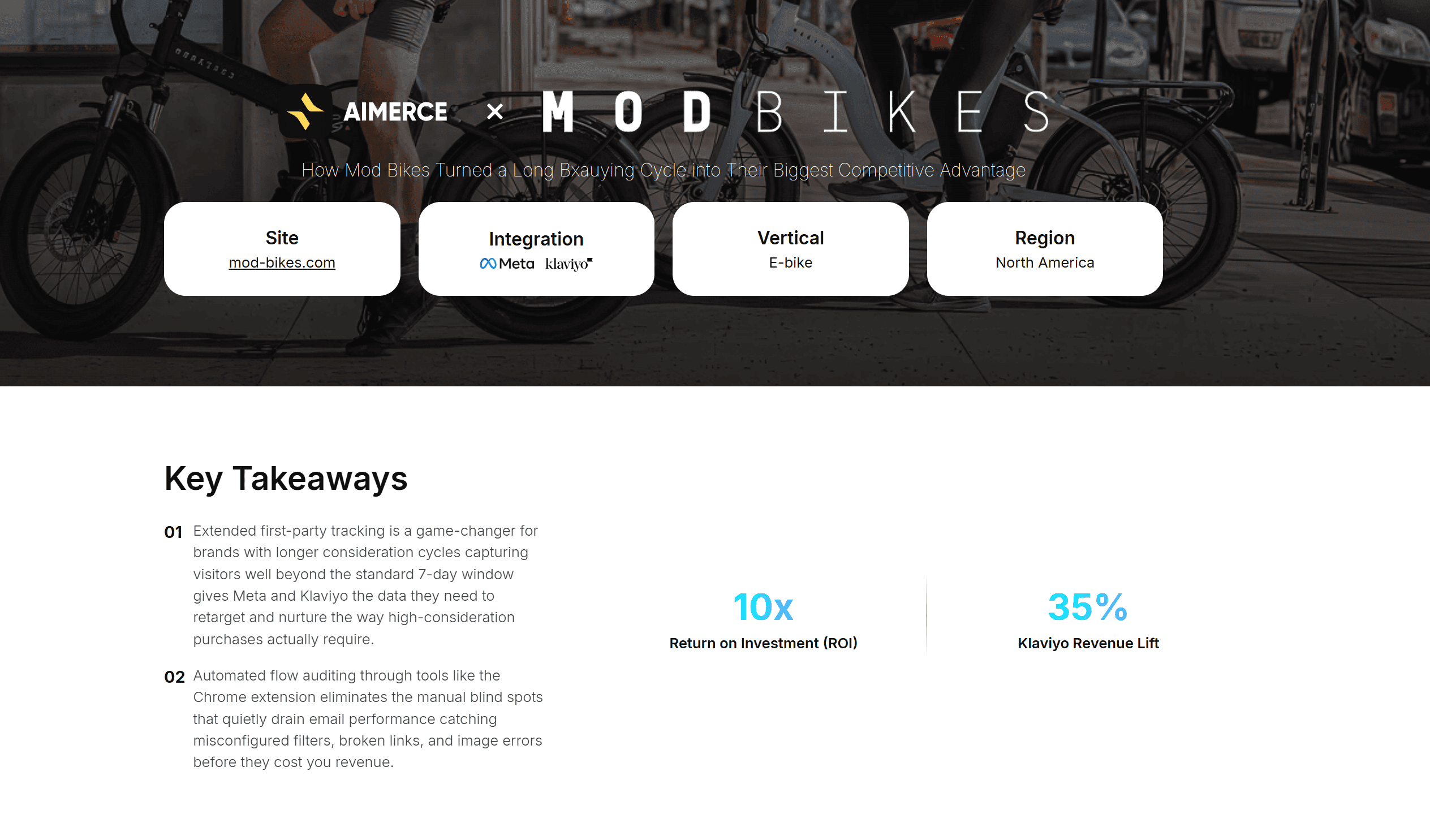
Mod Bikes, an American electric bike brand, is a good example. People often research e-bikes for weeks before they buy. Under standard tracking, Klaviyo struggled to identify returning visitors, so browse abandonment emails and re-engagement sequences only reached a small share of interested shoppers.
After moving to Aimerce's extended first-party tracking, Mod Bikes could recognize returning visitors for up to a year instead of around seven days. Aimerce reported that one change generated $209,426 in Klaviyo revenue, a 25.86% increase. Mod Bikes' team says their abandoned browse flow became their top-performing flow.
 We see this as a potential opportunity for other brands with longer buying cycles. Their emails might already be doing their job, but they're not reaching enough shoppers.
How do you get your flows ready for the extra traffic?
Once more shoppers start triggering your flows, any weaknesses in the flows themselves become more expensive. Before or shortly after fixing your tracking, pay attention to a few things:
- Browse abandonment: This should be a short flow of two or three emails that starts within a few hours of the visit, showing the exact product they viewed. Our Klaviyo browse abandonment flow guide will walk you through the setup.
- Flow filters: Make sure people who have already purchased are filtered out. Also, someone who is in your checkout flow shouldn't also get your browse emails at the same time.
- Frequency: You don't want to bombard shoppers with too many emails in a single day.
- Deliverability: More sends mean more impact on your sender reputation. Keep sending to engaged profiles and suppress people who haven't opened your emails in months.
We go deeper in our article on recovering lost flow revenue with extended tracking.
The takeaway
If your abandonment flows aren't getting triggered much, don't immediately start rewriting your emails. First, check how many of the abandoners Klaviyo can actually see. For brands with considered purchases, some of the biggest revenue gains can come from fixing who the flow can reach, not what the emails say.
Gavin Hewitson is the founder of In-box, an email marketing agency that helps ecommerce brands grow revenue through Klaviyo and Omnisend.
FAQ
Why isn't my Klaviyo abandonment flow triggering? Often because Klaviyo doesn't recognize the shopper when they browse or start checkout. Browser cookie limits, device switching, and blocked scripts can all stop Klaviyo from identifying returning visitors, so the flow never starts.
How long does Klaviyo recognize returning visitors? With browser-based tracking, often only around seven days in Safari and other browsers that limit script-based cookies. Server-side, first-party tracking can recognize returning visitors for longer.
How do I know if my Klaviyo flows are missing shoppers? Compare Klaviyo's Viewed Product events with product page views in Shopify, check how many people enter your browse abandonment flow, and compare Started Checkout with Shopify's abandoned checkouts. Big gaps point to a tracking problem.
Does server-side tracking change my Klaviyo emails? No. It changes who the flow can reach, not what the emails say. Your existing flows and offers stay the same.
Which brands benefit most from extended Klaviyo tracking? Brands with longer buying cycles and higher-priced products, like furniture, e-bikes, jewelry, and high-end skincare, where shoppers often return weeks after their first visit.
Sources
[1] Aimerce, "How Mod Bikes Turned a Long Buying Cycle into Their Biggest Competitive Advantage),"
[2] In-box, "The four Klaviyo abandonment flows every ecommerce brand needs,"
[3] In-box, "Klaviyo browse abandonment flow guide,"
[4] In-box, "Recovering lost flow revenue with extended tracking,"
Related reading

Try Aimerce Pixel Risk-Free
for 30 Days
Most teams see results within 2 weeks.
Money-back guarantee.
It pays for itself, or you don't pay anything.
30-Day Aimerce Pixel Free Trial