Quick Answer: Meta published research on Hierarchical Interest Representation, a system trained on two complementary objectives, one self-supervised, one grounded in real pixel and CAPI events, designed to find high-intent buyers using fewer actual conversions. It's unreleased research, not a live ranking change. The real takeaway: this reduces Meta's dependence on conversion volume, not on conversion accuracy, so the few real signals your account sends matter more, not less.
Key Takeaways
- Meta published research, not a live product change, on a system called Hierarchical Interest Representation, aimed at improving deep funnel ad ranking by inferring buyer interest even from limited engagement data.
- The system exists because purchase-level signals are extremely sparse relative to Meta's overall ad volume. Millions of advertisers and billions of users generate very few actual deep-funnel conversions to learn from.
- It's trained on two complementary objectives, not one replacing the other: a self-supervised one that compares broad and narrow views of the same user or product without needing a conversion, and a supervised one that predicts whether a real engagement happened, grounded directly in pixel and CAPI events.
- That combination buys Meta less dependence on conversion volume, not less dependence on conversion data itself. The system still needs real conversions as ground truth, it just needs fewer of them.
- Meta disclosed no ad performance numbers, no ROAS, conversion lift, or ranking improvement. The only concrete figure in the research is a 30x training speedup, an infrastructure metric, not an advertiser-facing one.
- A system that leans harder on fewer real conversions makes each one count for more. Incomplete or duplicated purchase events don't just mean less data reaching Meta, they mean corrupted ground truth in the small sample the whole system depends on most.
- Because the system is trying to understand products directly from ad content, creative variations that only change presentation, a different hook, a different creator, don't give it much new to learn from. Varying the underlying concept, motivation, problem, use case, or benefit, does.
What is Meta's Hierarchical Interest Representation research?
It's a new research direction aimed at improving how Meta's ad systems figure out who genuinely wants to buy something, not just who's clicking around.
Meta describes it as an upstream layer sitting above its existing ranking systems (GEM, Andromeda, and the Adaptive Ranking Model), designed to learn unified representations connecting what a user is actually interested in with the full breadth of what advertisers are offering, specifically for deep funnel outcomes like purchases, not just clicks or views.
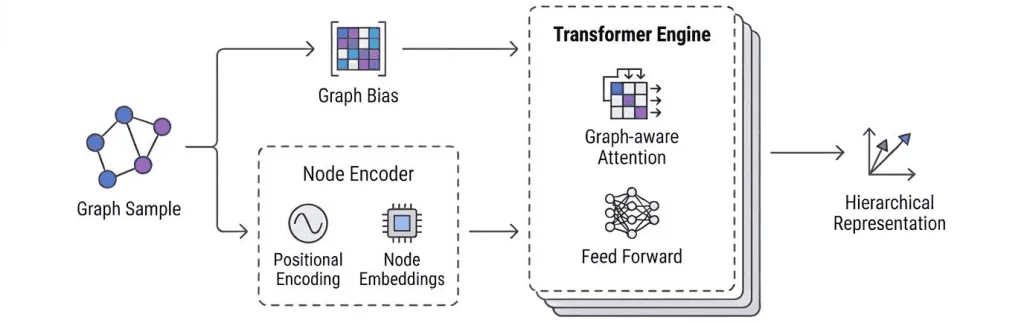 Alternative text to copy in Strapi: Architectural flowchart of Meta's Hierarchical Interest Representation model. The diagram shows a graph sample feeding node encoders, positional encodings, and node embeddings into a Transformer Engine featuring graph-aware attention and feed-forward layers, outputting a hierarchical interest representation.
Image credits: Meta
Alternative text to copy in Strapi: Architectural flowchart of Meta's Hierarchical Interest Representation model. The diagram shows a graph sample feeding node encoders, positional encodings, and node embeddings into a Transformer Engine featuring graph-aware attention and feed-forward layers, outputting a hierarchical interest representation.
Why did Meta need this in the first place?
Because the signal that matters most, real purchases, is extremely rare relative to how much ad activity happens on the platform every month.
Meta serves ads from millions of advertisers to billions of people monthly, but actual deep-funnel conversions are a tiny fraction of that total activity. That's a hard problem for any ranking system: there's an enormous amount of ad inventory and audience data, but very little of the specific signal, "this exact type of person bought this exact type of thing", that would make targeting precise. Meta's research explicitly names this as the motivating problem: engagement signals in the deep funnel are sparse, and building a system that still performs well under that scarcity is the whole point.
How does the research actually try to solve the sparse-data problem?
With two training objectives that work together rather than one replacing the other, one self-supervised, one grounded directly in real conversion data.
Cross-view distillation is the self-supervised half. For each anchor node, a user or a product, the model compares a broad view and a narrow view of the same thing, and trains itself to predict that they belong to the same interest cluster. Because this doesn't require an actual conversion to work, Meta states directly that it extends supervision well beyond the small slice of users who actually convert, which is precisely how the system compensates for how sparse deep-funnel data really is.
Engagement prediction is the second, supervised half. Given two entities, an engagement type, and a time, the model predicts whether a real engagement actually happened. This is the piece that still runs on real pixel and CAPI events, giving the system direct grounding in what people actually did rather than only in patterns inferred by comparison.
Put together, this is a hybrid system. One half learns by comparing patterns across users and products without needing a conversion at all. The other half learns from real, observed behavior. What that combination buys Meta is less dependence on conversion volume, not less dependence on conversion data itself. The system still needs real conversions as ground truth. It just needs fewer of them, because the self-supervised half fills in the rest.
Worth being precise about one more detail here: Meta's own description of the underlying graph explicitly includes pixels as one of the entity types it connects alongside users, ads, advertisers, campaigns, and products [1]. In plain terms, that means the actual pixel and Conversions API events an account sends aren't a side input to this system, they're one of the direct building blocks the whole graph is constructed from, and specifically what the supervised half of training runs on.
What does "less dependence on conversion volume" actually mean in practice?
It means Meta needs fewer real conversions to train a useful model, not that real conversions stop mattering.
The self-supervised half of the system can learn useful structure, which users and products cluster together, without ever touching a conversion event. But that structure still has to be grounded in something real eventually, and that grounding comes entirely from the supervised half: actual pixel and CAPI events describing what genuinely happened. Fewer conversions required still means real conversions matter. What shifts is how much surrounding, inferred structure has to correctly orient itself around the ones that do arrive.
Is this already affecting ad accounts today?
No. Meta frames this explicitly as a research area, not a shipped feature, and the post's own closing section describes ongoing work still to come, on training efficiency, embedding freshness, and further specialization.
This distinction matters for how much urgency to attach to it. There's nothing to configure, toggle, or react to in your ad account right now. What's genuinely useful is understanding the direction Meta's ranking systems are heading, since research like this tends to eventually influence production systems, even when the specific implementation details change along the way.
What does this actually mean for a DTC advertiser?
Two things worth paying attention to, even before anything ships. The two training objectives above explain how Meta reduces its dependence on conversion volume, but the system also separately uses AI to read product images, video, and catalog content directly, which is a different piece of the architecture working alongside the training objectives, not part of them. Between the two: product and catalog content quality is becoming a more direct input to how well Meta understands what you sell, and the accuracy of the real signals you do send matters more, not less, as the system leans harder on inferring from limited data.
What Changes, and What Doesn't
| Traditional engagement-based targeting | Hierarchical Interest Representation (research) | |
|---|---|---|
| Primary signal | Direct engagement history: clicks, add-to-carts, purchases | Engagement history plus AI-derived understanding of product and advertiser content |
| Handling new or low-history advertisers | Weak, little history to learn from | Designed to generalize using content understanding, even for unseen entities |
| Sensitivity to sparse deep-funnel data | High, thin data means thin targeting | Built specifically to work around this, but still requires real signal as ground truth |
| What still has to be accurate | The purchase and conversion events you send | The purchase and conversion events you send |
| Live in ad accounts today | Yes | No, research stage as of publication |
What does this mean for your creative strategy specifically?
If a system is trying to understand what a product actually is and who it's for directly from ad content, then creative variations that only change the hook or the presenter aren't really giving it anything new to learn from.
Five ads shot with five different creators, using the same underlying message, problem, and benefit, can still look nearly identical to a system that's parsing what the ad is actually claiming and who it's claiming it for. The distinction that matters more under this direction of research is variation in the underlying concept: a different buyer motivation, a different problem being solved, a different use case, a different level of prior awareness, or a different benefit being emphasized. Each genuinely different concept gives the system another distinct angle on demand to learn from, in a way that another take on the same angle doesn't.
This also reinforces why broad targeting has been trending the way it has. If the system is increasingly responsible for figuring out who to show an ad to based on what the ad and product actually are, manually narrowing the audience yourself works against the same mechanism that's supposed to do that discovery.
Should you rethink how you brief creative for Meta?
Yes, if creative testing today mostly varies presentation rather than concept. The practical shift is testing distinct underlying ideas, not just distinct executions of the same idea.
Does this make tracking accuracy less important?
No, if anything it argues the opposite, and arguably more so than a simpler "sparse data needs clean data" read suggests. The two training objectives are complementary specifically because the self-supervised half fills in around real conversions rather than replacing them, which means each real conversion an account sends is doing more work, with less redundant data around it to cover for a bad one.
If a system is designed to squeeze useful patterns out of a smaller number of genuine deep-funnel conversions, an account that's missing purchase events to ad blockers, losing them to Safari's ITP, or double-counting them due to a pixel-and-server dedup gap isn't just sending less data. It's corrupting the small, high-value sample that the supervised half of training depends on most, with fewer other real conversions around it to dilute the error. Better representation learning on Meta's end doesn't compensate for that, it can only work with what it actually receives.
What should you actually do about this research right now?
Focus on the two things that were already good practice and that this research reinforces: clean, complete, deduplicated conversion tracking, and genuinely informative product and catalog content.
If your purchase tracking has known gaps: this is a reason to prioritize fixing that now rather than waiting, since any future ranking system, this one or its eventual successor, depends on the same underlying signal quality. Server-side capture and automatic deduplication, which is what Aimerce handles for Shopify stores, are the practical version of "getting the accurate signal right" this research keeps pointing back to.
If your product catalog or creative content is thin: this research signals that content quality may become a more direct input to how new or lower-history products get understood, worth investing there independent of whether this specific system ships as described.
If you're relying heavily on keyword-stacked audience targeting: the direction of travel described in this research points away from that, toward inferred interest built from content and behavior together.
If you're tempted to treat this as something to react to immediately: there's nothing live to configure yet. The useful response today is strengthening the fundamentals this research assumes you already have in place.
Zooming out, the direction of this research points toward five things that increasingly matter more than manually engineering an audience yourself: a clear, accurate conversion signal, tracking that's actually complete and deduplicated, product content the system can understand, creative that covers genuinely different concepts rather than just different executions, and enough volume for a learning system to work with. None of that is new advice individually. What this research clarifies is why all five sit upstream of targeting itself, rather than being separate best practices.
Disclaimer:
- Nothing here is shipped yet, there's no setting to adjust in your ad account today.
- The opposite is true for a system explicitly designed to work around scarce, high-value signal.
- This research is specifically trying to use content understanding to fill data gaps, richer content gives it more accurate material to work with.
- The underlying need for clean, deduplicated conversion data doesn't depend on this specific system going live.
FAQ
What is Hierarchical Interest Representation? It's a Meta research direction for improving deep funnel ad ranking by learning unified representations that connect user interest with what advertisers offer, using graph-based learning and AI-processed product content to work around the scarcity of real purchase-level signals.
Is this live in Meta Ads Manager right now? No. Meta describes it explicitly as a research area, with ongoing work still described as in progress. There's nothing to configure or expect to change in ad accounts as a direct result of this specific publication.
Why does Meta say deep-funnel signals are sparse? Because actual purchase-level conversions are a small fraction of the overall ad activity happening across millions of advertisers and billions of users each month, leaving relatively little direct signal for a ranking system to learn precise buyer intent from.
What are the two training objectives behind this research? Cross-view distillation, which is self-supervised and compares broad and narrow views of the same user or product without needing a conversion, and engagement prediction, which is supervised and grounded directly in real pixel and CAPI events. Meta treats them as complementary, not as one replacing the other.
Does this reduce the importance of server-side conversion tracking? No, it argues for the opposite. A system built to extract more from limited signal depends even more on the accuracy of the real signal it receives, since it has less room to compensate for missing or duplicated conversion events.
What are GEM, Andromeda, and the Adaptive Ranking Model? They're existing components of Meta's ads ranking and recommendation systems that this new research is designed to eventually feed into and improve, rather than replace.
What performance improvements has Meta disclosed for this research? None specific to ad performance. The only concrete number in the published research is a 30x training speedup, which describes how quickly Meta's own infrastructure can train the model, not any change to ad account results.
Does this change how I should approach creative testing? It's worth testing distinct underlying concepts, different buyer motivations, problems, use cases, or benefits, rather than just different executions of the same concept, since a system trying to understand products directly from ad content gets more to learn from genuinely different ideas than from another take on the same one.
What should advertisers actually do in response to this research? Focus on what's already good practice: complete, deduplicated conversion tracking and genuinely informative product and catalog content. Both matter more, not less, under a ranking approach built to work around sparse signal.
Sources
[1] Engineering at Meta, "Exploring Hierarchical Interest Representation For Meta Ads Deep Funnel Optimization," July 15, 2026, engineering.fb.com
Related reading

Try Aimerce Pixel Risk-Free
for 30 Days
Most teams see results within 2 weeks.
Money-back guarantee.
It pays for itself, or you don't pay anything.
30-Day Aimerce Pixel Free Trial