Quick Answer: Meta groups ads that look too similar under one Entity ID, so Andromeda treats them as a single ad with a single shot at the auction. To beat creative fatigue, make ads from genuinely different ideas, changing the persona, desire, or awareness stage rather than just the color, one word, or the music. Put many varied ads into fewer ad sets, watch the Creative limited and Creative fatigue labels in Ads Manager's Delivery column, and launch a new concept when one is flagged. Match static formats to the funnel: native for cold audiences, problem-led for warm, and offer layouts for hot. For BFCM offers, favor bundles, buy-two-get-one, subscribe-and-save, or paid-upfront deals that pay back your acquisition cost faster.
Key Takeaways
- Ads that look too similar share one Entity ID, so Andromeda treats 30 near-identical ads as one ad.
- Real diversity means new angles, personas, and visuals. Changing a color, a word, or the music doesn't count.
- Testing 25 varied ads in one ad set tends to beat 5 ads in each of 5 ad sets.
- Meta now flags fatigue in the Delivery column: Creative limited means a higher cost per result, and Creative fatigue means double or more.
- Judge BFCM offers by CAC payback, not just conversion rate. Bundles and paid-upfront deals bring the cash back faster.
Last October I said the answer to BFCM creative was Creative Machine. A year later I still think that's right. What's changed is how the ads are evaluated.
So let's see what's new.
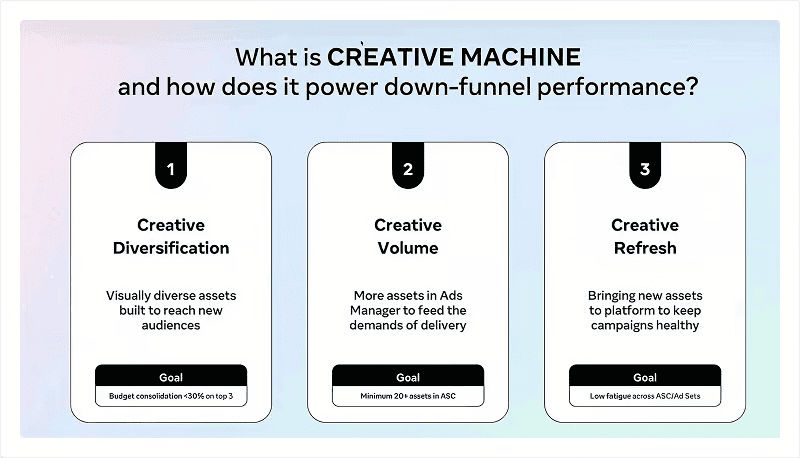 Meta ads creative strategy for BFCM 2026: diversify concepts, consolidate ad sets, and match formats to the funnel
How do you fight creative fatigue on Meta?
Remember that back in late 2025, Meta started assigning an Entity ID based on an ad's visual pattern. If you upload 30 ads that are too similar, with the same background or the same creator, they're assigned the same Entity ID.
To Andromeda, that's one ad, and one shot at the auction.
To beat that, make ads based on different ideas. Don't make 40 ads that are basically the same. Changing only the color, one word, or the music usually doesn't count, because it's still the same basic idea.
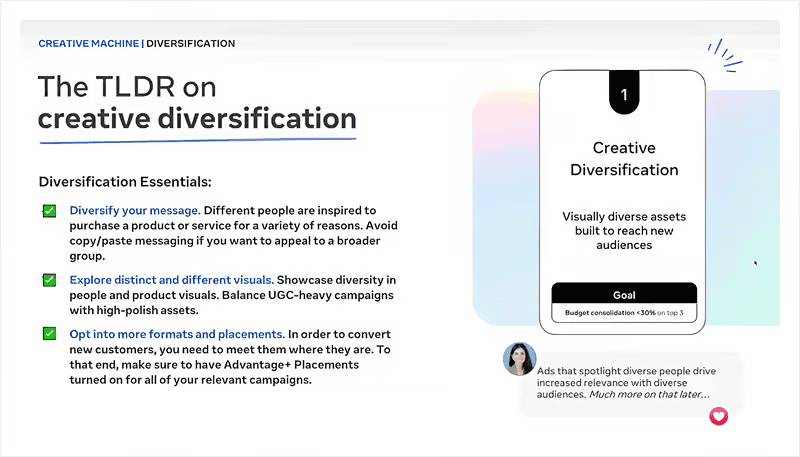 Similar Meta ads grouped under one Entity ID, compared with genuinely different ad concepts
How do you diversify so it actually counts?
Here's what does count:
- New angles: build each concept around a persona, a pain point, a benefit, or an emotional hook.
- Distinct messaging and visuals: people buy for different reasons, so show different people, different scenes, and raw, authentic UGC.
- The P.D.A. framework (Persona, Desire, Awareness): change at least one of these three core elements. Adjusting just one of them makes Meta see your ad as a fresh concept instead of another variation.
- Different products in one ad set: let Meta find which product opens the door for which person.
- A reason to buy beyond price: a good price and solid reviews aren't a brand. Give people something more to buy into.
- More formats and placements: Meta recommends keeping Advantage+ placements on, so you meet new customers where they already are.
Why diversify and consolidate is the golden rule
My takeaway from last year's volume debate between Jordan M and Charley T still holds. If you have product-market fit, enough budget, and the people to make it, more creative is the answer. Jordan showed an account that spent $3.5MM in 30 days and ran 9,973 ads. Most brands can't do that, and they don't need to. But volume without different ideas is just copy-paste, and it looks lazy.
My default for where those ads go:
- Make more ads, but make them genuinely different.
- Don't spread them across too many ad sets. Testing 25 varied ads in one ad set tends to beat 5 ads in each of 5 ad sets.
- Plan around the cap. Advantage+ sales campaigns allow up to 50 ads per ad set, so plan your concept count around that.
I'll be honest, though: there's no universal rule here. If your creative and your offer really work, campaign structure matters less than people argue about online.
How do you spot and swap fatigued ads?
Each ad can only reach so many people before it wears out. The better the ad, the bigger the pool it reaches before that happens.
The good news is you don't need a third-party tool to catch it anymore. Meta flags it in the Delivery column in Ads Manager:
- Creative limited: cost per result is higher than your past ads, but less than double.
- Creative fatigue: cost per result is double your past ads or more.
Meta will also warn you before you publish if it predicts an ad will fatigue in its first 7 days. When an ad gets flagged, launch a new concept next to it. You don't have to kill the old one the same day. Just let the new one take over.
And if you don't know which ads will work, the only way to find out is still to run more ads. Period.
How do you use AI to build concepts, not copies?
People will say that turning off Meta's AI features performs better. Maybe in some accounts. But Advantage+ is the standard, and since AI makes producing creative so cheap and easy, you really have no excuse not to stay ahead of the competition.
Here's how I use it:
- Build your personas. Run a deep research tool, like ChatGPT's deep research, to find out who your customers are: their desires and pain points, their motivations and objections, and the words they actually use (not the words you use). Write up a few personas that fit your ICP, and describe them like you've known them for years.
- Find your angles. What are your USPs? What outcome do people want? How does your product solve each persona's problem? Then map concepts around desire, pain points, testimonials, objection flipping, and scroll-stopping pattern interrupts.
- Write the brief. [Pain or frustration] + [Big promise or relief] + [Your mechanism, or how fast it works] + [Proof or case study].
- Mix and match. Persona + desire + awareness stage = one concept. For example, busy office workers + want a healthier routine + warm audience. Or stay-at-home moms + want more energy + hot audience. Let AI generate the variations, then you pick what goes live.
For the images themselves, Google's Nano Banana, Higgsfield, Gemini, and Claude are fine places to start.
How do you match the ad format to the funnel?
Static ads that work on Meta tend to fall into three formats, and each one owns a stage of the funnel.
| Format | Funnel stage | What it does |
|---|---|---|
| Native | Top of funnel, cold audience | A scene that implies a story, with little or no text |
| Problem-led | Middle of funnel, warm audience | One specific person inside the problem, landing on the product as the answer |
| Offer | Bottom of funnel, hot audience | The product in the middle, a few benefit callouts, and a short headline |
1. Native (top of funnel, cold audience)
This is the awareness stage of the customer journey, where brands attract a broad audience to educate them and spark interest rather than push for an immediate sale.
For example, take a gut-health brand targeting an older audience. A probiotic brand narrows in on bloating specifically, aimed at a 55-year-old. The ad shows a woman sitting at her kitchen table, hand resting on her stomach, plate pushed away half-finished. No copy, just the scene. The story lives underneath the ad, in the platform's description field, as a "wall of text": potentially thousands of words written in first person, covering a dinner she had to leave early, the outfits she's stopped wearing, and how she finally found something that helped, ending with a mention of the product.
Another great example is Duolingo's "Death of Duo" campaign, where the mascot faked its own death. These images use little or no text and focus on scenes that imply a story or spark curiosity.
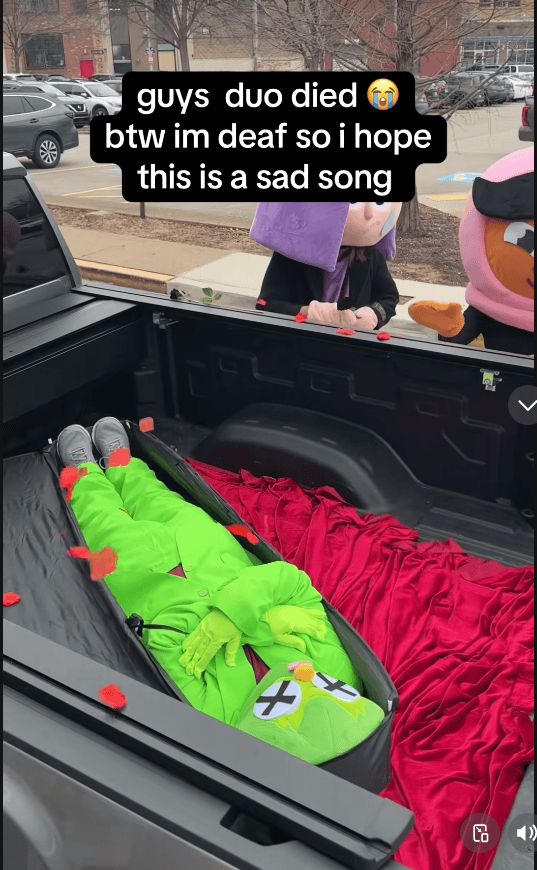 Duolingo's Death of Duo campaign, an example of a native top-of-funnel ad built around a story rather than text
Source: TikTok (Duolingo)
2. Problem-led (middle of funnel, warm audience)
This format targets people who already know your brand or product but aren't ready to buy yet.
It puts one specific person inside the problem. Not "reduce bloating fast," but "canceling plans because of how my stomach feels." Under it, four or five sentences about the problem, landing on the product as the answer.
For example:
- Acne skincare: "checking my chin in every reflective surface I pass"
- Coffee or energy: "staring at my inbox at 2pm doing absolutely nothing"
- Pet supplements: "watching him hesitate at the bottom of the stairs"
Another great example I like is AG1's morning thoughts with Hugh Jackman.
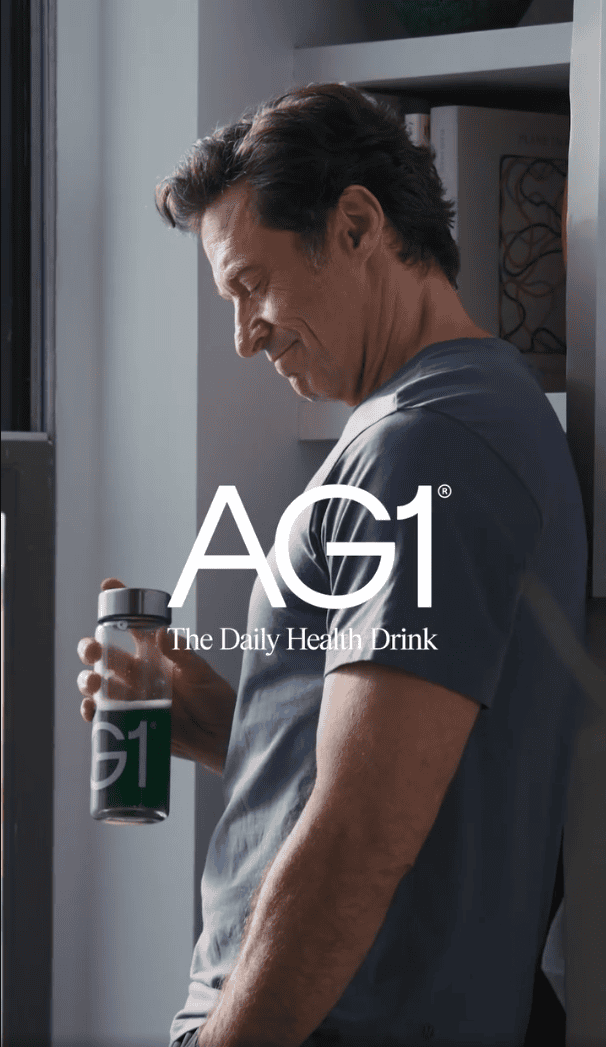
AG1's morning thoughts ad with Hugh Jackman, an example of a middle-of-funnel ad from the Meta Ads Library
Source: Meta Ads Library (AG1)
3. Offer (bottom of funnel, hot audience)
The simplest layout ever: the product in the middle, a few benefit callouts, and often a short line as the headline. This format isn't meant to persuade strangers. It converts people who've already seen your other ads and know your product.
The same layout works in video too. HexClad's ad, for example, puts the pan front and center with a single claim and lets the product demo do the rest.
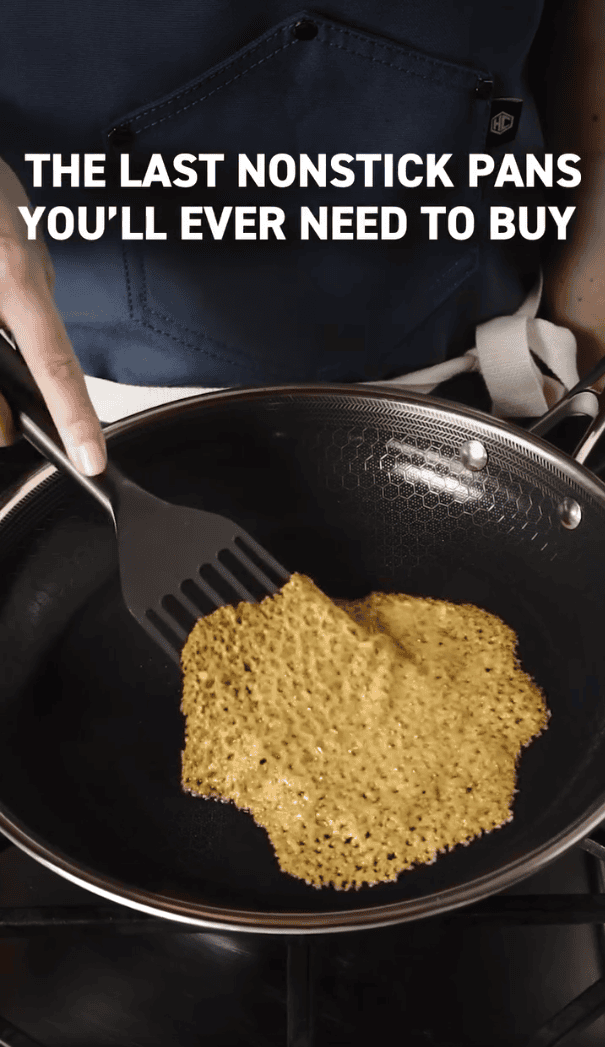
HexClad's offer-style ad with the pan front and center and a single claim, from the Meta Ads Library
Source: Meta Ads Library (HexClad)
Which BFCM offers pay back fastest?
A simple "30% off everything" sale may attract buyers, but it can take a long time to recover your advertising costs.
The number to watch is CAC payback. If a customer costs $100 to acquire and their first order recovers that $100 on day one, you can reinvest right away. The faster the cash comes back, the faster you can buy more ads.
Offers that get you there faster:
| Offer | Why it pays back faster |
|---|---|
| Bundles | A starter kit (bands, a mat, a door anchor) instead of a single band. Same CPA, bigger first order. |
| Buy two, get one free | A bigger first order, plus more chances to turn a one-time buyer into a repeat one. |
| Subscribe-and-save | Usually a smaller first order, but it locks in repeat revenue and pulls LTV forward. |
| Paid upfront | For apps, 50% off three months paid upfront beats a free trial. The order is smaller, but the cash lands now instead of maybe. |
Then watch where the budget goes. For an account spending around $175K a month, one way to split it is roughly $100K on native, $50K on text-heavy, and $25K on offer. The main idea is not to spend too much on ads aimed at people who already know the brand. Most of the budget should reach new customers.
🤞 Here to help you win,
Yiqi
This playbook is part of our BFCM Klaviyo & Meta Academy, a free series for DTC brands running through mid-December, with new sessions every week. Join the BFCM Academy
FAQ
What is a Meta Entity ID? A grouping Meta assigns to ads based on their visual pattern. Ads that are too similar, with the same background or creator, share one Entity ID, so Andromeda treats them as a single ad in the auction.
How do you avoid creative fatigue on Meta? Make ads from genuinely different ideas, changing the persona, desire, or awareness stage, and launch a new concept when Ads Manager flags an ad as Creative limited or Creative fatigue.
What do Creative limited and Creative fatigue mean in Ads Manager? They're labels in the Delivery column. Creative limited means cost per result is higher than your past ads but less than double. Creative fatigue means cost per result is double your past ads or more.
Should you use more ad sets or more ads per ad set? Usually more ads in fewer ad sets. Testing 25 varied ads in one ad set tends to beat 5 ads in each of 5 ad sets. Advantage+ sales campaigns allow up to 50 ads per ad set.
What is the P.D.A. framework for Meta ads? Persona, Desire, Awareness. Changing at least one of these three elements makes Meta treat your ad as a fresh concept rather than a variation.
What BFCM offers recover ad spend fastest? Offers that increase the first order or bring cash in upfront, like bundles, buy two get one free, subscribe-and-save, and paid-upfront plans. Watch CAC payback, not just conversion rate.
Sources
[1] Aimerce, "The Ultimate 2026 BFCM Data Driven Meta Ads Creatives Playbook," [2] TikTok, "Duolingo: Death of Duo," [3] Meta Ads Library, "AG1," [4] Meta Ads Library, "HexClad,"
Related reading
30-Day Aimerce Pixel Free Trial